Comută pe versiunea Print
 Vezi mai mult







































 Pentru opere de artă sau reproduceri care depășesc 105 cm (aproximativ 41 de inch) pe oricare dintre laturi, cadrul va fi livrat demontat, sub formă de kit. Această metodă asigură o livrare sigură și previne deteriorarea în timpul transportului.


A Study in Vulnerability: Examining Vincent van Gogh’s ‘Idol’
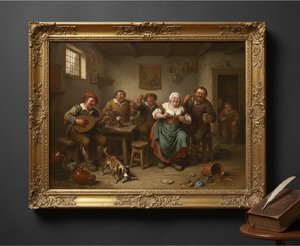
Vincent Willem van Gogh's “Idol,” created circa 1886, stands as a deceptively simple yet profoundly resonant depiction of human form—a testament to the artist’s unwavering commitment to capturing raw emotion and anatomical precision. This chalk drawing, housed within the Van Gogh Museum in Amsterdam, transcends mere representation; it embodies a core element of Van Gogh's artistic philosophy: an unflinching gaze at the human condition. The photograph accompanying this piece showcases its placement amongst other celebrated artworks, highlighting its significance within the broader context of Impressionist and Post-Impressionist art movements.- Subject Matter & Composition: The drawing portrays a nude male figure positioned in a contemplative stance—one foot elevated as he turns his gaze upwards, suggesting introspection and perhaps a yearning for transcendence. This posture is deliberately understated, prioritizing anatomical accuracy over dramatic gesture, aligning perfectly with Van Gogh’s stylistic preferences.
- Style & Technique: Executed in chalk, “Idol” exemplifies Van Gogh's signature Realism style—a departure from the shimmering surfaces of Impressionism. Unlike his contemporaries who sought to capture fleeting moments of light and color, Van Gogh focused on conveying solidity and texture, meticulously rendering musculature and bone structure with remarkable detail. The artist’s technique is characterized by short, impasto brushstrokes that build up layers of pigment, creating a palpable sense of physicality.
Historical Context: Exploring the Artist's Inner Landscape
Painted during Van Gogh’s formative years in Paris—a period marked by experimentation and intellectual engagement— “Idol” reflects his evolving artistic sensibilities. Influenced by Cézanne and Japanese prints, he sought to distill visual experience into its essential forms, prioritizing structure and tonal harmony over decorative embellishment. The drawing emerged from a broader exploration of themes related to spirituality and human vulnerability – concepts central to Van Gogh’s personal struggles and artistic vision.- Symbolism: While devoid of overt narrative content, “Idol” carries significant symbolic weight. The upward gaze represents aspiration and contemplation—a desire for connection with something beyond the material world. Furthermore, the nude figure embodies purity and vulnerability—themes frequently revisited by Van Gogh throughout his oeuvre.
- Emotional Impact: Viewing “Idol” evokes a feeling of quiet solemnity. The artist’s masterful rendering of anatomy combined with the subdued palette contributes to an atmosphere of profound introspection. It invites contemplation on themes of mortality, faith, and the beauty inherent in human imperfection—resonances that continue to captivate audiences today.
A Reproduction Worthy of Distinction
OriginalUniqueArt offers exceptional reproductions of “Idol,” meticulously crafted by skilled artisans using archival pigments on premium canvas. Unlike mass-produced prints, these hand-painted versions capture the nuances of Van Gogh’s original technique—the subtle variations in tone and texture that convey the artist's emotional intensity. Investing in a OriginalUniqueArt reproduction ensures you experience the artwork's enduring beauty and intellectual depth, bringing a piece of artistic history into your home.Întrebări și răspunsuri
Ce nuanță dominantă străbate întregul "Idol" de Vincent Van Gogh?
O nuanță de Spectru de la verde la violet traversează întregul "Idol" de Vincent Van Gogh.
Ce armonie de culori prezintă "Idol" de Vincent Van Gogh?
"Idol" de Vincent Van Gogh prezintă o armonie cromatică Paletă unitară.
Ce paletă și ce culoare dominantă definesc "Idol"?
"Idol" de Vincent Van Gogh utilizează o paletă de culori Culori pastelate, având culoarea Gri-bej chit (#faf4c2) ca nuanță dominantă.
 Previzualizare
 Trimite prin felicitare
 Distribuie
 Detalii despre lucrare
 Ghid
Ghid

 Descarcă imaginea
 Produse similare
 Radiografie
 Galerie foto
 Q&A
Q&A Statistici