Comută pe versiunea Print
 Vezi mai mult







































 Pentru opere de artă sau reproduceri care depășesc 105 cm (aproximativ 41 de inch) pe oricare dintre laturi, cadrul va fi livrat demontat, sub formă de kit. Această metodă asigură o livrare sigură și previne deteriorarea în timpul transportului.


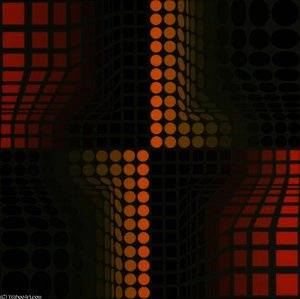
Vega-Nor: A Symphony of Geometric Illusion
Victor Vasarely’s “Vega-Nor,” completed in 1969, stands as a cornerstone of Op Art – Optical Art – a movement that fundamentally challenged our perception of reality. This monumental canvas (200 x 200 cm) isn't merely a visual spectacle; it’s an intellectual exploration into the nature of visual experience itself. The artwork depicts a vast sphere dominated by intricate patterns composed of smaller circles and spheres arranged in seemingly random configurations. Yet, beneath this apparent chaos lies a meticulously crafted system designed to induce mesmerizing optical illusions.The Genesis of Geometric Abstraction
Vasarely’s artistic journey began with a grounding in Bauhaus principles – functional design combined with geometric abstraction – fostered at Műhely under Sándor Bortnyik's guidance. This formative influence instilled within him a belief that art could transcend representational imagery and communicate directly through fundamental visual elements. He rejected traditional painting techniques, opting instead for a method he termed “plasmatic geometry,” utilizing silkscreen printing to achieve unparalleled precision and reproducibility of his designs. The resulting prints are remarkably consistent across iterations, demonstrating Vasarely’s unwavering commitment to establishing a repeatable artistic process – a radical departure from the conventions of his time.Decoding the Visual Language: Pattern and Illusion
The mesmerizing effect of “Vega-Nor” derives from Vasarely's masterful manipulation of visual perception. The overlapping circles and spheres create an illusion of movement, suggesting that the sphere is rotating or pulsating subtly. This dynamism isn’t achieved through brushstrokes but rather through the careful placement of shapes – a technique characteristic of Op Art. Color plays a crucial role in amplifying this perceptual distortion; Vasarely employed vibrant hues strategically to heighten the visual impact and guide the viewer's gaze across the surface. The repetition of geometric forms contributes to a sense of rhythm and harmony, mirroring the underlying mathematical principles governing Vasarely’s artistic system.Historical Context: Challenging Perception in Flux
“Vega-Nor” emerged during a period of significant cultural upheaval – the late 1960s – marked by anxieties surrounding social change and technological advancement. Op Art responded to these concerns by questioning accepted notions of visual representation, asserting that art could actively shape our understanding of the world. Vasarely’s work aligned with broader artistic trends exploring non-figurative abstraction and embracing new technologies like silkscreen printing, reflecting a desire for innovation and experimentation within the art community. It represents a triumph of conceptual art over traditional aesthetics.Symbolism Beyond Form: A Reflection of Order Amidst Chaos
While seemingly devoid of recognizable imagery, “Vega-Nor” possesses profound symbolic resonance. The sphere itself embodies wholeness and unity – concepts central to philosophical thought throughout history. However, Vasarely’s deliberate disruption of geometric order serves as a counterpoint, suggesting that beauty can be found even in apparent randomness. This duality speaks to the human condition—the tension between stability and dynamism, control and surrender—themes explored extensively by artists grappling with the complexities of their era.- Artist: Victor Vasarely
- Year Created: 1969
- Medium: Silkscreen Print
- Dimensions: 200 x 200 cm
Întrebări și răspunsuri
„Vega-Nor” prezintă contraste puternice între lumină și întuneric?
Contrastul lumină-umbră din "Vega-Nor" este înregistrat ca Seren. Contrastul descrie cât de puternic diferă zonele luminoase de cele întunecate.
La ce etapă din cariera lui Victor Vasarely corespunde data de 1969 a operei „Vega-Nor”?
Data din 1969 plasează „Vega-Nor” în Mature Period dezvoltării lui Victor Vasarely.
Ce dimensiune de print pentru "Vega-Nor" de Victor Vasarely se potrivește cu camera recomandată?
Pentru o Living Room, dimensiunea recomandată de imprimare pentru "Vega-Nor" de Victor Vasarely este Dimensiune mare.
Mai multe detalii despre această pictură
 Previzualizare
 Trimite prin felicitare
 Distribuie
 Detalii despre lucrare
 Ghid
Ghid

 Descarcă imaginea
 Produse similare
 Radiografie
 Galerie foto
 Întrebări și răspunsuri
 Statistici