Romanticism · 1830
Niagara Falls (Thomas Cole, 1830)
Thomas Cole (1801–1848) a realizat Niagara Falls. Data sa este din 1830. Face parte din mișcarea Romanticism. Este realizată în Oil On Canvas.
- 1830
- Oil On Canvas

 Previzualizare

 Tablou în ulei pictat manual
 Trimite prin felicitare
 Distribuie
 Fișă informativă


 Descarcă imaginea
 Produse similare
 Radiografie
 Galerie foto
 Întrebări și răspunsuri

 Statistici
Niagara Falls, pe scurt
- Titlu
- Niagara Falls
- Artist
- Thomas Cole (1801–1848)
- Artist născut în
- Bolton, Regatul Unit
- Date
- 1830
- Medium
- Oil On Canvas
- Mișcare
- Romanticism
- Perioadă
- 19th Century
- Subiect
- waterfall, people, trees, rocks, river, mist
Ce reprezintă Niagara Falls?
Identification of Niagara Falls by Thomas Cole
Niagara Falls is an oil painting created by Thomas Cole in 1830. The work focuses on the American wilderness and the depiction of natural power. It captures a large body of water falling from a great height, creating a scene of cascading water and rising mist. The landscape includes several trees and rocky terrain surrounding the falls.
The composition includes a man standing on a rock in the foreground. Two other individuals are visible within the scene: one person stands closer to the left side, while another is positioned further back on the right side. These figures provide a sense of scale against the massive movement of the water. The environment is characterized by lush, forested cliffs and a sky filled with clouds and mist.
The Composition and Visual Elements
The composition is centered on a large body of water falling from a great height, creating a vertical movement that dominates the scene. This cascading water descends into a lower river area, surrounded by several trees that frame the landscape. A man is positioned on a rock in the foreground, facing the falls. His presence provides a sense of scale against the massive volume of the water.
Two other people are visible within the landscape, distributed to create depth. One individual stands closer to the left side of the composition, while another person is located further back on the right side. These figures are placed amidst the natural terrain, which includes rocky outcrops and dense foliage. The arrangement of the trees and the placement of the figures guide the eye from the immediate foreground toward the distant, falling water.
Technique and Artistic Style
This oil painting is a primary example of the Romantic landscape style. As a foundational work of the Hudson River School, it utilizes a composition that emphasizes the scale of the natural world. The artist employs a specific technique of layering oil to render the textures of the cascading water and the surrounding rock formations. The application of paint allows for a depiction of mist rising from the base of the falls, creating a sense of atmospheric depth against the sky.
The artist relies heavily on the interplay of light and shadow to establish the environment. Light appears to catch the spray of the water and the edges of the foliage, while deep shadows are placed within the crevices of the cliffs and the dense areas of the forest. This contrast defines the physical volume of the landscape. The brushwork captures the movement of the water and the varied textures of the trees, grounding the scene in a tangible, physical reality.
Related Works by Thomas Cole
The artist's exploration of the American wilderness includes several significant compositions from different periods of his career. In 1826, he produced Kaaterskill Falls. This work focused on the vertical energy of the landscape. Later, in 1836, he completed The Oxbow. This painting juxtaposes a river valley against cultivated farmland. During that same year, he also finished The Course of Empire, a five-part series tracing the rise and fall of civilizations.
Cole continued to develop his approach to landscape and allegory in his later years. In 1842, he created The Voyage of Life, an allegorical series depicting the various stages of an individual's existence. These works demonstrate his ongoing interest in the relationship between the natural environment and human presence. His output moved from the study of specific waterfalls to broader, more complex thematic sequences.
Imagini la înaltă rezoluție ale lui Niagara Falls

Domeniu public: artistul a decedat în 1848.
Alte dimensiuni, cadrări și citări →Thomas Cole, Niagara Falls (1830). Domeniu public
Întrebări despre Niagara Falls, răspunsuri
În ce an a fost creată "Niagara Falls" de Thomas Cole?
"Niagara Falls" de Thomas Cole a fost creat(ă) în 1830.
Ce tehnică a fost utilizată pentru "Niagara Falls" de Thomas Cole?
Thomas Cole a utilizat tehnica Oil On Canvas pentru "Niagara Falls". Tehnica definește natura materială a lucrării originale.
Ce subiecte sunt reprezentate în "Niagara Falls" de Thomas Cole?
"Niagara Falls" de Thomas Cole surprinde: waterfall, people, trees, rocks, river, mist, clouds.
Imaginea pentru "Niagara Falls" de Thomas Cole poate fi reprodusă liber?
"Niagara Falls" de Thomas Cole este în domeniul public (în domeniul public – drepturile de autor au expirat). Acest statut reglementează modul în care imaginea lucrării poate fi reprodusă.
Cine a creat "Niagara Falls"?
„Niagara Falls” a fost creat de Thomas Cole. Informațiile de pe această pagină descriu opera originală a lui Thomas Cole.
Din ce curent artistic face parte "Niagara Falls" de Thomas Cole?
„Niagara Falls” este o operă de Romanticism. Acest curent indică tradiția artistică din care face parte lucrarea.
Din ce perioadă a carierei lui Thomas Cole face parte „Niagara Falls”?
"Niagara Falls" reprezintă perioada Mature Period a lui Thomas Cole.
Ce vârstă avea Thomas Cole când a fost creat "Niagara Falls"?
Când „Niagara Falls” a fost creat în 1830, Thomas Cole – născut în 1801 – avea 29 ani.
Este "Niagara Falls" de Thomas Cole în domeniul public și care este motivul?
Statutul drepturilor de autor pentru "Niagara Falls" - în domeniul public – drepturile de autor au expirat - este determinat de data decesului artistului, în anul 1848.
Despre artistul Thomas Cole

1801–1848, Regatul Unit
Thomas Cole
Viața și Arta lui Thomas Cole Născut pe 1 februarie 1801, în Bolton le Moors, Lancashire, Anglia, Thomas Cole și-a început călătoria departe de peisajele care, în cele din urmă, i-ar fi definit numele. Familia sa a emigrat în Statele Unite în 1818, căutând un nou început într-o țară a unor teritorii vaste și necunoscute. În acei ani de început, a fost un om cu multiple vocații, lucrând ca gravor și, ulterior, găsind un domeniu de activitate stabil ca pictor de portrete, începând din anul 1822. S-a format în mare parte prin autoinstruire, dezvoltându-și privirea prin observație și prin studiul cărților, mai degrabă decât printr-o instruire academică formală.
Alte lucrări ale lui Thomas Cole
 Oxbow
 Visul arhitectului1840
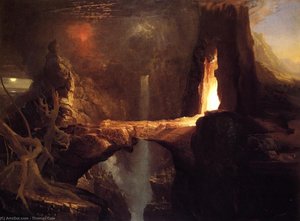 Expulzii. Lună și Lumină de Fațadă1828
 Vederea asupra Florenței din San Miniato1837

Eseuri despre Niagara Falls
 French artworks of the 1880sFrench Impressionist masterpieces by Claude Monet, Pierre-Auguste Renoir, and Georges Seurat. Find museum-quality reproductions on Original…
 Barbizon School vs. Hudson River School: Two Visions of the Natural WorldDiscover the key differences between Barbizon and Hudson River School landscapes. Master art history with our expert comparison guide.
 The Sublime Cascade: Examining the Tradition of Waterfall Landscapes in Art HistoryExplore the evolution of waterfall landscapes from the Northern Renaissance to the Hudson River School. Trace this epic art history now.