Comută pe versiunea Print
 Vezi mai mult







































 Pentru opere de artă sau reproduceri care depășesc 105 cm (aproximativ 41 de inch) pe oricare dintre laturi, cadrul va fi livrat demontat, sub formă de kit. Această metodă asigură o livrare sigură și previne deteriorarea în timpul transportului.


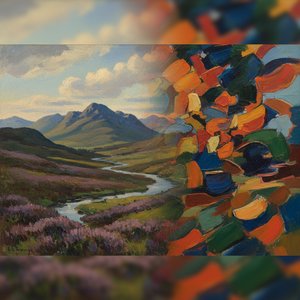
Hay Time – A Vision of Scottish Pastoral
“Hay Time,” painted in 1952 by Sir William George Gillies, stands as a testament to the enduring beauty of Scottish landscape painting and a masterful embodiment of Surrealist influences. More than just a depiction of a rural scene—a valley bathed in golden afternoon light—the artwork delves into deeper layers of symbolism and artistic innovation that continue to resonate with viewers today.
- Subject Matter: The canvas captures a quintessential Scottish vista – rolling hills covered in ripening haystacks, punctuated by scattered dwellings and winding roads. Gillies’ meticulous attention to detail brings forth the textures of grass, stone, and wood, creating an immersive experience for the observer.
- Style & Technique: Gillies' style leans heavily towards Surrealism, albeit tempered with Cézanne’s foundational geometric principles. He employs a muted palette dominated by earthy tones—ochres, browns, greens—reflecting the natural world around him. The brushstrokes are loose and expressive, conveying movement and capturing the fleeting quality of light.
- Historical Context: Painted during the post-war period, “Hay Time” reflects a broader artistic trend toward exploring subconscious imagery and challenging conventional realism. Gillies’ exposure to André Lhote's Cubist teachings in Paris and his subsequent encounter with Paul Klee’s imaginative use of color profoundly shaped his artistic vision.
The painting’s symbolism extends beyond its immediate visual representation. The haystacks themselves symbolize fertility and abundance, mirroring the cyclical rhythms of agricultural life—a core element of Scottish culture. Simultaneously, the positioning of the houses within the valley suggests a harmonious coexistence between humanity and nature – an ideal Gillies sought to convey through his art.
More than just aesthetically pleasing, “Hay Time” evokes a profound emotional response. The tranquil atmosphere invites contemplation, transporting viewers back to a simpler time—a moment of serene beauty amidst the grandeur of the Scottish Highlands. It’s a painting that speaks to our innate desire for connection with the natural world and celebrates the enduring power of artistic expression.
- Size: 51 x 71 cm
- Artist: Sir William George Gillies (Born 1898, Haddington; Died 1973)
- Nationality: United Kingdom
Întrebări și răspunsuri
Ce subiect și ce atmosferă surprinde "Ora de Rumeguș" de William George Gillies?
„Ora de Rumeguș” surprinde scottish landscape, mountain valley, rural scene, autumn foliage, landscape painting, gillies style, british art, post-war art, având o atmosferă Serenitate.
Poate fi reprodusă în mod legal opera "Ora de Rumeguș" de William George Gillies, aflată la Abbot Hall Art Gallery?
Statutul drepturilor de autor pentru "Ora de Rumeguș" de William George Gillies este clar: opera este încă protejată de drepturile de autor. Prezența sa la Abbot Hall Art Gallery nu schimbă acest statut.
Ce nuanță dominantă străbate întregul "Ora de Rumeguș" de William George Gillies?
Culoarea dominantă a operei "Ora de Rumeguș" de William George Gillies este Spectru de la verde la violet. Această nuanță constituie tonul de bază al paletei cromatice.
Mai multe detalii despre această pictură
 Previzualizare
 Trimite prin felicitare
 Distribuie
 Detalii despre lucrare
 Ghid
Ghid

 Descarcă imaginea
 Produse similare
 Radiografie
 Galerie foto
 Întrebări și răspunsuri
 Statistici