Vezi în context
 Trimite
 Distribuie
 Detalii
 Ghidul

 Descarcă
 Produse similare
 Radiografie
 Diaporama
 Statistici
Petrarch's Virgil, title page
 Acrylic On Canvas
- WallArt
- Late Gothic
 1336
1336 29.0 x 20.0 cm
 Biblioteca Ambrosiana
 Citește mai mult
Giclée / Imprimare artistică
Printuri giclée sau pe canvas de calitate muzeală, cu proces de producție rapid și opțiuni flexibile de finisare. ( Comandă pictură realizată manual Treci la imagine digitală)




P118B lei10

P118H lei10

P118W lei10

P438Z lei10

P508JH lei12

P508YH lei12

P805H lei10

P805Z lei10

P919BZ lei10

P919G lei10

P919XJ lei10

P959ZH lei10

P968JZ lei12

W106C lei8

W218G lei10

W218JH lei8

W218Y lei10

W307PJ lei10

W316G lei10

W316PJ lei8

W316Y lei10

W398PJ lei8

W4111J lei10

W500HY lei15

W500JH lei15

W692G lei12

W849H lei8

W940BG lei15

W953PJ lei8




Alegeți dintre dimensiunile noastre prestabilite, care respectă proporțiile originale ale operei de artă.

Introduceți lățimea și înălțimea de care aveți nevoie, pentru a se potrivi ramei sau peretelui dumneavoastră. O printare poate fi doar tăiată, niciodată extinsă dincolo de dimensiunea imaginii originale, astfel încât o dimensiune cu o formă diferită va pierde o parte din imagine. Vă trimitem o simulare digitală pentru aprobare înainte de a imprima orice. Imaginea afișată pe această pagină nu prezintă tăierea reală — doar simularea arată acest lucru.
Livrare în întreaga lume () în 2 săptămâni, în loc de cele 4/5 săptămâni standard. (24 Octombrie)

Livrare expres gratuită la nivel mondial

Pânză de in premium

Asigurare completă pentru transport

Garanție de rambursare a taxelor vamale

Garanția fidelității culorilor

Politica de retur în 100 de zile (doar pentru defecte)

Garanție de rambursare 100%

Reducere pentru comenzi multiple
 Opțiunea cu sticlă este disponibilă doar pentru dimensiuni de sub 110 cm

Petrarch's Virgil, title page
Giclée / Imprimare artistică
Dimensiune reproducere
-


Preț total
lei 370
A Testament to Scholarly Reverence: Simone Martini’s Petrarch's Virgil
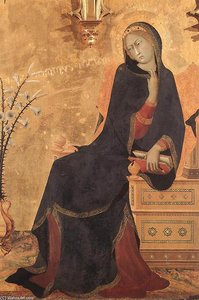
Simone Martini’s “Petrarch’s Virgil,” created in 1336, transcends mere depiction; it embodies the spirit of its time—a confluence of piety, intellect, and artistic sophistication that cemented Martini’s legacy as one of Siena’s most celebrated masters. Executed during a period marked by burgeoning humanist thought and papal patronage, this title page serves not only as an announcement of Virgil's epic poem “Aeneid” but also as a profound meditation on the relationship between faith and reason, virtues central to Petrarch’s philosophical worldview. Martini skillfully captures this duality through meticulous observation and masterful execution—a hallmark of Sienese painting during the Trecento period.- Subject Matter & Composition: The scene portrays Petrarch, a renowned humanist scholar and poet, seated upon a bench beneath a canopy adorned with foliage, accompanied by Virgil, the Roman poet whose “Aeneid” served as inspiration for Petrarch’s own literary endeavors. The inclusion of a sheep—a symbol of innocence and pastoral virtue—further underscores the poem's themes of moral contemplation and spiritual renewal.
- Style & Technique: Martini’s style is characterized by its exquisite delicacy and luminous color palette, reflecting the influence of Giotto di Bondone and Florentine proto-Renaissance aesthetics. He employs tempera paint on ivory panel—a technique favored for its ability to achieve unparalleled brilliance and tonal subtlety—resulting in a surface that glows with ethereal light. The artist’s meticulous attention to detail is evident in every brushstroke, capturing the textures of fabric, foliage, and skin with remarkable accuracy.
Historical Context: Siena Under Papal Influence
Siena during Martini's lifetime experienced a significant resurgence under papal patronage following Gregory XI’s relocation of the papacy from Avignon to Rome. This period witnessed an unprecedented flourishing of artistic activity, fueled by papal commissions aimed at glorifying God and reaffirming papal authority. Martini’s “Petrarch’s Virgil” exemplifies this cultural dynamism—a product of a milieu where intellectual curiosity intersected with religious devotion, shaping artistic sensibilities and elevating the visual arts to new heights.- Symbolism: Beyond its immediate depiction of Petrarch and Virgil, the artwork resonates with broader symbolic meanings. The canopy represents divine protection and contemplation, mirroring Petrarch’s pursuit of spiritual enlightenment. Similarly, the sheep symbolizes purity and pastoral ideals—values championed by Petrarch as reflections of Christian morality.
- Emotional Impact: Martini's masterful rendering evokes a sense of serene solemnity, inviting viewers to contemplate the profound connection between literature and faith. The luminous colors and delicate brushwork convey an atmosphere of tranquility and intellectual reverence—capturing the essence of Petrarch’s humanist spirit.
Legacy & Artistic Significance
“Petrarch’s Virgil” stands as a cornerstone of Sienese painting, demonstrating Martini's unparalleled ability to synthesize stylistic influences from Giotto and Florence into a uniquely expressive idiom. It represents the apex of Trecento elegance—a testament to Martini’s artistic genius and his contribution to the burgeoning Renaissance movement. Today, reproductions of this masterpiece offer art lovers and collectors alike an opportunity to experience firsthand the beauty and intellectual depth of Siena's artistic heritage.Întrebări și răspunsuri
Unde pot găsi opere de artă similare cu "Petrarch's Virgil, title page" de Simone Martini?
Pagina Lucrări similare pentru "Petrarch's Virgil, title page" de Simone Martini prezintă opere de artă similare.
Unde ar trebui expusă o reproducere a "Petrarch's Virgil, title page" de Simone Martini?
Formatul Portrait al operei "Petrarch's Virgil, title page" de Simone Martini este recomandat pentru o Living Room. Formatul și spațiul împreună ghidează amplasarea unei reproduceri.
Pot vedea "Petrarch's Virgil, title page" de Simone Martini sub diferite lumini?
„Petrarch's Virgil, title page” poate fi examinat strat cu strat pe pagina Raze X a operei de artă, un vizualizator inspirat de masa de lumină a unui conservator, care oferă unsprezece lecturi optice ale imaginii.
Biografie artist
A Sienese Master of Elegance and Grace
Simone Martini, born around 1284 in the heart of Siena, Italy, stands as a pivotal figure in the transition from medieval to Renaissance art. He wasn’t merely a painter; he was an architect of elegance, a master of line and color who infused his works with a courtly refinement that distinguished him from contemporaries like Giotto. While historical accounts vary regarding his early training—some suggest apprenticeship under Duccio di Buoninsegna, the leading Sienese artist of the time, while others point to Florence and the influence of Giotto—Martini undeniably forged a unique artistic path. His brother-in-law, Lippo Memmi, was also an artist with whom he frequently collaborated, further enriching the vibrant artistic landscape of Siena. The city itself played a crucial role in shaping Martini’s aesthetic; Siena, a thriving center of commerce and culture, fostered an environment where art flourished, blending religious devotion with worldly sophistication.
The Flourishing of International Gothic
Martini's style is immediately recognizable for its departure from the more monumental forms favored in Florence. He embraced a delicate sensibility, characterized by flowing lines, soft decorative details, and an overall sense of grace. This aesthetic wasn’t born in isolation; it was profoundly influenced by external forces. The Via Francigena, a major pilgrimage route traversing Europe, brought with it artistic currents from France—particularly the refined elegance of French manuscript illumination and ivory carving. These influences are readily apparent in Martini's work, manifesting as intricate patterns, elongated figures, and a heightened attention to surface ornamentation. He didn’t simply copy these styles; he synthesized them with existing Sienese traditions, creating something entirely new. His paintings weren’t merely representations of religious scenes but rather elegant narratives imbued with emotional depth and visual poetry.
Early Life and Training
Little is known about Simone Martini's early life, a common situation for many artists of the period. While some accounts suggest he began his artistic training under Duccio di Buoninsegna, the most celebrated Sienese painter of his time, definitive proof remains elusive. Others propose that he spent formative years in Florence, absorbing the influences of Giotto, whose naturalistic style represented a significant departure from the more stylized conventions of the Gothic era. Regardless of the precise details of his early education, it’s clear that Martini quickly developed a distinctive artistic voice—one characterized by an unparalleled sensitivity to line, color, and composition. His collaboration with Lippo Memmi, his brother-in-law, further enriched his creative environment, fostering a dynamic exchange of ideas and techniques.
Major Works and Artistic Development
Martini’s most celebrated works exemplify the pinnacle of his artistic development. The *Maestà* fresco, commissioned for the Palazzo Pubblico in Siena around 1315, stands as a testament to his mastery—a monumental depiction of the Virgin Mary enthroned with angels and saints that seamlessly blends Gothic elegance with emerging Renaissance principles. The *Annunciation*, painted circa 1330, showcases Martini’s ability to capture delicate emotion and intricate detail, while the *Saint Louis of Toulouse Crowning His Brother Robert of Anjou* (1317), created during his time in Naples, demonstrates his skill in portraying complex narratives with a refined sense of courtly splendor. His *Saint Catherine of Alexandria Polyptych*, completed around 1320, further highlights his command of color and form, solidifying his reputation as one of the most influential artists of his generation.
Legacy and Historical Significance
Simone Martini’s impact on the development of European art cannot be overstated. He played a crucial role in disseminating the International Gothic style—a movement characterized by its elegance, refinement, and emphasis on decorative detail—across the continent. His influence extended to generations of artists who followed, shaping the course of late medieval and early Renaissance painting. Martini’s work wasn't simply about technical skill; it was about creating a visual language that resonated with the sensibilities of his time—a language of beauty, grace, and spiritual devotion. Even today, his paintings continue to captivate viewers with their exquisite detail, harmonious compositions, and enduring sense of elegance. His frescoes in San Francesco d’Assisi demonstrate his mastery of large-scale decorative painting, while works like the *Saint Catherine of Alexandria Polyptych* showcase his unparalleled command of color and form. Simone Martini died in Avignon in 1344, leaving behind a legacy that continues to inspire awe and admiration centuries later—a testament to the enduring power of art to transcend time and touch the human spirit.

Simone Martini
1284 - 1344 , Italia
Informații rapide
- Artistic Movement Or Style: Gotic Internațional
- Artists Or Movements Influenced By This Artist: ['Duccio di Buoninsegna']
- Artists Who Influenced This Artist:
- Duccio di Buoninsegna
- Giotto
- Date Of Birth: c. 1284
- Date Of Death: 1344
- Full Name: Simone Martini
- Nationality: Italian
- Notable Artworks:
- Maestà
- Annunțarea
- Saint Louis
- Place Of Birth: Siena, Italia
Articole conexe

Sacred Symbols & Golden Light: A Journey Through the Divine Artistry of the Early Medieval Era
Embark on a visual journey through Early Medieval art. Explore the profound beauty of illuminated manuscripts, sacred symbols, and golden light through an expert historical lens, celebrating the enduring legacy of medieval craftsmanship and divine artistry.
Late Medieval Masterpieces: 10 Artworks That Defined an Era | OriginalUniqueArt
Journey through 10 defining Late Medieval masterpieces – from Giotto's frescoes to Jan van Eyck’s realism. Explore the stories, techniques & vibrant colors of Gothic art. Find museum-quality reproductions and elevate your home decor with OriginalUniqueArt.com! Discover all masterpieces on OriginalUniqueArt.com

Simone Martini: Innovation, Spirituality & Courtly Refinement in Sienese Painting
Explore the captivating world of Simone Martini, a pivotal figure in Sienese painting & the International Gothic style. Discover his innovative techniques, spiritual depth, and lasting influence on early Renaissance art.

High Medieval Art: 10 Masterpieces That Shaped an Era | OriginalUniqueArt
Journey through High Medieval Art! Explore 10 iconic masterpieces – from Giotto's frescoes to stunning Gothic cathedrals. Discover the stories behind these timeless paintings, sculptures & illuminated manuscripts. Find museum-quality art reproductions at OriginalUniqueArt.com.

Divine Light & Golden Splendor: A Journey Through the Sacred Grandeur of High Medieval Art
Embark on a soulful journey through High Medieval art. Explore the divine light of Gothic cathedrals, Byzantine splendor, and sacred masterpieces that shaped Western history with our expert-led cultural reflections.