Comută pe versiunea Print
 Vezi mai mult







































 Pentru opere de artă sau reproduceri care depășesc 105 cm (aproximativ 41 de inch) pe oricare dintre laturi, cadrul va fi livrat demontat, sub formă de kit. Această metodă asigură o livrare sigură și previne deteriorarea în timpul transportului.


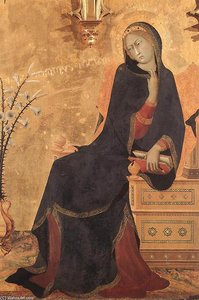
Maestà: A Symphony of Grace and Divine Femininity
Simone Martini’s Maestà, completed around 1315 in Siena, transcends mere depiction; it embodies the very essence of Sienese Gothic art and stands as a testament to artistic brilliance. Painted on alabaster, this monumental fresco captures an exquisite portrayal of Mary holding the infant Jesus—a motif deeply rooted in Christian iconography—yet Martini elevates it beyond simple representation into a profound meditation on motherhood, piety, and divine beauty. The commission itself speaks volumes about Siena’s spiritual fervor during the early fourteenth century, reflecting the city's prominent role as a pilgrimage destination devoted to Saint Catherine of Siena, whose veneration fueled artistic creativity.- Style & Technique: Martini’s mastery lies in his meticulous attention to detail and his masterful use of tempera paint on alabaster—a technique that ensured exceptional luminosity and vibrancy. The fresco employs a layered approach, beginning with underdrawings followed by grisaille (monochromatic) outlines to establish the composition before applying delicate washes of color. This painstaking process resulted in an astonishingly realistic depiction of drapery folds and facial expressions, characteristic of Martini’s distinctive style.
- Composition & Symbolism: The pyramidal structure of the painting draws inspiration from Byzantine models, emphasizing Mary's centrality as the Virgin Mother—a figure revered throughout Christendom. Each element contributes to a complex tapestry of symbolism. The radiant aureole surrounding Mary symbolizes divine holiness and illuminates her serene countenance. The drapery is adorned with intricate floral motifs – lilies representing purity and roses symbolizing Christ’s passion—reflecting medieval artistic conventions aimed at conveying spiritual truths.
- Historical Context: Siena during Martini's time was a vibrant hub of artistic patronage, driven by the piety of its citizens and bolstered by papal support. The Maestà exemplifies the prevailing aesthetic sensibilities of the period, prioritizing elegance, refinement, and emotional resonance over purely narrative concerns. It represents a crucial juncture between Byzantine tradition and burgeoning Renaissance ideals—a moment where artists sought to capture not just what was seen but also what was felt.
- Emotional Impact: Viewing Maestà evokes a palpable sense of tranquility and reverence. Martini’s skillful rendering of Mary's gaze – conveying compassion and maternal tenderness – invites contemplation on themes of faith, devotion, and the sacred feminine. The painting’s luminous colors and exquisitely crafted textures transport the viewer to a realm of spiritual beauty, cementing its place as one of the most celebrated masterpieces of Gothic art.
Întrebări și răspunsuri
Unde pot găsi opere de artă similare cu "Maestà (detaliu)" de Simone Martini?
Descoperă opere de artă similare cu "Maestà (detaliu)" de Simone Martini în pagina Lucrări similare a lucrării.
La ce etapă din cariera lui Simone Martini corespunde data de 1315 a operei „Maestà (detaliu)”?
Data din 1315 plasează „Maestà (detaliu)” în Mature Artistic Style dezvoltării lui Simone Martini.
Care este atmosfera generală a operei "Maestà (detaliu)" de Simone Martini?
Ambianta generală a operei "Maestà (detaliu)" de Simone Martini este Elegant. Această stare descrie atmosfera generală a lucrării.
 Previzualizare
 Trimite prin felicitare
 Distribuie
 Detalii despre lucrare
 Ghid
Ghid

 Descarcă imaginea
 Produse similare
 Radiografie
 Galerie foto
 Q&A
Q&A Statistici