
 Vezi în context
 Trimite
 Distribuie
 Detalii
 Ghidul

 Descarcă
 Produse similare
 Radiografie
 Diaporama
 Statistici
Levitation
 Encaustic
- WallArt
- Post-Impressionism
 2005
2005- Contemporary
 300.0 x 500.0 cm
 Kunsthaus Zürich
 Citește mai mult
Lucrarea de artă afișată pe această pagină este protejată de legile privind drepturile de autor, ceea ce înseamnă că nu putem crea sau vinde în mod legal o reproducere identică. Această protecție este garantată prin acorduri internaționale, precum Convenția de la Berna și de legile naționale, inclusiv cele prevăzute de Legea dreptului de autor din S.U.A. – Titlul 17. Toate drepturile rezervate. Orice reproducere neautorizată este interzisă.
Ca alternativă respectuoasă și legală, oferim tablouri pictate manual, personalizate, inspirate de original. Artistii noștri experimentați și profesioniști studiază cu atenție stilul, starea de spirit și esența artistică a originalului pentru a crea o piesă nouă și unică, care evocă aceeași emoție – rămânând, în același timp, o creație originală în sine.
Această metodă respectă pe deplin reglementările privind drepturile de autor, deoarece nu implică copierea sau duplicarea operei protejate. În schimb, este o reinterpretare creativă – o pictură nouă, influențată de original, dar care nu este identică cu acesta.
Reproducere pictată manual în ulei
Pictură în ulei pe pânză, realizată manual de artiștii noștri la dimensiunea și ramele dorite de dumneavoastră, pe comandă. ( Comută pe versiunea Print Treci la imagine digitală)




P118B lei10

P118H lei10

P118W lei10

P438Z lei10

P508JH lei12

P508YH lei12

P805H lei10

P805Z lei10

P919BZ lei10

P919G lei10

P919XJ lei10

P959ZH lei10

P968JZ lei12

W106C lei8

W218G lei10

W218JH lei8

W218Y lei10

W307PJ lei10

W316G lei10

W316PJ lei8

W316Y lei10

W398PJ lei8

W4111J lei10

W500HY lei15

W500JH lei15

W692G lei12

W849H lei8

W940BG lei15

W953PJ lei8




Alegeți dintre dimensiunile noastre prestabilite, care respectă proporțiile originale ale operei de artă.

Introduceți lățimea și înălțimea de care aveți nevoie, pentru a se potrivi ramei sau peretelui dumneavoastră. Această lucrare este pictată manual, așa că pentru o dimensiune cu o formă diferită, artistul poate picta puțin mai mult în jurul imaginii sau poate tăia puțin din margini — dumneavoastră decideți. Vă vom trimite o simulare digitală pentru aprobare înainte de a începe pictarea. Imaginea afișată pe această pagină nu reprezintă rezultatul real — doar simularea este reprezentativă.
După plasarea comenzii, echipa OriginalUniqueArt.com va contacta clientul prin e-mail pentru instrucțiuni și îi va furniza o previzualizare a machetei
Livrare în întreaga lume () în 3-4 săptămâni, în loc de cele 5 săptămâni standard. (23 Octombrie). Fără compromisuri în ceea ce privește calitatea.

Livrare expres gratuită la nivel mondial

Pânză de in premium

Asigurare completă pentru transport

Garanție de rambursare a taxelor vamale

Garanția fidelității culorilor

Politica de retur în 100 de zile (doar pentru defecte)

Garanție de rambursare 100%

Reducere pentru comenzi multiple
 Opțiunea cu sticlă este disponibilă doar pentru dimensiuni de sub 110 cm

Levitation
Tip de reproducere
Dimensiune reproducere
-


Preț total
lei 1391
A Vision Suspended in Time: The Enigmatic World of Sigmar Polke
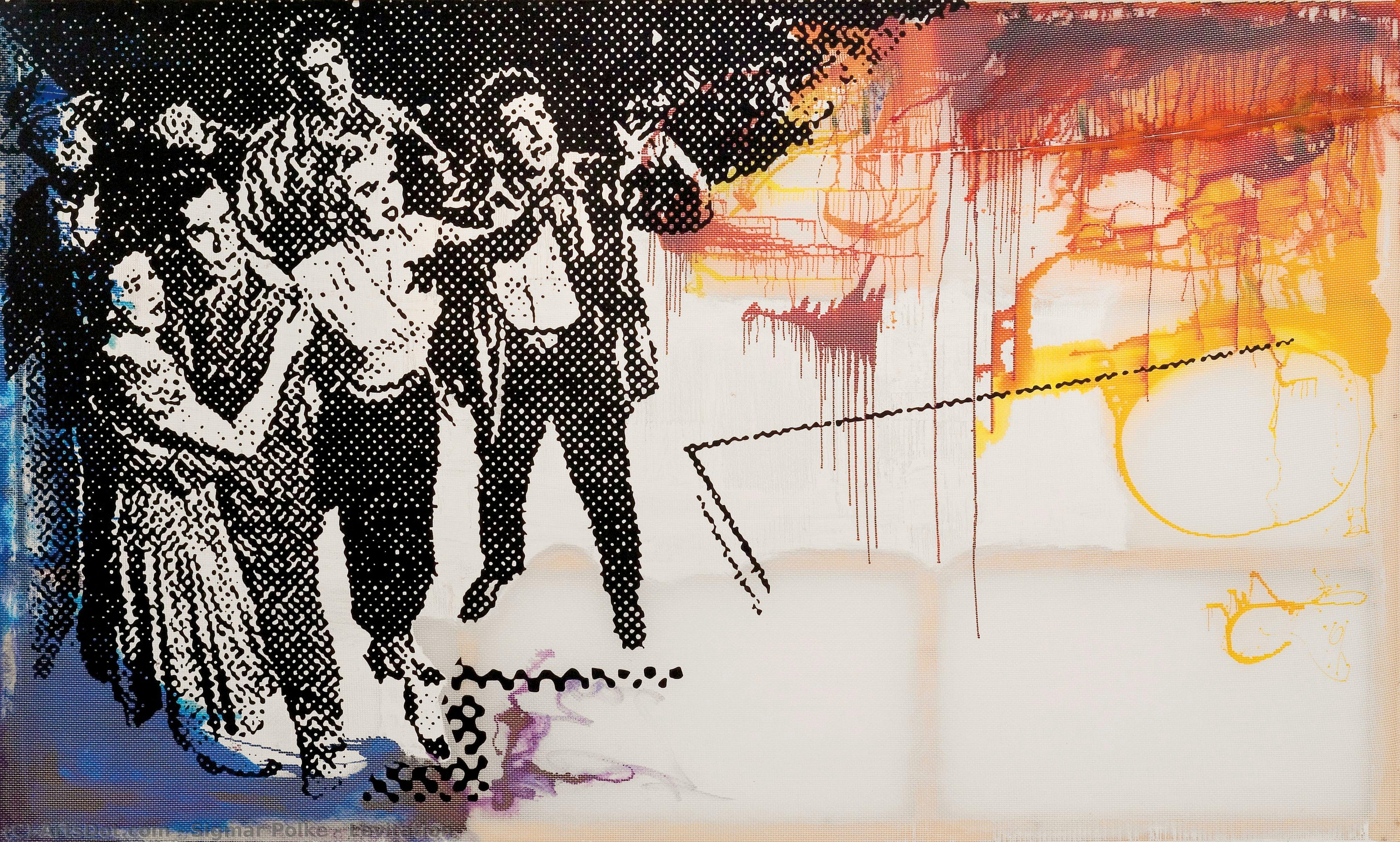
In the vast landscape of contemporary art, few names resonate with as much mystery and technical audacity as Sigmar Polke. His masterpiece, Levitation, created in 2005, serves as a profound meditation on the very nature of perception. At first glance, the viewer is met with a seemingly banal tableau—a table laden with objects that ground the scene in reality—yet this familiarity is quickly subverted by an underlying sense of existential weight. A group of figures stands before this arrangement, their faces captured in a moment of shared perplexity and quiet observation. It is a scene that feels simultaneously frozen in a cinematic still and vibrating with the tension of an unfolding drama, inviting those who gaze upon it to question what is truly visible and what remains hidden beneath the surface of our daily lives.
The emotional resonance of Levitation lies in its ability to evoke a sense of profound displacement. Polke, whose early life was shaped by the tumultuous migrations of post-war Europe, infused his work with a lifelong skepticism toward fixed truths. In this monumental canvas, measuring an imposing 300 x 500 cm, that skepticism transforms into a haunting beauty. The artwork does not merely depict a moment; it captures the feeling of being suspended between memory and reality, between the tangible world we touch and the ephemeral shadows of history that haunt our collective consciousness.
The Alchemy of Decay: Technique and Texture
To encounter Levitation is to witness a masterclass in the manipulation of medium. Polke’s distinctive style is a breathtaking blend of photographic realism and painterly abstraction, achieved through the demanding technique of encaustic. By layering beeswax, resin, and pigment, he creates a surface that possesses an almost organic vitality. This process allows for a luminous quality that seems to glow from within, yet it is simultaneously interrupted by subtle distress and fractures. These intentional imperfections imbue the work with an inherent sense of decay, mirroring the artist's preoccupation with the passage of time and the inevitable transformation of all things.
For the discerning collector or interior designer, this texture offers an unparalleled sensory experience. The way light interacts with the resinous layers creates a dynamic visual field that changes as one moves around the piece. It is not a static image but a living entity. This layering process serves as a metaphor for memory itself—built upon layers of experience, some bright and clear, others obscured by the weathered patina of time. The result is a work of art that demands presence, offering a sophisticated depth that elevates any space it inhabits.
Historical Echoes and Symbolic Depth
The historical context of Levitation adds a layer of poignant gravity to its visual splendor. Produced in the wake of the September 11th attacks, the painting reflects Polke’s broader engagement with global instability and the fragility of established narratives. By drawing inspiration from filmic conventions, he utilizes the language of mass media to heighten the emotional impact, prompting viewers to consider how much of our "reality" is actually a construction of the images we consume. The figures in the painting, caught in their moment of observation, act as proxies for the viewer, reflecting our own anxieties and our search for meaning in an increasingly fractured world.
Symbolically, the artwork operates on multiple planes. The table, with its collection of objects, represents the material world, while the title Levitation suggests a spiritual or psychological transcendence—a lifting away from the mundane into the realm of pure thought and perception. For those seeking to bring a piece of art history into their homes, this reproduction offers more than mere decoration; it provides a gateway to a complex dialogue about existence, loss, and the enduring power of the human gaze. It is an investment in a profound intellectual and aesthetic experience that continues to challenge and inspire.
Întrebări și răspunsuri
Cât de saturată este paleta culorilor din "Levitation"?
Culorile din "Levitation" de Sigmar Polke au o saturație de Subtle Color. Saturația descrie cât de vii sau de tenue sunt culorile.
Cum se raportează subiectul operei „Levitation” la temele obișnuite ale lui Sigmar Polke?
Printre temele renumite ale lui Sigmar Polke - experimentation, perception, surrealism, philosophical inquiry, critique, social commentary, protest, iconic image - „Levitation” aduce o perspectivă proprie asupra painting, reflection, gravity, artist, witnesses, fabric, perspective.
În ce tehnică este realizată lucrarea "Levitation" de Sigmar Polke?
"Levitation" este realizat în Encaustic."
Biografie artist
Sigmar Polke - A Life Forged in Displacement: The Early Years and Artistic Formation of Sigmar Polke
Sigmar Polke’s artistic journey was profoundly shaped by the tumultuous currents of 20th-century history, beginning with his birth in Olsztyn, Poland, in 1941. His early life was marked by displacement; as a child, he fled with his family first to Thuringia and then, seeking refuge from Communist rule, to West Germany in 1953. This experience of being uprooted, of existing between worlds, instilled within him a lifelong skepticism towards fixed ideologies and a fascination with the instability of perception – themes that would become central to his art. Before dedicating himself fully to painting, Polke underwent an apprenticeship as a stained glass worker in Düsseldorf (1959-1960), a formative experience that honed his technical skill and introduced him to the possibilities of manipulating light and color. He then formally studied at the Kunstakademie Düsseldorf (1961-1967) under a constellation of influential figures: Karl Otto Götz, Gerhard Hoehme, and most significantly, Joseph Beuys. It was within this environment that Polke began to forge his unique artistic voice, one characterized by experimentation, irony, and a relentless questioning of established norms.Early Influences and Artistic Beginnings
The formative years of Sigmar Polke’s artistic development were deeply impacted by the geopolitical landscape of postwar Germany. Growing up in Olsztyn—then Poznań—Poland—under Nazi occupation—and subsequently relocating to West Germany amidst the anxieties of the Cold War, instilled a profound awareness of displacement and instability. This experience permeated his worldview and fueled his artistic impulse. His apprenticeship as a stained glass worker provided him with invaluable technical training and an understanding of how light interacts with color – skills that would prove crucial in shaping his later explorations of visual materiality. Crucially, he enrolled at the Kunstakademie Düsseldorf in 1961, where he encountered the intellectual ferment surrounding German Art Informel and was profoundly influenced by Joseph Beuys’s radical vision of art as a tool for social transformation. Beuys's emphasis on shamanistic rituals and his belief in the transformative power of artistic gesture resonated deeply with Polke, shaping his approach to experimentation and challenging conventional notions of artistic expression.Capitalist Realism and Critique of Ideology
Emerging in the early 1960s, Polke swiftly aligned himself with a burgeoning countercultural movement. In 1963, alongside Gerhard Richter, Konrad Lueg, and Manfred Kuttner, he co-founded *Kapitalistischer Realismus* (Capitalist Realism). This was not an artistic style in the traditional sense but rather a deliberate provocation—a critique of both Western consumer culture and the rigid dogma of Soviet Socialist Realism. The movement’s name itself was deliberately ambiguous, suggesting that both systems were equally capable of producing artificial realities. Polke's early paintings from this period often appropriated imagery from advertising, comics, and popular media, presenting them with a detached irony that exposed their underlying ideological structures. He wasn’t simply rejecting capitalism; he was demonstrating its pervasive influence on perception itself. This initial foray into critical commentary established a pattern of subversive engagement that would define his career. The group's manifesto declared: “We want to show the world that we are not interested in any ideology.”Photography and Material Alchemy
The 1970s witnessed Polke’s decisive shift towards photography, driven by an unwavering curiosity about the visual world and a desire to push the boundaries of artistic representation. He embarked on extensive travels—to Pakistan, Afghanistan, Brazil, France, and the United States—documenting everyday life with meticulous detail and capturing fleeting moments of beauty and absurdity. However, Polke didn’t treat photography as merely a recording device; he subjected his images to radical chemical manipulation – dissolving prints in solvents, bleaching them with ultraviolet light, and applying abrasive pastes – transforming them into unpredictable textures and altering their chromatic palettes. This process mirrored his broader artistic preoccupation with chance operations and material alchemy—the deliberate introduction of imperfections and the exploration of how materials interact under unforeseen conditions. He famously stated: “I want to make paintings that are like photographs.”Legacy and Recognition
Sigmar Polke’s oeuvre spanned decades, encompassing painting, photography, film, sculpture, and installation art. His work consistently interrogated notions of authenticity, representation, and the relationship between art and society—themes that continue to resonate with contemporary artists. He received the Golden Lion at the Venice Biennale in 1986, recognizing his contribution to the revitalization of German art after decades of ideological repression. Throughout his career, Polke maintained a steadfast commitment to experimentation and intellectual rigor, refusing to conform to stylistic conventions or artistic trends. His influence can be seen in the work of numerous artists who followed him—those who embrace ambiguity as a source of creative power and who challenge established norms with uncompromising conviction. Sigmar Polke passed away in Cologne in June 2010 after a long battle with cancer, leaving behind an unparalleled body of work that secures his place among the most important figures in postwar art. His legacy resides not only in his distinctive visual language but also in his unwavering belief in the transformative potential of artistic inquiry.
Sigmar Polke
1941 - 2010 , Germania
Informații rapide
- Artistic Movement Or Style:
- Realism capitalist
- Neo-expresionism
- Artists Or Movements Influenced By This Artist: ['Pop Art']
- Artists Who Influenced This Artist: ['Joseph Beuys']
- Date Of Birth: 13 februarie 1941
- Date Of Death: 10 iunie 2010
- Full Name: Sigmar Polke
- Nationality: German
- Notable Artworks:
- Bunnies
- Raised Chair with Geese
- Place Of Birth (City And Country): Oels, Polonia
Articole conexe
Timeless Shadows: The Artistry, History, and Emotional Resonance of Black and White Photography
Explore the profound artistry of black and white photography. From historical mastery to the interplay of light and shadow, discover how monochrome captures timeless emotion and form through a sophisticated lens of art history.

Beyond the Lens: Photography's Enduring Influence on Modern & Contemporary Art
Explore photography's pivotal role in shaping modern & contemporary art. Discover key movements, influential artists like Stieglitz, and expert collecting advice from OriginalUniqueArt.
Shadow & Soul: Why Black & White Photography Remains the Ultimate Power Move in Modern Art
Discover why black & white photography remains a powerful force in contemporary art. Explore the impact of light, shadow, and texture through a visual journey of monochrome mastery and learn how to elevate your space with timeless grayscale aesthetics.

Top 10 Capodopere Alb-Negru: Frumusețe Atemporală în Artă | OriginalUniqueArt.ro
Descoperă top 10 picturi celebre dominate de alb, de la Monet la Kandinsky! Explorează istoria artei, tehnicile artistice și frumusețea atemporală a capodoperelor clasice. Reproduceri de calitate muzeală pe OriginalUniqueArt.com – inspiră-ți decorul!

Monochrome Visions: Exploring the Aesthetic & Historical Significance of Black & White Photography
Explore the rich history & artistic power of black and white photography. From early techniques to iconic masters like Ansel Adams, discover why monochrome continues to captivate art lovers today. Expert insights for collectors.