Înalta Renaștere
Disputa (Rafael)
Rafael (1483–1520) a realizat Disputa. Face parte din mișcarea Înalta Renaștere. Este realizată în Frescă.
- Frescă

 Tablou în ulei pictat manual
 Trimite prin felicitare
 Distribuie
 Ghid


 Descarcă imaginea
 Produse similare
 Galerie foto
 Întrebări și răspunsuri

 Statistici
Disputa: esențialul
- Titlu
- Disputa
- Artist
- Rafael (1483–1520)
- Artist născut în
- Urbino, Italia
- Medium
- Frescă
- Mișcare
- Înalta Renaștere
- Perioadă
- Renașterea
Ce reprezintă Disputa?
A Divine Dialogue: Unveiling Raphael’s *Disputa*
Raphael's *Disputa*, painted between 1509 and 1510, is a cornerstone of High Renaissance art, residing within the breathtaking Stanze di Raffaello in the Apostolic Palace at Vatican City. This monumental fresco isn’t merely a painting; it’s a theological statement rendered with unparalleled grace and intellectual depth, inviting viewers into a visual discourse on faith, reason, and divine truth.Subject & Composition: Heaven Meets Earth
The *Disputa* presents a complex yet harmonious composition divided into two distinct realms. The upper portion depicts a celestial gathering of theologians, saints, prophets, and martyrs arranged in a semi-circular formation around Christ and the Virgin Mary. They engage in animated discussion, their gestures conveying reverence and intellectual fervor. Below, on an architectural platform resembling a classical temple apse, earthly theologians – recognizable figures like Saint Augustine, Saint Thomas Aquinas, and Saint Gregory – continue the debate concerning the Holy Sacrament. This deliberate juxtaposition visually represents the convergence of heavenly wisdom and human inquiry. The composition is masterfully structured with a pyramidal form culminating in Christ, drawing the eye upwards towards the divine source.Style & Technique: The High Renaissance Ideal
*Disputa* exemplifies the hallmarks of the High Renaissance: balance, clarity, and idealized beauty. Raphael’s mastery of perspective creates a convincing sense of depth, while his use of *sfumato* – subtle gradations of light and shadow – lends an ethereal quality to the figures. Executed as a fresco, the painting demonstrates Raphael's technical brilliance in applying pigments to wet plaster, resulting in vibrant colors that have endured for centuries. The figures are not static; they possess dynamic poses and expressive faces, conveying a sense of lively intellectual exchange.Historical Context & Symbolism
Commissioned by Pope Julius II as part of the decoration of his private library (the *Stanza della Segnatura*), *Disputa* reflects the humanist spirit of the Renaissance – a renewed interest in classical learning and philosophical inquiry alongside religious faith. The room itself was intended to represent different branches of human knowledge: theology, law, poetry, and philosophy. The painting’s symbolism is rich and layered. The Holy Spirit, represented as a dove emanating light, signifies divine inspiration. The inclusion of prominent theologians underscores the importance of reason and scholarship in understanding religious doctrine. The architectural setting evokes the grandeur of ancient Rome, linking Christian theology to classical tradition.Emotional Impact & Lasting Legacy
*Disputa* transcends its theological subject matter to evoke a profound sense of awe, reverence, and intellectual curiosity. The painting’s harmonious composition and idealized figures inspire contemplation on the nature of truth, faith, and knowledge. It is not merely a depiction of a debate but an invitation to participate in it – to engage with the eternal questions that have occupied humanity for centuries. Raphael's *Disputa* remains a testament to his artistic genius and continues to captivate viewers with its beauty, intellectual depth, and enduring spiritual power.- Explore high-quality reproductions of *The Disputation of the Holy Sacrament* to bring Renaissance grandeur into your space.
- Discover more about Raphael’s life and artistic contributions within the context of the High Renaissance movement.
Disputa în înaltă rezoluție

Domeniu public: artistul a decedat în 1520.
Mai multe dimensiuni, cadruri și citări →Rafael, Disputa. Domeniu public
Întrebări despre Disputa
Ce spațiu se potrivește cu nuanțele din "Disputa" de Rafael?
Având în vedere paleta de culori Nuanțe pământii, recomandăm pentru "Disputa" o Living Room.
Ce stare de spirit transmite "Disputa" de Rafael în cadrul mișcării Înalta Renaștere?
"Disputa" emană o Sacru notă emoțională, specifică mișcării Înalta Renaștere.
Ce origine națională stă la baza Înalta Renaștere-ului din "Disputa"?
Care este nuanța dominantă în "Disputa"?
Ce utilizare și ce spațiu sunt recomandate pentru "Disputa" de Rafael?
„Disputa” este recomandat pentru Piesa centrală de impact, iar spațiul ideal de expunere este o Living Room.
Ce spațiu este recomandat pentru "Disputa" de Rafael?
O reproducere a „Disputa” se potrivește de minune într-un Living Room.
Pentru cine este recomandat "Disputa" de Rafael ca cadou?
În ce perioadă a carierei lui Rafael se încadrează "Disputa"?
Ce atmosferă ar aduce într-o încăpere o reproducere a operei "Disputa" de Rafael?
Cu atmosfera sa Eteric, „Disputa” este recomandată pentru o Living Room.
Despre artistul Rafael

1483–1520, Italia
Rafael
Viața și Identitatea lui Rafael Rafael, cunoscut de istorie sub mai multe nume, printre care Raffaello Sanzio, Raffaello Santi și Raffaello Sanzio da Urbino, a fost o figură centrală a Renașterii Italene de înaltă clasificare. Viața sa a fost definită de o măiestrie duală în pictură și arhitectură, o versatilitate care i-a permis să navigheze fără efort între dimensiunea intimă a unui portret și cerințele monumentale ale construcțiilor papale. S-a născut în Urbino, Italia, pe 6 aprilie 1483, într-o lume vibrantă de activitate intelectuală și artistică. Cariera sa a fost marcată de o productivitate imensă, care a necesitat gestionarea unui atelier vast pentru a satisface nevoile patronilor săi.
Alte lucrări ale lui Rafael
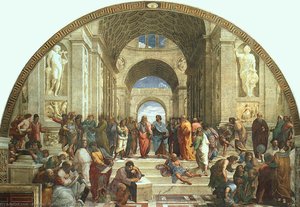 Școala Atenei1511
 Madonna Sistina1513
 Raphael1520
 Nunta Fecioarei Maria1504

Eseuri despre Disputa
 Giotto di Bondone: Revolutionizing Late Medieval Painting through Narrative InnovationExplore the revolutionary art of Giotto di Bondone! Discover his groundbreaking techniques, iconic frescoes like those in the Arena Chapel,…
 Masterpieces of Light: The Top 25 Artworks by Duccio di BuoninsegnaJourney through the divine elegance of Duccio di Buoninsegna. Explore 25 iconic Sienese masterpieces, from the Maestà to the Rucellai Madon…
 Raphael: Cele Mai Remarcabile 25 de Capodopere – Artă Clasică pentru Decorul Casei TaleDescoperă cele mai frumoase 25 de picturi ale lui Raphael, maestru al Renașterii italiene! Explorează Școala din Atena, Madonnele și alte c…