Comută pe versiunea Print
 Vezi mai mult







































 Pentru opere de artă sau reproduceri care depășesc 105 cm (aproximativ 41 de inch) pe oricare dintre laturi, cadrul va fi livrat demontat, sub formă de kit. Această metodă asigură o livrare sigură și previne deteriorarea în timpul transportului.


Diagonal Composition: A Symphony of Abstraction
‘Diagonal Composition’, by Piet Mondrian, stands as an undeniable emblem of De Stijl – a Dutch artistic movement that irrevocably altered the landscape of 20th-century art and design. More than just a visual arrangement; it’s a profound declaration of aesthetic belief, asserting that true beauty resides in reductive simplification and universal harmony achieved through geometric abstraction. This artwork isn't merely looking at a picture; it’s experiencing an idea crystallized onto canvas.Decoding Form: Style & Technique
Mondrian approached this monumental task with meticulous precision. His palette was deliberately restrained – primary red, blue, and yellow, complemented by the serene neutrality of white and reinforced by the unwavering strength of black. These hues weren't chosen at random; they represented fundamental building blocks of visual perception according to Mondrian’s philosophical convictions. The canvas itself is dissected into a dynamic grid formed by bold, black lines – some vertical, others horizontal – but crucially positioned on a diamond orientation—the very title reflecting this distinctive structural element. This deliberate rejection of representational imagery underscores the artist's commitment to capturing essence rather than surface appearance. The technique employed was characterized by painstaking brushwork, resulting in flat planes of color devoid of textural variation. Each stroke aimed for flawless execution, prioritizing clarity and purity of form above expressive gesture. Oil paint facilitated this process, ensuring consistent coverage and contributing to the artwork’s palpable sense of order and equilibrium. It's a testament to Mondrian’s mastery that despite its apparent simplicity, every element contributes to an overwhelming impression of balance and contemplation.The Genesis of Neoplasticism: Historical Context
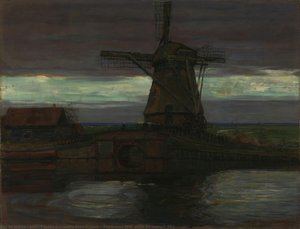
‘Diagonal Composition’ emerged from a period brimming with artistic ferment – the fervent experimentation that defined De Stijl alongside Theo van Doesburg. Initially, Mondrian's oeuvre explored landscapes steeped in Dutch Impressionistic tradition—pieces like *The Red Mill* demonstrating his early dedication to observing and faithfully portraying nature. However, spurred by philosophical influences including Theosophy, he progressively distanced himself from naturalism, seeking a more transcendent expression of spiritual truths. By 1917, De Stijl was formally established, cementing Mondrian’s advocacy for *Neoplasticism* – a stylistic paradigm prioritizing fundamental geometric forms and colors as conduits for conveying universal concepts. This artwork embodies the very spirit of this movement, born from a desire to transcend earthly concerns and embrace an idealized vision of reality. The creation coincided with turbulent socio-political currents, prompting artists like Mondrian to grapple with questions of purpose and beauty amidst chaos—a reflection of the era's anxieties and aspirations.Symbolism & Meaning: Beyond Geometry
The artwork’s visual language speaks volumes about Mondrian’s worldview. The diamond grid isn’t merely a structural device; it symbolizes stability, harmony, and the interconnectedness of opposing forces – concepts central to De Stijl’s metaphysical underpinning. Each rectangle embodies purity and balance, representing the fundamental elements of existence according to Mondrian's belief system. The deliberate absence of perspective reinforces this notion of flatness, inviting viewers to engage with the artwork on an intellectual level—to contemplate its underlying principles rather than simply admiring its aesthetic qualities. Ultimately, ‘Diagonal Composition’ transcends mere visual appeal; it represents a profound assertion of artistic faith – a quest for universal harmony expressed through the purest possible form.- Material: Oil paint on canvas
- Dimensions: Unknown
- Date: Unknown
Întrebări și răspunsuri
Cum pot descoperi opere de artă similare cu "Compoziție Diagonală" de Piet Mondrian?
Pagina Lucrări similare pentru "Compoziție Diagonală" de Piet Mondrian prezintă opere de artă similare.
Cum poate fi integrată "Compoziție Diagonală" de Piet Mondrian în decorul casei?
"Compoziție Diagonală" de Piet Mondrian este recomandată pentru Punct focal, ideal într-un Living Room. Combinația dintre utilizare și spațiu oferă îndrumări despre unde se potrivește o reproducere.
Ce amplasare se potrivește formatului lucrării "Compoziție Diagonală" de Piet Mondrian?
Formatul Format pătrat al operei "Compoziție Diagonală" de Piet Mondrian este recomandat pentru o Living Room. Formatul și spațiul împreună ghidează amplasarea unei reproduceri.
Mai multe detalii despre această pictură
 Previzualizare
 Trimite prin felicitare
 Distribuie
 Detalii despre lucrare
 Ghid
Ghid

 Descarcă imaginea
 Produse similare
 Radiografie
 Galerie foto
 Întrebări și răspunsuri
 Statistici