

 Vezi în context
 Trimite
 Distribuie
 Detalii
 Ghidul

 Descarcă
 Produse similare
 Radiografie
 Diaporama
 Statistici
Fantasy
 Oil On Canvas
- WallArt
- Symbolist Painting
 1866
1866 148.0 x 263.0 cm
 Ohara Museum of Art
 Citește mai mult
Giclée / Imprimare artistică
Printuri giclée sau pe canvas de calitate muzeală, cu proces de producție rapid și opțiuni flexibile de finisare. ( Comandă pictură realizată manual Treci la imagine digitală)




P118B $10

P118H $10

P118W $10

P438Z $10

P508JH $12

P508YH $12

P805H $10

P805Z $10

P919BZ $10

P919G $10

P919XJ $10

P959ZH $10

P968JZ $12

W106C $8

W218G $10

W218JH $8

W218Y $10

W307PJ $10

W316G $10

W316PJ $8

W316Y $10

W398PJ $8

W4111J $10

W500HY $15

W500JH $15

W692G $12

W849H $8

W940BG $15

W953PJ $8




Alegeți dintre dimensiunile noastre prestabilite, care respectă proporțiile originale ale operei de artă.

Puteți introduce propriile dimensiuni pentru a se potrivi unui anumit cadru sau spațiu. Dacă dimensiunea selectată nu corespunde proporțiilor imaginii originale, vom decupa lucrarea de artă sau vom extinde imaginea cu margini oglindite sau cu o culoare uniformă. Un mockup digital va fi trimis pentru aprobarea dumneavoastră înainte de începerea producției.
Vă rugăm să rețineți că previzualizarea de pe ecran nu reflectă decuparea sau extinderea reală. Doar mockup-ul va arăta cu exactitate compoziția finală.
Deși dimensiunile personalizate sunt disponibile, vă recomandăm să selectați o dimensiune din lista predefinită pentru a păstra proporțiile originale.
Livrare în întreaga lume () în 2 săptămâni, în loc de cele 4/5 săptămâni standard. (27 Septembrie)

Livrare expres gratuită la nivel mondial

Pânză de in premium

Asigurare completă pentru transport

Garanție de rambursare a taxelor vamale

Garanția fidelității culorilor

Politica de retur în 100 de zile (doar pentru defecte)

Garanție de rambursare 100%

Reducere pentru comenzi multiple
 Opțiunea cu sticlă este disponibilă doar pentru dimensiuni de sub 110 cm

Fantasy
Giclée / Imprimare artistică
Dimensiune reproducere
-


Preț total
$ 80
A Dream Woven in Blue: Exploring ‘Fantasy’ by Pierre Puvis de Chavannes
Pierre Cécile Puvis de Chavannes's “Fantasy,” painted in 1866, isn’t merely a depiction of a mythological scene; it’s an invitation to step into a realm where imagination reigns supreme. This captivating work, currently housed within the Ohara Museum of Art in Kurashiki, Japan, transcends the boundaries of simple representation, offering instead a profound meditation on inspiration, innocence, and the allure of the fantastical. It's a piece that whispers of classical ideals blended with the nascent currents of Symbolism, marking a pivotal moment in French art history.
The painting immediately draws the eye to its central figures: a serene female figure seated upon a draped blue cloth, her gaze directed towards a magnificent winged horse – Pegasus – mid-flight. Beneath her, a small child kneels, seemingly reaching out with an expression of gentle curiosity or perhaps even playful engagement with the scene. The backdrop is a carefully constructed landscape of stylized trees and distant mountains, shrouded in atmospheric haze that lends an ethereal quality to the entire composition. Puvis de Chavannes masterfully employs a muted color palette dominated by blues, greens, and creams, creating a tranquil and almost dreamlike atmosphere—a deliberate choice that emphasizes mood over precise detail.
Composition and Technique: A Symphony of Softness
The painting’s pyramidal structure, anchored by the seated female figure, establishes a sense of stability and balance. Puvis de Chavannes skillfully utilizes lines to guide the viewer's eye through the scene; horizontal bands in the landscape create depth, while diagonal lines—particularly those formed by Pegasus’s flight path—inject movement and dynamism. Notably, the artist eschews sharp outlines, opting instead for a technique of soft blending and subtle tonal variations. This deliberate lack of definition contributes significantly to the painting's dreamlike quality, blurring the edges between figures and landscape, inviting the viewer to lose themselves within the scene.
The brushwork itself is remarkably understated—almost invisible. Puvis de Chavannes employed a layering technique, applying thin glazes of paint to achieve delicate gradations of color and texture. This meticulous approach results in a surface that appears smooth and luminous, further enhancing the painting’s ethereal atmosphere. The absence of pronounced impasto or heavy brushstrokes speaks volumes about the artist's commitment to capturing an elusive, almost intangible quality—the very essence of fantasy itself.
Symbolism and Narrative: Echoes of Myth and Imagination
“Fantasy” is rich in symbolic meaning, inviting multiple interpretations. The seated female figure is often seen as representing inspiration or the muse – a source of creative energy and artistic vision. The child beneath her could symbolize innocence, potential, or perhaps even the future generation inheriting this imaginative realm. Pegasus, the legendary winged horse, embodies poetic flight, aspiration, and the transcendence of earthly limitations. The wreath crafted by the child further reinforces the theme of creation and artistry.
Puvis de Chavannes’s work resonates deeply with the Symbolist movement, which sought to explore subjective experiences and emotions through art. The painting isn't simply a literal depiction; it’s an evocation—a suggestion of a world beyond the tangible, where dreams and fantasies take flight. It draws upon classical mythology – particularly the association of Pegasus with Apollo and poetry – while simultaneously forging its own unique visual language.
A Legacy of Vision: Puvis de Chavannes and the Art of Public Imagination
Pierre Cécile Puvis de Chavannes’s legacy extends far beyond this single masterpiece. He was a pivotal figure in shaping public art during the early years of the Third Republic, serving as co-founder and president of the Société Nationale des Beaux-Arts. His monumental murals, adorning buildings throughout Paris, aimed to embody national ideals and inspire civic pride. “Fantasy,” however, stands apart as a testament to his artistic vision—a deeply personal exploration of imagination and beauty that continues to captivate viewers today. It’s a reminder that art can not only reflect the world around us but also transport us to realms beyond our wildest dreams.
Biografie artist
A Life Dedicated to Monumental Visions
Pierre Cécile Puvis de Chavannes, a name often simply rendered as Puvis de Chavannes, occupies a unique and pivotal position in 19th-century French art. Born in Lyon in 1824, he rose to become known as “the painter for France,” a testament to his profound impact on public art during the early years of the Third Republic. His legacy extends far beyond mere decoration; Puvis de Chavannes crafted visual narratives that embodied national ideals and resonated with a generation grappling with political and social transformation. He wasn’t merely illustrating history, but actively shaping its visual memory for the future. His influence on subsequent artists, particularly those aligned with Symbolism and Art Nouveau, is undeniable, and his collaborative spirit extended to working alongside medallists, offering designs and insightful suggestions.From Engineering Aspirations to Artistic Devotion
The early life of Pierre-Cécile Puvis was marked by a trajectory that initially diverged from the world of art. Born into a family of modest means – his father an engineer descended from Burgundy nobility – he received an education at Amiens College and Lycée Henri IV in Paris, preparing him for a career following in his father’s footsteps. However, a serious illness proved to be a turning point, forcing a period of convalescence that allowed space for introspection and the burgeoning of artistic inclinations. A transformative journey to Italy ignited within him a passion for painting, prompting a decisive shift away from engineering and towards a life dedicated to creative expression. He embraced his ancestral heritage by incorporating “de Chavannes” into his name, a subtle assertion of identity and lineage. His formal training included brief mentorships under luminaries like Eugène Delacroix, Henri Scheffer, and Thomas Couture, yet he ultimately favored independent study, establishing a spacious studio near the Gare de Lyon that became a hub for artistic exploration. He diligently honed his understanding of anatomy through classes at the Académie des Beaux Arts, laying a solid foundation for his later monumental works.The Genesis of a Symbolist Style
Puvis de Chavannes’s artistic style is generally categorized as Symbolist, though it evolved from roots in Romanticism. His work is instantly recognizable by its simplified forms, rhythmic linear compositions, and a distinctive, muted palette reminiscent of fresco painting. He wasn't interested in photographic realism; instead, he sought to distill essence, to capture the underlying spirit of his subjects. He frequently drew inspiration from classical antiquity and idealized landscapes, weaving allegorical themes into grand narratives. His early commissions, beginning in the 1860s at the Musée de Picardie in Amiens – including *Concordia*, *Bellum*, *Le Travail* (Work), and *Le Repos* (Rest) – established his reputation for large-scale mural paintings. These weren’t simply decorative elements; they were carefully considered statements about civic virtue, labor, and the pursuit of harmony. Later, a significant series of murals commissioned for the Museum of Fine Arts in Lyon further cemented his position as a leading figure in public art. Notable works like *The Woodcutters* (1873), currently housed at the San Antonio Museum of Art, demonstrate his ability to imbue everyday scenes with symbolic weight and poetic grace. Paintings such as *Massilia, Greek Colony*, and *Sacred Grove* exemplify his characteristic style and thematic interests, showcasing nude figures within evocative landscapes that invite contemplation.Major Works and Collaborative Projects
Puvis de Chavannes’s career was punctuated by a series of ambitious projects that showcased both his artistic skill and his collaborative spirit. The murals for the Amiens Museum, particularly *Concordia*, *Bellum* (War), *Le Travail* (Work), and *Le Repos* (Rest), established him as a master of monumental painting. These works, executed with remarkable precision and emotional depth, explored fundamental themes of human existence – peace, labor, and rest – through carefully constructed allegorical scenes. His commission to decorate the Panthéon in Paris resulted in a series of powerful murals depicting the life of Saint Geneviève, the patron saint of France. These paintings, characterized by their serene beauty and symbolic resonance, remain among his most celebrated achievements. Beyond mural painting, Puvis de Chavannes collaborated extensively with medallists, creating designs for medals that reflected both artistic elegance and civic pride. His involvement in public art extended beyond these large-scale commissions; he also designed decorative elements for various buildings throughout France, contributing to the aesthetic fabric of cities like Poitiers and Marseilles.Historical Significance and Lasting Influence
The impact of Puvis de Chavannes on the artistic landscape of France – and beyond – was profound. He is credited with influencing an entire generation of painters and sculptors, particularly those associated with Modernism. His emphasis on simplified forms, decorative patterns, and allegorical themes resonated deeply with artists seeking to break away from traditional academic constraints. Georges de Feure was among his notable protégés, benefiting directly from his guidance and mentorship. Émile Zola eloquently lauded his art as “an art made of reason, passion, and will,” capturing the intellectual and emotional depth inherent in his creations. His most celebrated achievement lies in his contribution to the development of public art during a period of significant political and social change in France. His murals weren’t merely aesthetic enhancements; they were intended to embody national ideals and provide visual narratives for civic spaces, fostering a sense of collective identity and shared values. The monumental murals at the Panthéon in Paris, illustrating the life of St. Geneviève, stand as enduring testaments to his skill and vision. Puvis de Chavannes remains an important figure in 19th-century French art, bridging the gap between Romanticism and Symbolism and paving the way for the artistic innovations of the modern era. His work continues to inspire awe and admiration, reminding us of the power of art to shape our understanding of history, culture, and the human condition.
Puvis de Chavannes
1824 - 1898 , Franța
Informații rapide
- Artistic Movement Or Style: Simbolism
- Artists Or Movements Influenced By This Artist:
- Feure
- Modernism
- Artists Who Influenced This Artist:
- Delacroix
- Scheffer
- Couture
- Date Of Birth: 14 Decembrie 1824
- Date Of Death: 24 Octombrie 1898
- Full Name: Pierre Cécile Puvis de Chavannes
- Nationality: Francez
- Notable Artworks:
- Concordia
- Bellum
- Travail
- Repos
- Place Of Birth: Lyon, Franța
Articole conexe
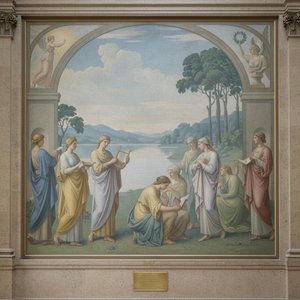
Pierre Puvis de Chavannes: Symbolism, Mural Painting, and the Pursuit of Ideal Beauty
Explore the life & work of Pierre Puvis de Chavannes, a pivotal Symbolist painter renowned for his monumental murals. Discover his aesthetic principles, key artworks like 'Hope,' and lasting influence on modern art. A deep dive into 19th-century French painting.

De la Scene Jungle la Geometrie cu Foiță de Aur: Ghidul Stilurilor de Murală Cele Mai Căutate în Prezent
Descoperă ghidul complet pentru arta murală în designul hotelier! Tendințe, stiluri, tehnici și sfaturi de la experți. Creează un spațiu unic și memorabil.

Transformarea Interioarelor: Cum Muralurile Redefinesc Bucătările și Băile
Descoperă cum arta murală transformă bucătăriile și băile în spații unice! Ghid complet cu tehnici, stiluri și inspirație de la experți. Creează-ți o casă de vis!
Ancorarea Tematicii Designului Interior cu Fresce: Un Ghid Complet pentru Designerii de Hoteluri
Ghid complet pentru designerii de hoteluri privind integrarea frescelor în designul interior de lux. Descoperă beneficiile, tehnicile și costurile implicate. Inspirație & consultanță gratuită!

Goya: Cele Mai Iconice Capodopere – Artă Spaniolă pentru Decor Rafinat | OriginalUniqueArt.ro
Descoperă cele mai frumoase 25 de picturi ale lui Francisco Goya! Explorează capodoperele romantice, portretele impresionante și gravurile puternice. Reproduceri artă spaniolă de calitate muzeală pentru un decor rafinat. Explorează colecția completă online pe OriginalUniqueArt.com
