 Comută pe versiunea Print
 Vezi mai mult







































 Pentru opere de artă sau reproduceri care depășesc 105 cm (aproximativ 41 de inch) pe oricare dintre laturi, cadrul va fi livrat demontat, sub formă de kit. Această metodă asigură o livrare sigură și previne deteriorarea în timpul transportului.


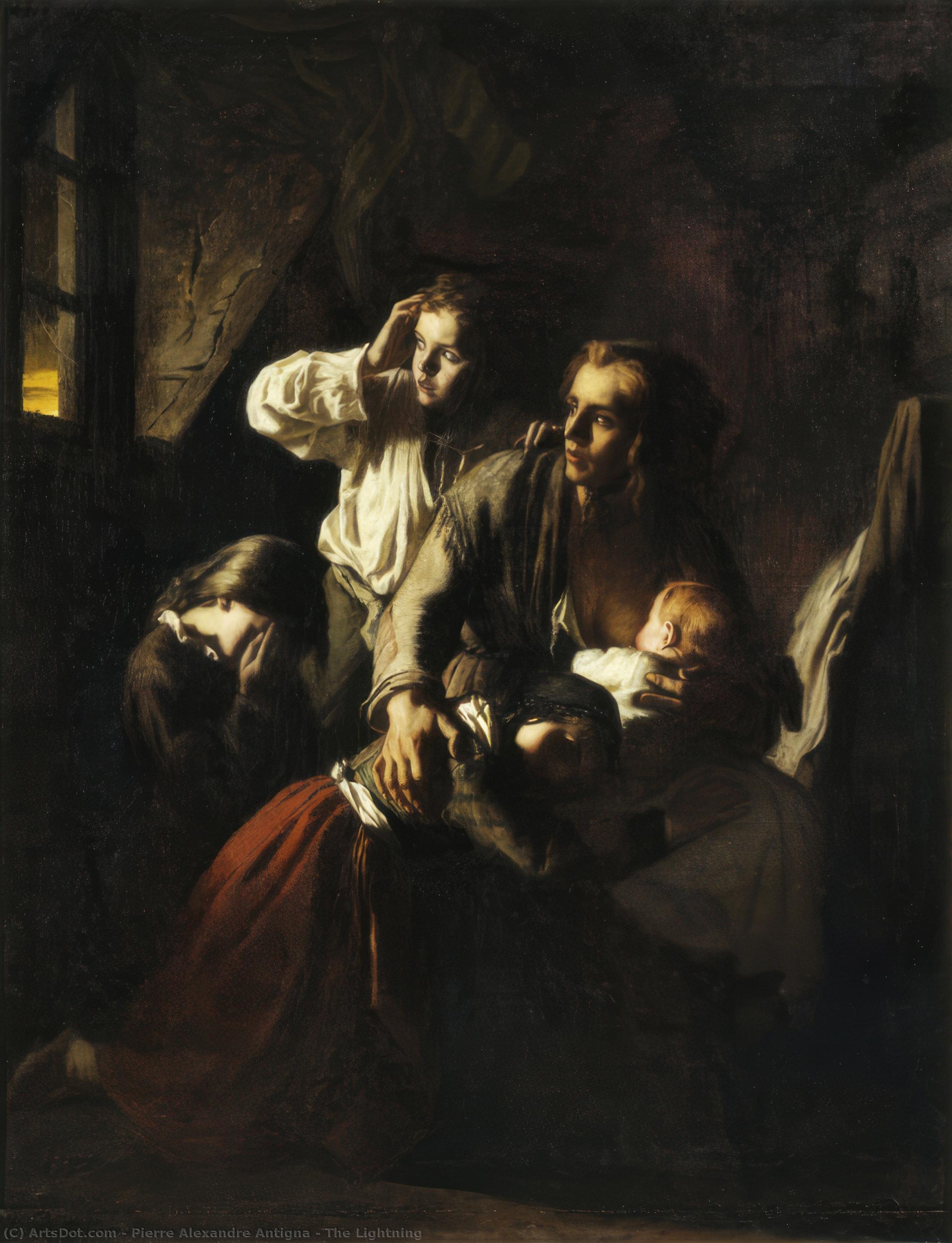
A Moment Frozen in Storm – “The Lightning” by Pierre Alexandre Antigna
“The Lightning,” painted in 1848 by the French artist Pierre Alexandre Antigna, is more than just a depiction of a family huddled together during an electrical storm; it’s a poignant meditation on vulnerability, familial love, and the raw power of nature. Antigna, a key figure in Parisian Realism, masterfully captures a fleeting moment of intense emotion within a dimly lit interior, drawing the viewer into a scene brimming with both immediate danger and profound tenderness. The painting immediately evokes a sense of urgency – the dark background, punctuated by the suggestion of rain-streaked windows, speaks to an external threat, while the central focus on the family’s embrace offers a powerful counterpoint.
Subject and Composition: A Study in Domesticity Under Duress
At the heart of the composition stands a man, identified as Pierre Alexandre Antigna himself, holding two infants close to his chest. His posture is one of unwavering protection, his gaze directed towards the children with an expression that blends concern and determination. Beside him, a young boy appears to be gazing out at the storm, perhaps contemplating its force or yearning for safety. The arrangement isn’t merely observational; Antigna deliberately places these figures within a confined space, emphasizing their dependence on one another and highlighting the vulnerability inherent in their situation. The limited palette – primarily dark browns, grays, and blues – reinforces this sense of confinement and impending darkness, while subtle highlights suggest the flickering light of an oil lamp, offering a fragile beacon of hope.
Technique and Style: The Nuances of Parisian Realism
Antigna’s style firmly aligns with the tenets of Parisian Realism, a movement that sought to depict life as it truly was – often unflatteringly – without resorting to romanticized ideals. He employs a meticulous attention to detail, evident in the textures of the clothing, the wrinkles on the man's face, and the delicate features of the infants. The brushwork is deliberately loose and expressive, particularly in rendering the shadows and suggesting the movement of the storm outside. Notably, Antigna’s use of light is crucial; it doesn’t illuminate the scene entirely but rather creates pockets of brightness that draw attention to key elements – the faces of the family members – while leaving much of the background shrouded in mystery. This technique enhances the dramatic effect and underscores the precariousness of their circumstances.
Symbolism and Historical Context: A Reflection of Urban Life
“The Lightning” was painted during a period of significant social upheaval in Paris, following the 1848 Revolution. The city was grappling with poverty, overcrowding, and political instability. Antigna’s choice to depict a family struggling against the elements resonated deeply with contemporary audiences, reflecting anxieties about urban life and the vulnerability of ordinary people. The storm itself can be interpreted as a metaphor for the turbulent times – a force beyond their control that threatens to overwhelm them. The act of holding the infants represents not just physical protection but also the preservation of hope and future generations amidst chaos. Drawing on research, it’s noted that Antigna lived in the impoverished Île Saint-Louis district, giving him firsthand experience with the hardships faced by many Parisians.
Emotional Impact and Legacy: A Timeless Portrait of Human Connection
Despite its somber subject matter, “The Lightning” possesses a remarkable emotional resonance. The painting’s power lies in its ability to evoke empathy for the family depicted – their vulnerability, their love, and their unwavering commitment to one another. It's a testament to the enduring strength of the human spirit in the face of adversity. Reproductions of this powerful work continue to captivate viewers today, offering a poignant reminder of our shared humanity and the importance of connection amidst uncertainty. The painting’s legacy resides not only in its artistic merit but also in its ability to spark reflection on social issues and the enduring value of family bonds.
Întrebări și răspunsuri
Cum se îmbină contrastul și armonia în "The Lightning"?
În "The Lightning", un Serene contrast se împletește cu o Strong Color Unity armonie.
Ce paletă de culori utilizează "The Lightning"?
Paleta lui "The Lightning" de Pierre Alexandre Antigna este descrisă ca fiind Earthy, oferind o descriere concisă a culorilor lucrării.
Cum echilibrează "The Lightning" lumina și întunericul?
Valorile înregistrate pentru "The Lightning" de Pierre Alexandre Antigna sunt: luminozitate de deep_shadow, luminanță de Dark.
Mai multe detalii despre această pictură
 Previzualizare
 Trimite prin felicitare
 Distribuie
 Detalii despre lucrare
 Ghid
Ghid

 Descarcă imaginea
 Produse similare
 Radiografie
 Galerie foto
 Întrebări și răspunsuri
 Statistici