Comută pe versiunea Print
 Vezi mai mult







































 Pentru opere de artă sau reproduceri care depășesc 105 cm (aproximativ 41 de inch) pe oricare dintre laturi, cadrul va fi livrat demontat, sub formă de kit. Această metodă asigură o livrare sigură și previne deteriorarea în timpul transportului.


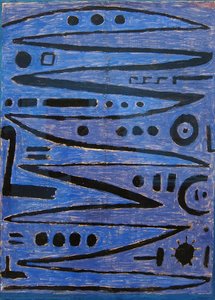
A Submerged World of Color: Exploring Paul Klee’s *The Golden Fish*
Paul Klee's *The Golden Fish*, painted sometime between 1925 and 1930, isn’t merely a depiction of marine life; it’s an invitation into a realm where imagination reigns supreme. This mesmerizing artwork embodies Klee’s signature style – a harmonious blend of Expressionism’s emotive intensity, Cubism's fragmented perspectives, and Surrealism’s dreamlike distortions—resulting in a visual experience that transcends literal representation and delves into the depths of human emotion. Subject & Composition: At its core lies a vibrant orange fish, gracefully positioned amidst a tranquil blue ocean expanse. Surrounding it are numerous smaller fish, skillfully arranged to convey movement and depth, creating an illusion of underwater dynamism. Adding an unexpected element to this serene tableau are two birds – one perched delicately on the upper left corner and another soaring towards the lower right—suggesting a connection between terrestrial and aquatic environments, blurring boundaries and fostering contemplation about nature’s interconnectedness. Klee's compositional choices prioritize fluidity and organic flow, mirroring the natural currents of the sea and rejecting rigid geometric structures. Style & Technique: Klee’s artistic approach distinguishes him as a pioneer of abstraction, prioritizing feeling over precise observation. He achieves this through layering translucent washes of color—primarily blues, reds, and yellows—creating luminous effects that illuminate the canvas and imbue it with an ethereal glow. The brushwork is remarkably delicate and meticulous, contributing to the painting’s overall harmony and precision. Unlike traditional realism, Klee utilizes simplified forms and bold hues to evoke emotion and convey symbolic meaning, aligning perfectly with the principles of Bauhaus art education. Historical Context & Artistic Influences: *The Golden Fish* emerged during a pivotal period in Klee's artistic development—immediately following his influential years at the Bauhaus school. This institution championed a holistic approach to art, integrating craftsmanship, design, and theoretical exploration, encouraging artists like Klee to experiment with innovative materials and techniques. The Bauhaus ethos profoundly impacted Klee’s worldview, shaping not only his visual language but also his intellectual understanding of art as a vehicle for communicating ideas and emotions—a legacy evident in his extensive writings on color theory, meticulously documented in *The Paul Klee Notebooks*. These notebooks reveal Klee's fascination with exploring the psychological dimensions of color, mirroring the broader artistic currents of the era. Symbolism & Emotional Impact: The golden fish itself serves as a potent symbol – representing prosperity, illumination, and spiritual awakening. Its vibrant hue embodies optimism and vitality, contrasting beautifully with the cool blues of the ocean depths. The birds symbolize freedom and aspiration, hinting at transcendence beyond earthly limitations. Ultimately, *The Golden Fish* invites viewers to contemplate themes of harmony, balance, and the beauty inherent in the natural world—leaving an indelible impression on anyone who appreciates Klee’s masterful artistry. It's a piece that speaks to the subconscious mind, prompting reflection on dreams, imagination, and the transformative power of color.- Dimensions: Unknown
- Medium: Watercolor and Gouache on Paper
Întrebări și răspunsuri
Ce subiecte sunt reprezentate în "Peștele Aurit" de Paul Klee?
"Peștele Aurit" de Paul Klee surprinde: underwater world, chromatic harmony, fish symbolism, geometric forms, dreamlike imagery, color exploration, bauhaus influence, fantasy art.
Pot vedea "Peștele Aurit" de Paul Klee pe propriul meu perete înainte de achiziție?
„Peștele Aurit” are o previzualizare în realitate augmentată: pagina Previzualizare în AR operei artistice o prezintă în propriul tău spațiu, pe un dispozitiv compatibil.
Care sunt culorile dominante în "Peștele Aurit" de Paul Klee?
"Peștele Aurit" de Paul Klee utilizează o paletă de culori Nuanțe pământii, având culoarea Verde ftalocianină (#1b1a11) ca nuanță dominantă.
Mai multe detalii despre această pictură
 Previzualizare
 Trimite prin felicitare
 Distribuie
 Detalii despre lucrare
 Ghid
Ghid

 Descarcă imaginea
 Produse similare
 Radiografie
 Galerie foto
 Întrebări și răspunsuri
 Statistici