Comută pe versiunea Print
 Vezi mai mult







































 Pentru opere de artă sau reproduceri care depășesc 105 cm (aproximativ 41 de inch) pe oricare dintre laturi, cadrul va fi livrat demontat, sub formă de kit. Această metodă asigură o livrare sigură și previne deteriorarea în timpul transportului.


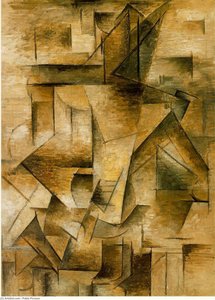
Woman with Book – A Surrealist Portrait of Marie-Thérèse Walter
Pablo Picasso’s “Woman with Book,” completed in 1932, stands as a cornerstone of Surrealism and exemplifies the artist's masterful exploration of form and emotion. More than just a depiction of a woman absorbed in reading, it’s a complex meditation on femininity, solitude, and the elusive nature of perception—themes that resonate powerfully even today.
- Style: Surrealism – Picasso deliberately eschewed traditional representational conventions, prioritizing dreamlike imagery and subconscious associations. This departure from Cubism marks a significant shift in his artistic trajectory.
- Technique: Oil on Canvas – Picasso employed thick impasto brushstrokes, layering pigment onto the canvas to create textured surfaces that convey both physicality and psychological depth. The bold use of color—primarily blues and reds—further enhances the painting’s dramatic impact.
- Composition: Geometric simplification – Picasso reduced the woman's figure and surroundings to essential geometric shapes, emphasizing flatness and creating a sense of spatial compression. This technique aligns with Surrealist principles of destabilizing visual reality.
The historical context surrounding “Woman with Book” is crucial to understanding its significance. Created during Picasso’s affair with Marie-Thérèse Walter—a young dancer who captivated him and became his muse—the painting captures a moment of intimacy and contemplation amidst the turbulent backdrop of their relationship. Walter herself was a subject of considerable fascination for Picasso, representing both sensual beauty and vulnerability.
Symbolism permeates every aspect of the artwork. The woman’s closed eyes suggest introspection and detachment from the external world, mirroring the artist's own preoccupation with psychological states. The book symbolizes knowledge and contemplation—yet its presence is ambiguous, hinting at unanswered questions and unspoken desires. Even the positioning of the chair and clock contributes to the painting’s symbolic resonance, emphasizing time’s passage and the fleeting nature of experience.
Emotionally, “Woman with Book” evokes a sense of melancholy beauty—a poignant portrayal of solitude and longing. Picasso's masterful manipulation of color and form captures not only visual details but also intangible feelings, inviting viewers to contemplate themes of identity, desire, and the complexities of human relationships. It’s a painting that lingers in the mind long after viewing, prompting reflection on the mysteries of consciousness and the enduring power of art.
- Notable Influences: Cubism – Picasso's earlier explorations of Cubism profoundly shaped his artistic vision, informing his approach to spatial representation and compositional structure.
- Related Works: Explore Picasso’s other masterpieces like “The Aubade,” “Claude with a ball,” and “Matador” for further insight into his stylistic evolution and thematic preoccupations.
“Woman with Book” remains an enduring testament to Picasso's genius—a captivating artwork that continues to inspire artists and collectors alike.
Întrebări și răspunsuri
„Woman with book” este mai degrabă o lucrare luminoasă sau întunecată în ansamblu?
Valorile înregistrate pentru "Woman with book" de Pablo Picasso sunt: luminozitate de umbră, luminanță de Umbră difuză.
Ce intensitate de culoare are "Woman with book" de Pablo Picasso?
Intensitatea culorilor din "Woman with book" este Echilibrat. Această intensitate descrie cât de puternice par a fi culorile.
Ce dimensiune și orientare sunt recomandate pentru o printare a lucrării "Woman with book" de Pablo Picasso?
Pentru o printare a lucrării "Woman with book" de Pablo Picasso, recomandăm dimensiunea de Format mare în orientare Orientare verticală.
Mai multe detalii despre această pictură
 Previzualizare
 Trimite prin felicitare
 Distribuie
 Detalii despre lucrare
 Ghid
Ghid

 Descarcă imaginea
 Produse similare
 Radiografie
 Galerie foto
 Întrebări și răspunsuri
 Statistici