
 Trimite
 Distribuie
 Detalii
 Ghidul

 Descarcă
 Produse similare
 Diaporama
 Statistici
Dream Houses (Variation I)


 Citește mai mult
Giclée / Imprimare artistică
Printuri giclée sau pe canvas de calitate muzeală, cu proces de producție rapid și opțiuni flexibile de finisare. ( Comandă pictură realizată manual Treci la imagine digitală)




































Alegeți dintre dimensiunile noastre prestabilite, care respectă proporțiile originale ale operei de artă.

Puteți introduce propriile dimensiuni pentru a se potrivi unui anumit cadru sau spațiu. Dacă dimensiunea selectată nu corespunde proporțiilor imaginii originale, vom decupa lucrarea de artă sau vom extinde imaginea cu margini oglindite sau cu o culoare uniformă. Un mockup digital va fi trimis pentru aprobarea dumneavoastră înainte de începerea producției.
Vă rugăm să rețineți că previzualizarea de pe ecran nu reflectă decuparea sau extinderea reală. Doar mockup-ul va arăta cu exactitate compoziția finală.
Deși dimensiunile personalizate sunt disponibile, vă recomandăm să selectați o dimensiune din lista predefinită pentru a păstra proporțiile originale.
Livrare în întreaga lume () în 2 săptămâni, în loc de cele 4/5 săptămâni standard. (26 Septembrie)

Livrare expres gratuită la nivel mondial

Pânză de in premium

Asigurare completă pentru transport

Garanție de rambursare a taxelor vamale

Garanția fidelității culorilor

Politica de retur în 100 de zile (doar pentru defecte)

Garanție de rambursare 100%

Reducere pentru comenzi multiple
 Opțiunea cu sticlă este disponibilă doar pentru dimensiuni de sub 110 cm

Dream Houses (Variation I)
Giclée / Imprimare artistică
Dimensiune reproducere
-


Preț total
$ 80
A Visionary Fragment: The Ethereal Essence of Dream Houses (Variation I)
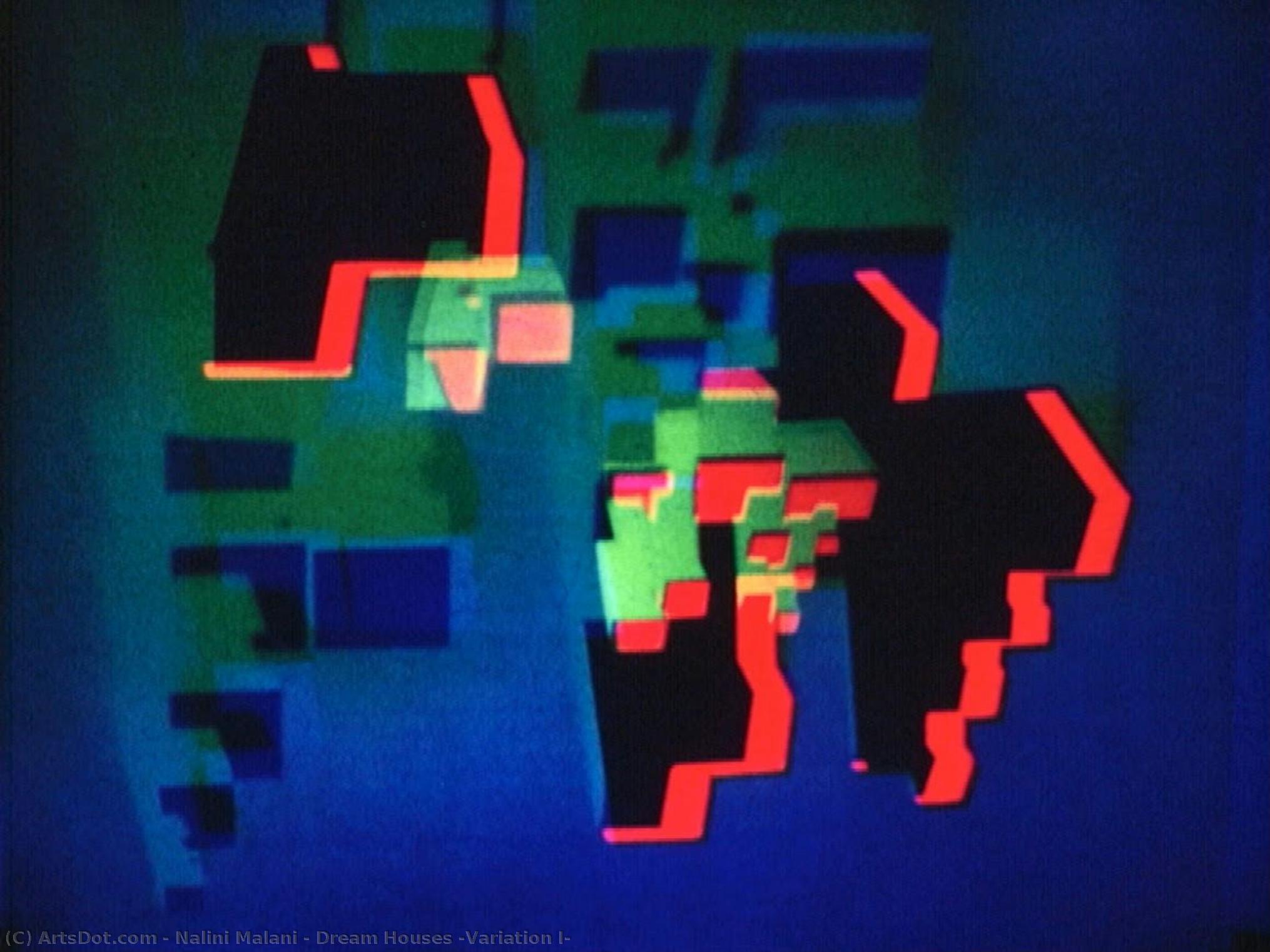
In the evocative realm of Nalini Malani, the boundaries between reality and memory often dissolve into a hauntingly beautiful abstraction. Dream Houses (Variation I), a piece dating from 1969, serves as a profound window into this liminal space. At first glance, the viewer is met with a striking, almost visceral composition: a central figure, rendered with a deep blue tint that suggests both melancholy and nocturnal introspection, emerges against a stark, pulsating red background. The torso of the subject, draped in the dark shadows of a black shirt, acts as an anchor within a sea of chromatic intensity. This digital-style painting—though possessing the soul of traditional expressionism—utilizes a distorted, filtered aesthetic that challenges the eye to find stability amidst the flux of color and form.
The technique employed in this variation creates a sense of layered existence. The cool, cerulean tones washing over the figure contrast sharply with the aggressive warmth of the crimson backdrop, creating a visual tension that is both unsettling and magnetic. This interplay of temperature and light suggests a psychological landscape rather than a physical one. To the collector or interior designer, this piece offers a sophisticated focal point; its abstract qualities allow it to integrate seamlessly into modern, minimalist, or avant-garde spaces, where its bold color palette can serve as a dramatic conversation starter or a meditative centerpiece.
The Weight of History and the Symbolism of Displacement
To truly appreciate the emotional gravity of Malani’s work, one must look toward the historical currents that shaped her hand. Born in Karachi amidst the seismic shifts of the 1947 Partition, Malani’s very identity is a tapestry woven from threads of migration and loss. While Dream Houses (Variation I) presents an abstract silhouette, the underlying themes of the artist's biography—displacement, the search for rootedness, and the fragmentation of the self—permeate the canvas. The "dream" in the title may not merely refer to a nocturnal vision, but to the elusive, often fractured concept of "home" in a world defined by shifting borders and political upheaval.
The distortion within the painting serves as a powerful metaphor for the instability of memory and the fragility of human identity. As the figure appears partially obscured or altered by digital-like filters, we are reminded of how trauma and history can reshape our perception of ourselves. For those seeking to adorn their homes with art that possesses profound intellectual depth, this reproduction offers more than mere decoration; it provides a connection to a narrative of resilience. It is a piece that invites the viewer to contemplate the shadows of the past while finding beauty in the fragmented remains of what we once called home.
Biografie artist
A Life Shaped by Partition: The Early Years and Artistic Awakening
Nalini Malani’s artistic journey is inextricably linked to the tumultuous birth of India and Pakistan in 1947. Born in Karachi, a city that would soon become part of a newly formed nation, her earliest memories are shadowed by the trauma of Partition – the mass displacement, violence, and communal strife that irrevocably altered the lives of millions. This experience wasn’t merely a historical backdrop to her childhood; it was a foundational wound that deeply informed her artistic vision. Her family's subsequent migration to India, first to Kolkata and then to Mumbai, instilled in her a lifelong sensitivity to themes of identity, belonging, and the enduring consequences of political upheaval. The sense of loss, displacement, and the search for rootedness would become recurring motifs throughout her diverse body of work, resonating with audiences across cultures and generations. Even as a young artist, Malani recognized the power of art not just as aesthetic expression but as a means to confront difficult truths and give voice to marginalized narratives.From Painting to Pioneering Video Art
Initially trained as a painter at the Sir Jamsetjee Jeejebhoy School of Art in Mumbai, Nalini quickly realized that traditional mediums couldn’t fully capture the complex realities she sought to portray. In the late 1960s, she boldly embraced video art – a nascent medium offering unprecedented possibilities for storytelling and experimentation. This transition wasn't simply a shift in technique; it represented a fundamental change in her artistic approach. Video allowed her to integrate time, movement, and sound, creating immersive experiences designed to challenge viewers on multiple levels. Her early work, such as “Dream Houses” (1969), created during a workshop led by Akbar Padamsee, is a striking example of this pioneering spirit – a digital abstraction reflecting the anxieties and aspirations of a nation in transition. Malani didn’t abandon painting entirely; instead, she skillfully integrated it into her multimedia installations, often employing reverse painting on glass—a technique learned from Bhupen Khakhar—to create ethereal and haunting images that seemed to float between worlds. This layering of techniques – painting, video, shadow play – became a hallmark of her distinctive visual language.Themes of Feminism, Memory, and Social Justice
Central to Nalini Malani’s artistic practice is a profound commitment to social justice, particularly concerning issues of gender inequality and the plight of marginalized communities. Her work consistently challenges patriarchal structures and gives voice to those silenced by power dynamics. She draws inspiration from diverse sources – mythology, literature, poetry, historical events—weaving together ancient narratives with contemporary concerns. The figures of mythical women like Medea, Cassandra, and Sita frequently appear in her art, reimagined as symbols of resilience and resistance. Memory is another crucial theme, explored through fragmented images, layered projections, and evocative soundscapes. Malani’s installations often create a sense of haunting presence, inviting viewers to confront the ghosts of the past and grapple with their own personal histories. The Partition remains a potent influence, prompting her to examine not only the political consequences of forced migration but also its psychological toll on individuals and communities. Her work is never didactic; instead, it operates through suggestion, ambiguity, and emotional resonance, allowing viewers to arrive at their own interpretations.Shadows, Projections, and a Unique Visual Language
Nalini Malani’s artistic style is remarkably versatile, encompassing painting, drawing, installation, performance, and video art. However, certain techniques consistently reappear throughout her oeuvre, creating a distinctive visual language that is instantly recognizable. The use of shadows is particularly striking – often projected onto architectural surfaces or translucent materials, they create ephemeral and haunting effects, suggesting the presence of hidden histories and unspoken truths. She frequently employs stop-motion animation and erasure animations, manipulating images to reveal underlying layers of meaning. Her innovative approach extends to her digital work, where she draws directly onto tablets with her finger, building intricate compositions that reflect a deeply personal and intuitive process. This tactile engagement with the medium allows her to imbue her art with a sense of immediacy and emotional depth. Her installations are often immersive environments, enveloping viewers in a world of sound, light, and shadow, challenging them to question their perceptions and confront uncomfortable realities.Recognition and Lasting Legacy
Nalini Malani’s contributions to contemporary art have been widely recognized through numerous awards and exhibitions. She was awarded the Padma Shri, one of India's highest civilian honors, in 2014, acknowledging her significant impact on the cultural landscape. She also received the Joan Miró Prize in 2019 and, most recently, the prestigious Kyoto Prize in Arts and Philosophy in 2023—a testament to her enduring influence on artists worldwide. Her work has been exhibited internationally at esteemed institutions such as the Stedelijk Museum Amsterdam, the National Gallery in London, and the Museum of Modern Art in New York. Malani is not merely an artist; she is a cultural historian, a social commentator, and a visionary innovator who continues to push boundaries and challenge conventional artistic norms. Her art serves as a powerful reminder of the importance of memory, empathy, and the ongoing struggle for justice and equality. Platforms like OriginalUniqueArt.com and OriginalUniqueArt.com play a vital role in making her work accessible to a wider audience, ensuring that her message continues to resonate with generations to come.
Nalini Malani
1946 - , Pakistan
Informații rapide
- Artistic Movement Or Style: Video art, Instalare
- Artists Or Movements Influenced By This Artist: ['Artiști indieni contemporani']
- Artists Who Influenced This Artist:
- Akbar Padamsee
- Bhupen Khakhar
- Date Of Birth: 1946
- Full Name: Nalini Malani
- Nationality: Indiană
- Notable Artworks:
- Dream Houses
- The Teller of Tales
- Listening to the Shades
- Place Of Birth: Karachi, Pakistan
Articole conexe

Cele mai importante 10 capodopere ale abstracției geometrice | Artă & Decor de lux pe OriginalUniqueArt.com
Descoperă cele mai importante 10 capodopere ale abstracției geometrice! Explorează istoria, artiștii (Mondrian, Kandinsky) și culorile vibrante care au definit arta modernă. Reproduceri de tablouri de lux pe OriginalUniqueArt.com pentru un decor interior rafinat. Explorează colecția online!

Top 10 Capodopere ale Expresionismului Abstract: Artă, Artiști și Decorațiuni de Lux | OriginalUniqueArt.ro
Descoperă Top 10 capodopere ale Expresionismului Abstract! Explorează poveștile lui Pollock, Rothko și De Kooning. Reproduceri de artă de lux & inspirație decor pe OriginalUniqueArt.ro. Găsește pictura perfectă pentru spațiul tău!

Top 10 Capodopere Albastre: Picturi Celebre și Inspirație pentru Decor
Descoperă top 10 picturi celebre dominate de nuanțe subtile de albastru! Explorează poveștile din spatele capodoperelor Monet, Renoir și Van Gogh. Inspirație decor interior & reproducere tablouri pe OriginalUniqueArt.com

Wassily Kandinsky: Cele Mai Iconice 25 De Opere – Artă Abstractă pentru Decor Rafinat
Descoperă cele mai emblematice 25 de opere ale lui Wassily Kandinsky, pionierul artei abstracte! Explorează culorile vibrante, compozițiile unice și istoria fascinantă din spatele fiecărei picturi. Reproduceri de calitate muzeală pe OriginalUniqueArt.com – inspiră-ți decorul cu artă modernă!

The Allure of Azure: Exploring the Symbolic & Aesthetic Depths of Blue in Art History
Explore the rich history of blue in art! Discover its symbolism, from ancient pigments to modern masterpieces by Kandinsky & Seurat. Uncover the psychological impact and cultural meanings behind this captivating hue.