Comută pe versiunea Print
 Vezi mai mult







































 Pentru opere de artă sau reproduceri care depășesc 105 cm (aproximativ 41 de inch) pe oricare dintre laturi, cadrul va fi livrat demontat, sub formă de kit. Această metodă asigură o livrare sigură și previne deteriorarea în timpul transportului.


Nahshon (detail) by Michelangelo Buonarroti
Michelangelo Buonarroti’s *Nahshon (detail)* stands as an emblem of Renaissance introspection and artistic mastery, nestled within the grandeur of the Cappella Sistina—a testament to papal ambition and humanist ideals. Created in 1511 during a period marked by profound theological debate and artistic innovation, this fresco fragment offers a glimpse into Michelangelo’s unparalleled ability to convey emotion through form and color. It's more than just pigment on plaster; it’s a distillation of philosophical contemplation rendered in breathtaking visual language.The Artistic Genius of Michelangelo Buonarroti
Michelangelo di Lodovico Buonarroti Simoni (1475-1564) was arguably the most influential artist of his era—a sculptor, painter, architect, and poet whose legacy continues to inspire awe centuries later. His formative years were spent honing his skills in Florence’s artistic crucible, absorbing the humanist philosophies championed by Lorenzo Medici and Filippo Brunelleschi. This exposure profoundly shaped his worldview and fueled his unwavering dedication to capturing human emotion with breathtaking realism—a pursuit evident throughout his oeuvre. The *Nahshon* detail exemplifies this commitment, demonstrating Michelangelo's profound understanding of anatomy and drapery, as well as his masterful manipulation of light and shadow. He wasn’t merely replicating what he saw; he was striving to embody the very essence of human experience.The Painting: A Symbol of Introspection
This particular section focuses on the central figure—a woman gazing into a mirror. Her posture exudes quiet contemplation; her gaze directed upwards reflects not merely visual perception but also an inner journey. The mirror itself serves as a potent symbol—representing self-awareness, duality, and perhaps even divine judgment. Michelangelo skillfully renders the woman’s flesh tones with subtle gradations of color, capturing the nuances of light and texture that contribute to the overall impression of solemn dignity. The drapery surrounding her is rendered with meticulous detail, creating folds and creases that convey movement and volume—a hallmark of Michelangelo's sculptural technique translated into fresco painting. It’s a masterful illusion of depth and materiality achieved through painstaking observation and artistic skill.Historical Context
The Cappella Sistina’s commission arose from Pope Julius II’s desire to revitalize the Catholic Church’s prestige following a period of crisis. Michelangelo was tasked with completing the ceiling frescoes, replacing Raphael’s unfinished work—a daunting challenge that demanded both technical brilliance and spiritual conviction. The chapel’s walls are adorned with scenes from Genesis, depicting God creating Adam and Eve, and the subsequent fall from grace—narratives intended to reaffirm Christian dogma and inspire piety. Michelangelo’s approach to these biblical stories was revolutionary; he eschewed traditional iconography in favor of dramatic compositions that prioritized psychological realism over stylized representation. He sought to communicate not just what happened but *how* it felt—a daring ambition for his time.Relevance to Art History
*Nahshon (detail)* embodies several key trends prevalent during the High Renaissance—namely, the revival of classical ideals and the exploration of human emotion. Michelangelo’s meticulous anatomical studies informed his depiction of the female figure, mirroring the humanist fascination with observing and understanding the human body as a microcosm of the universe. Furthermore, the fresco's subdued palette and masterful use of chiaroscuro—the interplay between light and dark—reflect the influence of Leonardo da Vinci’s artistic innovations. The image continues to resonate with viewers today because it speaks to universal themes of identity, reflection, and spiritual contemplation—themes that remain central to Western art history. It’s a testament to Michelangelo's enduring ability to capture the complexities of human consciousness and transform them into timeless beauty.- Nahshon (215 x 430 cm, Cappella Sistina, Vatican City, Italy)
- Rehoboam - Abijah (Cappella Sistina, Vatican City, Italy)
Întrebări și răspunsuri
Ce reprezintă "Nahshon (detail)" de Michelangelo Buonarroti?
Temele prezente în "Nahshon (detail)" de Michelangelo Buonarroti includ renaissance, michelangelo, fresco, religion, biblical, humanism, florence, cappella sistina. Împreună, acestea definesc subiectul întregii opere de artă.
Ce spațiu este recomandat pentru "Nahshon (detail)" de Michelangelo Buonarroti?
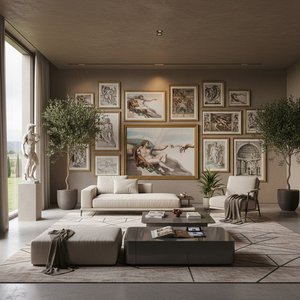
"Nahshon (detail)" de Michelangelo Buonarroti este recomandată pentru o Living Room. Această sugestie se bazează pe subiectul, culorile și atmosfera lucrării.
Ce dimensiune de reproducere se recomandă pentru "Nahshon (detail)" de Michelangelo Buonarroti?
Pentru "Nahshon (detail)", se recomandă o dimensiune de imprimare de Format mare. Sunt disponibile și alte dimensiuni, păstrând aceleași proporții.
Mai multe detalii despre această pictură
 Previzualizare
 Trimite prin felicitare
 Distribuie
 Detalii despre lucrare
 Ghid
Ghid

 Descarcă imaginea
 Produse similare
 Radiografie
 Galerie foto
 Întrebări și răspunsuri
 Statistici