

 Vezi în context
 Trimite
 Distribuie
 Detalii
 Ghidul

 Descarcă
 Produse similare
 Radiografie
 Diaporama
 Statistici
Stadholder Willem V


 Citește mai mult
Reproducere pictată manual în ulei
Pictură în ulei pe pânză, realizată manual de artiștii noștri la dimensiunea și ramele dorite de dumneavoastră, pe comandă. ( Comută pe versiunea Print Treci la imagine digitală)




P118B lei10

P118H lei10

P118W lei10

P438Z lei10

P508JH lei12

P508YH lei12

P805H lei10

P805Z lei10

P919BZ lei10

P919G lei10

P919XJ lei10

P959ZH lei10

P968JZ lei12

W106C lei8

W218G lei10

W218JH lei8

W218Y lei10

W307PJ lei10

W316G lei10

W316PJ lei8

W316Y lei10

W398PJ lei8

W4111J lei10

W500HY lei15

W500JH lei15

W692G lei12

W849H lei8

W940BG lei15

W953PJ lei8




Alegeți dintre dimensiunile noastre prestabilite, care respectă proporțiile originale ale operei de artă.

Introduceți lățimea și înălțimea de care aveți nevoie, pentru a se potrivi ramei sau peretelui dumneavoastră. Această lucrare este pictată manual, așa că pentru o dimensiune cu o formă diferită, artistul poate picta puțin mai mult în jurul imaginii sau poate tăia puțin din margini — dumneavoastră decideți. Vă vom trimite o simulare digitală pentru aprobare înainte de a începe pictarea. Imaginea afișată pe această pagină nu reprezintă rezultatul real — doar simularea este reprezentativă.
După plasarea comenzii, echipa OriginalUniqueArt.com va contacta clientul prin e-mail pentru instrucțiuni și îi va furniza o previzualizare a machetei
Livrare în întreaga lume () în 3-4 săptămâni, în loc de cele 5 săptămâni standard. (24 Octombrie). Fără compromisuri în ceea ce privește calitatea.

Livrare expres gratuită la nivel mondial

Pânză de in premium

Asigurare completă pentru transport

Garanție de rambursare a taxelor vamale

Garanția fidelității culorilor

Politica de retur în 100 de zile (doar pentru defecte)

Garanție de rambursare 100%

Reducere pentru comenzi multiple
 Opțiunea cu sticlă este disponibilă doar pentru dimensiuni de sub 110 cm

Stadholder Willem V
Tip de reproducere
Dimensiune reproducere
-


Preț total
lei 1389
Marie-Anne Collot: Sculptor of Dignity and Patronage
Marie-Anne Collot (Falconet), born in Paris in 1748, stands as a remarkable testament to artistic ambition within the gilded cage of aristocratic patronage. Her life’s trajectory mirrored the broader currents of Enlightenment France – a fervent embrace of neoclassical ideals intertwined with an unwavering devotion to her mentor and friend, Étienne Maurice Falconet. Unlike many female artists of her era confined to domestic roles, Collot carved out a distinguished career as sculptor, achieving international acclaim primarily through her portrait busts commissioned by influential figures like Catherine the Great—a feat itself indicative of the shifting social landscape where artistic merit could transcend gender boundaries. Falconet’s Influence and Early Artistic Development Étienne Maurice Falconet, Collot's teacher and collaborator, exerted a profound influence on her artistic sensibilities. Their partnership began in Jean Baptiste Lemoyne’s workshop, fostering an environment steeped in classical scholarship and challenging the conventions of courtly art. This formative experience instilled in Collot a critical understanding of sculptural technique—particularly the meticulous modeling of marble—and fueled her unwavering commitment to capturing the essence of her subjects with unflinching realism. Falconet's insistence on anatomical accuracy and emotional depth shaped Collot’s artistic vision, establishing her as one of the foremost sculptors of her generation. The Imperial Patronage: Catherine the Great and Artistic Recognition Collot’s fortunes dramatically shifted when she secured the patronage of Catherine II—the Empress of Russia—who recognized her exceptional talent and invited her to St Petersburg in 1766. This prestigious commission propelled Collot into the orbit of Russian aristocratic society, where she honed her skills crafting monumental sculptures celebrating imperial grandeur. Notably, Collot’s contribution to “The Bronze Horseman,” Peter the Great's equestrian statue—creating the head modeled by Falconet—became a symbol of Russia’s ambition and artistic prowess during Catherine’s reign. The Empress’s discerning eye ensured Collot’s work received widespread acclaim and cemented her reputation as a sculptor capable of elevating public art to unparalleled heights. A Legacy Etched in Marble: Collot's Notable Works Collot’s oeuvre encompasses an impressive array of marble busts—each imbued with meticulous detail and conveying profound psychological insight. Among her most celebrated creations are portraits of Falconet himself, Catherine the Great, Henry IV of France, and numerous members of the Russian court. These sculptures exemplify Collot’s mastery of neoclassical style—characterized by idealized forms rendered in polished marble—and demonstrate her ability to capture not merely physical likeness but also inner character. Her enduring legacy resides in her contribution to artistic history and her embodiment of a woman artist achieving success within a restrictive societal framework, securing her place as an icon of Enlightenment creativity.- Notable Works: Falconet Bust (State Hermitage Museum), Catherine the Great Bust (State Hermitage Museum)
Întrebări și răspunsuri
Unde pot găsi statistici despre "Stadholder Willem V" de Marie-Anne Collot?
Pagina Statistici pentru "Stadholder Willem V" de Marie-Anne Collot prezintă statistici privind vizitele publice: numărul de vizite lunare ale acestei opere, o comparație cu cele mai vizionate lucrări ale artistului și proveniența vizitatorilor.
Unde și în ce scop este recomandată piesa „Stadholder Willem V”?
Utilizarea (Accent de culoare) și spațiul (Living Room) sunt cele două recomandări menționate pentru "Stadholder Willem V" de Marie-Anne Collot.
Ce origine națională stă la baza Neoclassical Portraiture-ului din "Stadholder Willem V"?
Opera de Neoclassical Portraiture „Stadholder Willem V” a fost creată de un artist născut în France.
Biografie artist
A Sculptor of Grace and Precision
In the vibrant artistic landscape of 18th-century France, Marie-Anne Collot emerged as a rare and formidable talent, carving her name into the annals of history through the delicate medium of sculpture. Born in Paris, her journey into the world of fine art began not behind a desk, but before the canvas and clay, serving as a model at the age of fifteen within the esteemed workshop of Jean-Baptiste II Lemoyne. This early immersion in the tactile realities of form and anatomy provided a foundational influence that would later define her career as a master portraitist. Her path was further shaped by her profound connection to Etienne Falconet, serving as both his pupil and daughter-in-law, a relationship that placed her at the very heart of the era's most influential intellectual and creative circles.
The artistry of Collot was characterized by an extraordinary precociousness. Even in her earliest endeavors, such as the terracotta busts produced in Paris during the mid-1760s, she displayed a level of skill that suggested a deep, intuitive understanding of human character. Her work was not merely about capturing physical likeness but about translating the essence of her subjects into three-dimensional form. This talent allowed her to move seamlessly within the prestigious circles of the Enlightenment, finding favor among luminaries such as Diderot and even the imperial court of Russia.
From Paris to the Imperial Court
The trajectory of Collot’s career took a monumental turn when she accompanied Falconet to St. Petersburg. This period in Russia proved to be one of her most significant eras, as she worked amidst the grandeur of the Russian Court during the era of Catherine the Great. It was here that her reputation for excellence was solidified on an international stage. One of her most remarkable achievements involved the creation of the plaster model for the head of Peter the Great, a task undertaken after several attempts by Falconet himself had been rejected by the Empress. Such a feat speaks to a level of technical mastery and an ability to capture the commanding presence required for imperial iconography.
Her recognition was not limited to mere skill; it was formally institutionalized through her election to the Imperial Academy of Arts. By becoming an Academician, she achieved a distinction held by very few women of her time, marking her as a pioneer in a male-dominated discipline. Her presence in Russia allowed her to sculpt the portraits of various members of the Russian Court, earning the marvel of those who witnessed her ability to breathe life into clay and stone. Through these works, Collot bridged the gap between the intimate portrait bust and the monumental demands of imperial legacy.
Legacy of a Portraitist
Though much of her early work has been lost to the passage of time, the historical significance of Marie-Anne Collot remains anchored in her role as a bridge between the Rococo elegance of her mentors and the burgeoning classical sensibilities of the late 18th century. Her life was a testament to the power of mentorship and the breaking of gender barriers within the fine arts. As a sculptor who navigated the complex social and political landscapes of both France and Russia, she left an indelible mark on the art of portraiture.
Her contributions can be summarized through several key facets of her life:
- Artistic Lineage: Trained under the influential Jean-Baptiste II Lemoyne and Etienne Falconet.
- Technical Mastery: Renowned for her exquisite terracotta busts and her pivotal role in the modeling of imperial monuments.
- Historical Distinction: Achieved the prestigious status of Academician at the Imperial Academy of Arts.
- Cultural Connection: A central figure in the artistic dialogues involving Diderot and the Russian Imperial Court.

Marie-Anne Collot
1745 - 1814 , France
Informații rapide
- Artistic Movement Or Style: Portrait sculptor
- Artists Who Influenced This Artist:
- Jean-Baptiste II Lemoyne
- Etienne Falconet
- Full Name: Marie-Anne Collot
- Nationality: French
- Notable Artworks:
- Terracotta busts of Diderot
- Plaster model for Peter the Great's head
- Place Of Birth: Paris, France
- Date Of Birth: 1745
- Date Of Death: 1814
Articole conexe

Christopher Williams: Deconstructing Representation & Materiality in Contemporary Art
Explore the groundbreaking work of Christopher Williams, a pivotal figure in contemporary art. This analysis delves into his deconstruction of representation, materiality, and institutional critique – essential reading for serious collectors.

Penry Williams: Evoking Welsh Nostalgia Through Impressionistic Landscapes
Explore the captivating world of Penry Williams (1802-1885), a Welsh artist renowned for his evocative Impressionistic landscapes and scenes of Italy. Discover his life, style & legacy with OriginalUniqueArt.

Mary Vaux Walcott: Botanical Precision & Artistic Vision in American Conservation
Discover the exquisite botanical watercolors of Mary Vaux Walcott, celebrated as the 'Audubon of Botany.' Explore her life, art, and lasting impact on American conservation through detailed illustrations & Smithsonian contributions.

Sir William Blake Richmond: A Visionary of Aestheticism & Symbolism
Explore the life & art of Sir William Blake Richmond, a pivotal figure bridging Pre-Raphaelitism and Aestheticism. Discover his stunning portraits, mosaics at St Paul's Cathedral, and lasting influence on Victorian art.
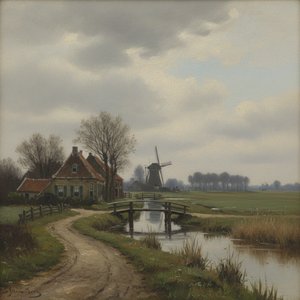
Jacob Henricus Maris: A Master of Dutch Atmospheric Realism & the Intimate Landscape
Explore the captivating world of Jacob Henricus Maris, a leading figure of the Dutch Hague School. Discover his atmospheric landscapes, signature brushstrokes & lasting influence on 19th-century art. Learn more at OriginalUniqueArt.
