
 Previzualizare
 Trimite prin felicitare
 Distribuie
 Detalii despre lucrare
 Ghid
Ghid

 Descarcă imaginea
 Produse similare
 Radiografie
 Galerie foto
 Q&A
Q&A Statistici
Man's Head, Self Portrait


 Vezi mai mult
Lucrarea de artă afișată pe această pagină este protejată de legile privind drepturile de autor, ceea ce înseamnă că nu putem crea sau vinde în mod legal o reproducere identică. Această protecție este garantată prin acorduri internaționale, precum Convenția de la Berna și de legile naționale, inclusiv cele prevăzute de Legea dreptului de autor din S.U.A. – Titlul 17. Toate drepturile rezervate. Orice reproducere neautorizată este interzisă.
Această metodă respectă pe deplin reglementările privind drepturile de autor, deoarece nu implică copierea sau duplicarea operei protejate. În schimb, este o reinterpretare creativă – o pictură nouă, influențată de original, dar care nu este identică cu acesta.
Giclée / Imprimare artistică
Printuri giclée sau pe canvas de calitate muzeală, cu proces de producție rapid și opțiuni flexibile de finisare. ( Comandă pictură realizată manual Comută pe Imagine Digitală)




P118B lei10

P118H lei10

P118W lei10

P438Z lei10

P508JH lei12

P508YH lei12

P805H lei10

P805Z lei10

P919BZ lei10

P919G lei10

P919XJ lei10

P959ZH lei10

P968JZ lei12

W106C lei8

W218G lei10

W218JH lei8

W218Y lei10

W307PJ lei10

W316G lei10

W316PJ lei8

W316Y lei10

W398PJ lei8

W4111J lei10

W500HY lei15

W500JH lei15

W692G lei12

W849H lei8

W940BG lei15

W953PJ lei8




Alegeți dintre dimensiunile noastre prestabilite, care respectă proporțiile originale ale operei de artă.

Introduceți lățimea și înălțimea necesare pentru a se potrivi ramei sau peretelui dumneavoastră. O printare poate fi doar tăiată, niciodată extinsă dincolo de dimensiunea imaginii originale, astfel încât o dimensiune cu o formă diferită va pierde o parte din imagine. Vă trimitem o simulare digitală pentru aprobare înainte de a imprima orice. Imaginea afișată pe această pagină nu prezintă tăierea reală — doar simularea arată acest lucru.
Livrare în întreaga lume () în 2 săptămâni, în loc de cele 4/5 săptămâni standard. (31 Octombrie)

Livrare expres gratuită la nivel mondial

Pânză de in de înaltă calitate

Asigurare completă pentru transport

Garanție de rambursare a taxelor vamale

Garanția fidelității culorilor

Politica de retur în 100 de zile (doar pentru defecte de fabricație)

Garanție de rambursare 100%

Ofertă pentru comenzi multiple
 Opțiunea cu sticlă este disponibilă doar pentru dimensiuni de sub 110 cm

Man's Head, Self Portrait
Giclée / Imprimare artistică
Dimensiune reproducere
-


Preț total calculat
lei 379
Man's Head, Self Portrait: A Deep Dive into Lucian Freud’s Expressionism
The Man's Head, Self Portrait by Lucian Freud, created in 1963, is a captivating piece of art that embodies the essence of Expressionism. This oil on canvas painting is a remarkable example of Freud's unique style and thematic exploration. As a prominent figure in British figurative art, Freud's work continues to fascinate audiences with its intense emotional depth.
Artistic Style and Influences
Freud’s Man's Head, Self Portrait showcases his mastery of Expressionism, a movement that emphasizes the subjective experience and emotional intensity. The painting's bold brushstrokes and vivid colors create a sense of tension and introspection, drawing the viewer into the artist’s inner world. Freud's work was influenced by various artistic movements, including Cubism and Modernism.
Technique and Composition
The artwork is a close-up oil painting portrait of a man in profile, rendered with thick impasto brushstrokes. It depicts a contemplative and slightly melancholic expression on the subject’s face. The composition focuses intensely on the figure's head and upper torso, creating an intimate and engaging view. The lighting is dramatic, highlighting the contours of his face and emphasizing shadows that add depth and volume. Perspective is shallow, typical of portraiture, drawing attention to the subject. Depth is created through variations in tone and texture rather than traditional linear perspective. The technique is primarily oil paint applied in thick layers (impasto), creating a tactile surface.
Historical Context and Symbolism
Created during a period of significant personal and artistic evolution for Freud, this self-portrait reflects his move away from earlier Surrealist influences towards a more direct and unflinching portrayal of the human condition. The raw honesty in depicting himself, without idealization, was revolutionary at the time. The somber expression and intense gaze suggest introspection and perhaps a sense of vulnerability. It is believed that Freud's family history, particularly his connection to Sigmund Freud, influenced his exploration of psychological themes within his art.
Emotional Impact and Legacy
Man’s Head, Self Portrait evokes a powerful emotional response in the viewer. The painting’s intensity and honesty create a sense of intimacy and vulnerability. It is considered one of Freud's most important works, solidifying his reputation as a master portraitist who fearlessly explored the complexities of human emotion. The Man’s Head, Self Portrait by Lucian Freud is a powerful example of the artist's ability to capture the human experience with honesty and intensity.
- Man's Head, Self Portrait, 1963 - Lucian Freud - WikiArt.org
- Man’s Head (Self Portrait III) 1963 - Art UK
Întrebări și răspunsuri
Unde ar trebui expusă o reproducere a "Man's Head, Self Portrait" de Lucian Freud?
Cu formatul său Square, o reproducere a operei „Man's Head, Self Portrait” este recomandată pentru un Living Room.
Ce dimensiune de reproducere se recomandă pentru "Man's Head, Self Portrait" de Lucian Freud?
Dimensiunea de imprimare recomandată pentru "Man's Head, Self Portrait" de Lucian Freud este Medium.
Cât de cunoscută este opera „Man's Head, Self Portrait” de Lucian Freud?
"Man's Head, Self Portrait" de Lucian Freud are un nivel de popularitate Recognized. Această clasificare reflectă cât de larg este recunoscută lucrarea.
Biografie artist
Lucian Freud - A Life Forged in Realism
Lucian Michael Freud, born December 8, 1922, Berlin (then part of the Weimar Republic), carried a lineage steeped in intellectual weight—the grandson of the pioneering psychoanalyst Sigmund Freud. Yet, young Lucian’s path diverged from exploring the subconscious through theory, instead finding expression through the intensely physical act of painting. The looming shadow of Nazism forced his family to flee Germany in 1933, settling in London, a relocation that profoundly shaped both his life and the often somber, unsettling tone defining his artistic vision. His early education was fragmented, marked by expulsion from Bryanston School, but formative instruction at Cedric Morris’s East Anglian School of Painting and Drawing proved pivotal. There, an emphasis on direct observation took root, becoming a cornerstone of his evolving style—a deliberate departure from the growing abstraction embraced by many contemporaries. This grounding in meticulous study of the visible world set him apart, establishing a unique artistic identity.- Early Life and Family
- Education
- The Surrealist Echoes
- Developing Realism
- Legacy and Influence
Early Life and Family
Lucian Freud was the son of Ernst L. Freud, an architect who emigrated to Berlin in 1933 to escape racial persecution, and Lucie Brasch, his mother—a German Jewish woman. The family’s experience during the Nazi era instilled a deep sense of urgency and shaped Freud's worldview. He attended Dartington Hall School from 1933-36, followed by Bryanston School (an independent public school in Devon) where he was expelled due to disruptive behaviour. Despite this setback, his artistic inclinations were nurtured at Cedric Morris’s East Anglian School of Painting and Drawing, fostering a lifelong fascination with observation and materiality. Freud's formative years instilled a profound appreciation for the tangible world—a perspective that would permeate his entire oeuvre.Education
Freud pursued formal artistic training at Central School of Arts and Crafts in London and East Anglian School of Painting and Drawing, where he honed his skills under Cedric Morris’s guidance. He was particularly drawn to the influence of Impressionism and Post-Impressionism, absorbing techniques that would later inform his distinctive style. His exposure to these movements broadened his artistic horizons and solidified his commitment to capturing fleeting moments of beauty—a characteristic that distinguishes him from many other artists of his time.The Surrealist Echoes
Freud’s early artistic explorations encompassed Surrealism and Expressionism, blending dreamlike imagery with emotional intensity. Influenced by artists such as Giorgio De Chirico and Hans Arp, he experimented with unconventional compositions and symbolic representations—reflecting the anxieties of the interwar period. However, these influences gradually yielded to a more disciplined approach, prioritizing meticulous detail and psychological depth.Developing Realism
By the early 1950s, Freud established his signature style: thickly impastoed paint, muted backgrounds amplifying flesh tones, and an almost brutal honesty in depicting the human form. He eschewed idealization or flattery, seeking instead to capture raw physicality, vulnerability, and psychological weight. This uncompromising vision—characterized by a profound respect for the materiality of paint—became his hallmark and distinguished him from many contemporaries who favored abstraction.Legacy and Influence
Lucian Freud’s 60-year career left an indelible mark on British portraiture, challenging conventional notions of beauty and representation. He wasn't interested in capturing social status or outward appearances; he sought to reveal something deeper, more primal—the essence of being human in all its complexity and imperfection. His influence extends beyond painting, inspiring artists across disciplines with his uncompromising vision and technical mastery. Freud’s work remains a powerful reminder of the enduring power of figurative art to confront us with ourselves. He was a key member of the “School of London,” a group of figurative painters working in London during a period dominated by abstract expressionism, united by their commitment to direct observation and emotional honesty. His paintings are held in major museums globally—the Tate in London, the Freud Museum London, and Goldsmiths’ College, University of London—enduring testaments to his artistic genius.
Lucian Freud
1922 - 2011 , Germania
Detalii rapide
- Artistic Movement Or Style: Școala Londoneză
- Artists Or Movements Influenced By This Artist: ['Francis Bacon']
- Artists Who Influenced This Artist:
- Sigmund Freud
- Hans Arp
- Joan Miró
- Giorgio De Chirico
- Date Of Birth: 8 decembrie 1922
- Full Name: Lucian Michael Freud
- Nationality: Britanic
- Notable Artworks:
- Camera pictorului
- Beneficii Supervisor Sleeping
- Place Of Birth: Berlin, Germania
Articole similare
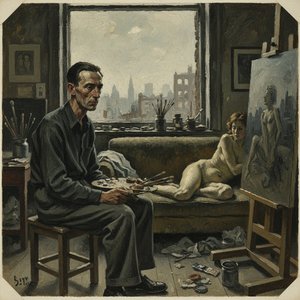
Lucian Freud: A Psychological Portraiture of Post-War Existence
Explore the profound psychological depth of Lucian Freud's portraits. Discover his unique realism, artistic evolution, and lasting influence on modern art. A collector’s guide to a master.

Oil on Canvas: A Historical & Technical Exploration of a Timeless Artistic Medium
Explore the rich history & enduring techniques of oil painting on canvas. Discover the science behind its longevity, conservation practices, and contemporary relevance. Expert insights for art enthusiasts.

The Enduring Legacy of Oil on Canvas: Technique, History & Aesthetic Impact
Explore the rich history & techniques of oil painting – from Renaissance masters to Impressionism. Discover pigments, layering methods, and why this timeless medium endures. Expert insights for artists & art enthusiasts.
Reflecting the Self: A History of Portraiture & Psychological Insight
Explore the fascinating history of self-portraiture from Renaissance masters like Dürer & Rembrandt to modern interpretations. Discover the psychological insights and artistic techniques behind these iconic works. Expert analysis for art enthusiasts.

The Echo of Self: Reflectivity as a Core Theme in Art History & Contemporary Practice
Explore the rich history of self-representation in art, from Renaissance masters to modern innovators. Discover how artists use portraiture to reveal identity, emotion & the depths of the human psyche. Expert insights for collectors.

