Text size

() ·

A painting made for you, by hand

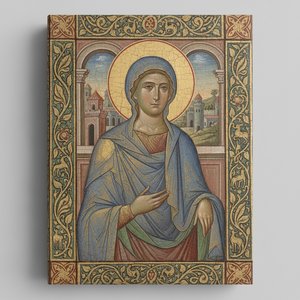
The Visitation

Reproducere pictată manual în ulei

Pictură în ulei pe pânză, pictată manual de artiștii noștri la dimensiunea și ramele dorite de dumneavoastră, pe comandă. ( Comută pe versiunea Print Comută pe Imagine Digitală)

Descriere obiect de colecție

Lorenzo Monaco’s "The Visitation" (1405) is a stunning Early Renaissance tempera panel. Explore Byzantine influences, opulent gold & vibrant colors depicting divine grace. A masterpiece of piety and spiritual encounter.

Biografie artist

Descoperă Lorenzo Monaco (1370-1425), pictor florentin care unește eleganța gotică și începuturile Renașterii italienești! Explorează operele sale spirituale, manuscrise iluminate și stilul său unic.

from ·

Chapter 1

How large should it be?

Slide to change the size; the picture on the left shows the frame at its real width. The proportions of the original are kept.

Standard
personalizat
CM
INCH

Alegeți dintre dimensiunile noastre prestabilite, care respectă proporțiile originale ale operei de artă.

lățime
înălțime

Introduceți lățimea și înălțimea necesare pentru a se potrivi ramei sau peretelui dumneavoastră. Această lucrare este pictată manual, așa că, pentru o dimensiune cu o formă diferită, artistul poate picta puțin mai mult în jurul imaginii sau poate tăia puțin din margini — dumneavoastră decideți. Vă vom trimite o simulare digitală pentru aprobare înainte de a începe pictarea. Imaginea afișată pe această pagină nu reprezintă rezultatul real — doar simularea este reprezentativă.

Chapter 2

How should it arrive?

Choose the edges of the stretched canvas

Choose your frame

Corner sample of the WhiteWrap canvas edge finish, stretched on lemn masiv bars
White lei1
Corner sample of the BlurSideWrap canvas edge finish, stretched on lemn masiv bars
Blurside lei1
Corner sample of the ExtendedWrap canvas edge finish, stretched on lemn masiv bars
Extended lei1
Corner sample of the P118B picture frame: polistiren turnat, 5 cm wide and 3 cm thick
P118B lei10
Corner sample of the P118H picture frame: polistiren turnat, 5 cm wide and 3 cm thick
P118H lei10
Corner sample of the P118W picture frame: polistiren turnat, 5 cm wide and 3 cm thick
P118W lei10
Corner sample of the P438Z picture frame: polistiren turnat, 5.5 cm wide and 3.5 cm thick
P438Z lei10
Corner sample of the P508JH picture frame: polistiren turnat, 7 cm wide and 3.5 cm thick
P508JH lei12
Corner sample of the P508YH picture frame: polistiren turnat, 7 cm wide and 3.5 cm thick
P508YH lei12
Corner sample of the P805H picture frame: polistiren turnat, 5 cm wide and 3.5 cm thick
P805H lei10
Corner sample of the P805Z picture frame: polistiren turnat, 5 cm wide and 3.5 cm thick
P805Z lei10
Corner sample of the P919BZ picture frame: polistiren turnat, 7 cm wide and 3.5 cm thick
P919BZ lei10
Corner sample of the P919G picture frame: polistiren turnat, 7 cm wide and 3.5 cm thick
P919G lei10
Corner sample of the P919XJ picture frame: polistiren turnat, 7 cm wide and 3.5 cm thick
P919XJ lei10
Corner sample of the P959ZH picture frame: polistiren turnat, 5 cm wide and 3 cm thick
P959ZH lei10
Corner sample of the P968JZ picture frame: polistiren turnat, 6 cm wide and 4 cm thick
P968JZ lei12
Corner sample of the W106C picture frame: lemn masiv, 5 cm wide and 3 cm thick
W106C lei8
Corner sample of the W218G picture frame: lemn masiv, 5 cm wide and 3 cm thick
W218G lei10
Corner sample of the W218JH picture frame: lemn masiv, 5 cm wide and 3 cm thick
W218JH lei8
Corner sample of the W218Y picture frame: lemn masiv, 5 cm wide and 3 cm thick
W218Y lei10
Corner sample of the W307PJ picture frame: lemn masiv, 6 cm wide and 3 cm thick
W307PJ lei10
Corner sample of the W316G picture frame: lemn masiv, 6 cm wide and 3 cm thick
W316G lei10
Corner sample of the W316PJ picture frame: lemn masiv, 6 cm wide and 3 cm thick
W316PJ lei8
Corner sample of the W316Y picture frame: lemn masiv, 6 cm wide and 3 cm thick
W316Y lei10
Corner sample of the W398PJ picture frame: lemn masiv, 5 cm wide and 3 cm thick
W398PJ lei8
Corner sample of the W4111J picture frame: lemn masiv, 6.5 cm wide and 3.5 cm thick
W4111J lei10
Corner sample of the W500HY picture frame: lemn masiv, 7 cm wide and 5 cm thick
W500HY lei15
Corner sample of the W500JH picture frame: lemn masiv, 7 cm wide and 5 cm thick
W500JH lei15
Corner sample of the W692G picture frame: lemn masiv, 8 cm wide and 4 cm thick
W692G lei12
Corner sample of the W849H picture frame: lemn masiv, 5 cm wide and 3 cm thick
W849H lei8
Corner sample of the W940BG picture frame: lemn masiv, 7.5 cm wide and 4.5 cm thick
W940BG lei15
Corner sample of the W953PJ picture frame: lemn masiv, 6 cm wide and 3.5 cm thick
W953PJ lei8
Corner sample of the H24-GOLD picture frame: lemn sculptat cu gesso, 10 cm wide and 6 cm thick
H24-GOLD lei30
Corner sample of the H24-SILVER picture frame: lemn sculptat cu gesso, 10 cm wide and 6 cm thick
H24-SILVER lei30
Corner sample of the H36-GOLD picture frame: lemn sculptat cu gesso, 15 cm wide and 6.5 cm thick
H36-GOLD lei45
Corner sample of the H36-SILVER picture frame: lemn sculptat cu gesso, 15 cm wide and 6.5 cm thick
H36-SILVER lei45

Moulding: . Overall size with the frame: .

Chapter 3

Who paints it, and should anything change?

Examples of what can be changed: Replace face with customer photo; Add pet (e.g., replace cat with dog); Include hidden message in background; Change background landscape or elements.
After order, OriginalUniqueArt.com team will email client for instructions and provide a mockup preview

Livrare în întreaga lume () în 3-4 săptămâni, în loc de cele 5 săptămâni standard. (2 Noiembrie). Fără compromisuri în ceea ce privește calitatea.

Chapter 4

The finishing touches

A nameplate, as in a museum?

Detalii plăcuță din bronz gravat

This elegant plaque features the artist's name and the title of the artwork, finely engraved for a timeless presentation.

It is made from bronze with a refined, elegant finish. The text is precisely laser-engraved for a sharp and permanent result. Measuring 9x2 cm, the plaque is compact yet easy to read. It's built to be durable and scratch-resistant, offering a professional, museum-quality look. Mounting is simple thanks to the included adhesive backing.

Detalii plăcuță din acril transparent

The plaque includes essential engraved details such as the artist's name, the title of the artwork, the date it was created, the type of media used-like oil on canvas or watercolor-a brief description of the piece, and a QR code that links to the complete artwork information.

It is crafted from clear acrylic, offering a sleek, modern appearance. The text is UV-engraved in black to ensure strong visual contrast. With a size of 10x15 cm, it ensures optimal readability. It comes equipped with two metal hooks for secure wall mounting. The plaque is designed to be weather-resistant, making it suitable for various environments, and it includes interactive features that work seamlessly with smartphone scanning.

Detalii placă din acril negru

This elegant plaque includes engraved information such as the artist's name, the title of the artwork, the date it was created, the type of media used (like oil on canvas or watercolor), a short description of the artwork, and a QR code for quick access to more information.

The plaque itself is made from refined black acrylic with a premium finish. The text is laser-engraved in white for high contrast and readability. Its size is 10x15 cm, designed to be easy to read. It comes with two metal hooks for professional mounting. The design is sleek and fits any interior style. It is also weather-resistant and durable, with built-in digital integration for mobile compatibility.

A protective varnish?

When do you need it?

Chapter 5

Your painting, as you ordered it

The Visitation

Tehnică de reproducere

Dimensiune reproducere

-

Selecție de artiști de elită

Mai multe detalii, rafinament și timp suplimentar de execuție

-

Ramă pentru reproducere artistică

-

-

Pentru opere de artă sau reproduceri care depășesc 105 cm (aproximativ 41 de inch) pe oricare dintre laturi, cadrul va fi livrat demontat, sub formă de kit. Această metodă asigură o livrare sigură și previne deteriorarea în timpul transportului.

Este necesară asamblarea profesională – acest produs nu este de tip DIY (de făcut singur).
Kitul trebuie asamblat, iar pânza întinsă, de către un legător de cadre experimentat, utilizând adeziv pentru lemn (neinclus în colet), o cheie pentru întinderea pânzei și cleme pentru a menține barele la unghi drept în timp ce adezivul se usucă. Asamblarea incorectă sau tensiunea neuniformă a pânzei pot deteriora permanent opera de artă și nu sunt acoperite de garanția noastră.

  • Toate barele din lemn masiv sunt incluse, tăiate cu precizie la dimensiunea necesară.

  • Asamblat cu șuruburile incluse, plus adeziv pentru lemn pentru îmbinările de colț, care nu este furnizat și trebuie achiziționat de către tâmplarul dumneavoastră.

  • Sunt necesare unelte profesionale care nu sunt incluse: o șipte de întindere a pânzei (tensionator) și cleme pentru a menține barele la unghi drept în timp ce adezivul se usucă.

Important:
Îmbinările de colț necesită adeziv pentru lemn, barele trebuie fixate cu clești de strângere până când adezivul este complet uscat, iar întinderea pânzei pe cadrul asamblat necesită un clește pentru întins pânza. Niciunul dintre aceste elemente nu este inclus în kit. Vă rugăm să consultați un încadrator profesionist cu experiență înainte de a comanda această dimensiune.

Etichetă de prezentare

-

-

Lac de protecție

Lac lucios (intensifică nuanțele și oferă protecție împotriva luminii și a umidității)

-

Personalizează opera mea de artă

Exemple de elemente ce pot fi personalizate: Înlocuirea feței cu fotografia clientului; Adăugarea unui animal de companie (de exemplu, înlocuirea unei pisici cu un câine); Includerea unui mesaj ascuns în fundal; Modificarea peisajului sau a elementelor din fundal.

-

Livrare rapidă

Livrare la nivel mondial () în 3-4 săptămâni, în loc de cele 5 săptămâni standard. (2 Noiembrie). Fără compromisuri când vine vorba de calitate.

-

Livrare rapidă

Livrare la nivel mondial () în 5 săptămâni. (9 Noiembrie).

Inclus

Preț total calculat

lei 1426

Preț total lei 1426

Opțiunea cu sticlă este disponibilă doar pentru dimensiuni de sub 110 cm

Included with every order

  • Livrare expres gratuită la nivel mondial
  • Pânză de in de înaltă calitate
  • Asigurare completă pentru transport
  • Garanție de rambursare a taxelor vamale
  • Garanția fidelității culorilor
  • Politica de retur în 100 de zile (doar pentru defecte de fabricație)
  • Garanție de rambursare 100%
  • Ofertă pentru comenzi multiple

The Visitation: A Florentine Monk’s Vision of Divine Grace

Lorenzo Monaco's "The Visitation," painted around 1405-1410, is more than just a religious depiction; it’s a poignant meditation on faith, family, and the profound mystery at the heart of Christian belief. Created during a pivotal transition in Florentine art – bridging the late Gothic with the nascent Renaissance – this tempera panel offers a glimpse into the deeply spiritual world of Lorenzo Monaco, a Camaldolese monk who profoundly shaped his artistic practice through his contemplative life.

The painting immediately draws the eye to its central composition: Mary Magdalene, rendered in a strikingly sober palette of muted blues and browns, stands before Elizabeth, her face radiating serenity. The scene depicts the iconic moment when Mary visits her cousin Elizabeth, bearing news of the miraculous conception of John the Baptist – an event that foreshadows the birth of Christ. Monaco masterfully captures the quiet intimacy of this encounter, eschewing dramatic gestures in favor of a subtle exchange of glances and a gentle offering of fruit, symbolizing both nourishment and divine grace.

A Byzantine Echo with Renaissance Nuances

Monaco’s style is a fascinating blend of influences. While firmly rooted in the late Gothic tradition – particularly evident in the flattened perspective, elongated figures, and rich use of gold leaf – he subtly incorporates elements that anticipate the burgeoning Renaissance. The composition, though not fully embracing linear perspective, demonstrates a greater attention to spatial relationships than typical of his predecessors. The drapery, while still stylized, possesses a newfound fluidity and naturalism, hinting at the realism that would soon dominate Florentine painting.

The panel’s execution is equally noteworthy. Monaco employed tempera on wood, a technique known for its luminous colors and durability. The layering of pigments – particularly the meticulous application of gold leaf to the architectural elements and the Virgin's garments – creates an astonishing sense of depth and texture. Notice the delicate brushstrokes that define the folds of fabric and the subtle gradations of light and shadow, contributing to a remarkably lifelike portrayal of the figures.

Symbolism Woven into Sacred Narrative

Beyond its immediate depiction, “The Visitation” is rich in symbolic meaning. The fruit offered by Mary represents both earthly sustenance and divine grace – a tangible reminder of God’s provision. The setting, though vaguely reminiscent of a domestic interior, feels more like a sacred space, imbued with an atmosphere of reverence and contemplation. The dark background, almost black in its intensity, serves to heighten the luminosity of the figures and emphasize their spiritual significance.

Furthermore, the painting’s connection to the story of John the Baptist is crucial. The Visitation foreshadows the coming of Christ, highlighting the role of Mary as a key figure in salvation history. Monaco's careful attention to detail—from the Virgin’s modest attire to Elizabeth’s serene expression—underscores the profound humility and grace associated with this pivotal moment.

A Legacy of Spiritual Intensity

Lorenzo Monaco’s “The Visitation” stands as a testament to his unique artistic vision. It's a work that transcends mere representation, offering instead a deeply felt meditation on faith, family, and the mysteries of divine grace. His ability to synthesize Byzantine influences with emerging Renaissance sensibilities resulted in a style characterized by both solemnity and emotional intensity – a legacy that continues to resonate with viewers today. Reproductions of this powerful image offer a window into the soul of a Florentine monk and his profound understanding of the sacred narrative.

Întrebări și răspunsuri

Cum se încadrează stilul operei „The Visitation” în contextul epocii creatorului său?

În "The Visitation" de Lorenzo Monaco, mișcarea Early Renaissance întâlnește epoca Renașterea.

Ce spațiu se potrivește cu nuanțele din "The Visitation" de Lorenzo Monaco?

Paleta de culori Dark din "The Visitation" de Lorenzo Monaco se armonizează perfect cu spațiul recomandat: un Living Room.

În ce perioadă a carierei lui Lorenzo Monaco se încadrează "The Visitation"?

„The Visitation” aparține perioadei Early Renaissance din cariera lui Lorenzo Monaco. Această clasificare corelează opera cu evoluția artistului.

More about this painting

Previzualizare Previzualizare AR Comută pe versiunea Print Comută pe Imagine Digitală Trimite prin felicitare
Detalii despre lucrare Ghid Adaugă la favorite Descarcă imaginea Produse similare Radiografie Galerie foto Q&A Statistici

In numbers

  • 1405the year it was painted
  • 29frames to choose from
  • standard sizes, in its own proportions
  • 5weeks to paint and deliver it
Lorenzo Monaco

Lorenzo Monaco

1370 - 1425, Italia

Quick facts about Lorenzo Monaco

  • Artistic Movement Or Style: Gótico internacional
  • Artists Or Movements Influenced By This Artist: ['Fra Angelico']
  • Artists Who Influenced This Artist:
    • Giotto
    • Spinello Aretino
    • Agnolo Gaddi
  • Date Of Birth: c. 1370
  • Date Of Death: c. 1425
  • Full Name: Lorenzo Monaco
  • Nationality: Italiano
  • Notable Artworks:
    • Pietà
    • Coronación de la Virgen
    • Adoración de los Magos
  • Place Of Birth: Siena, Italia

Biografie artist

A Florentine Monk’s Vision: The World of Lorenzo Monaco

Lorenzo Monaco, born Piero di Giovanni around 1370 in Siena, occupies a fascinating and pivotal position in the transition from the Gothic grace of the Trecento to the burgeoning Renaissance ideals of the Quattrocento. Though biographical details remain scarce, his artistic journey reveals a compelling story of adaptation, innovation, and deeply felt spirituality. Apprenticed in Florence, he absorbed the lessons of masters like Giotto, Spinello Aretino, and Agnolo Gaddi – artists who established a foundation of narrative clarity and emotional resonance. However, it was his embrace of monastic life in 1390, joining the Camaldolese order at Santa Maria degli Angeli, that truly shaped both his artistic identity and earned him the name by which he is best known: Lorenzo Monaco, or “Lawrence the Monk.” This commitment to a contemplative existence profoundly influenced the character of his work, imbuing it with an introspective quality and a focus on devotional themes.

Early Influences and Gothic Elegance

Lorenzo Monaco’s formative years were steeped in the artistic traditions of Siena and Florence—a crucible where Gothic sensibilities mingled with nascent Renaissance impulses. His training under Giotto, Spinello Aretino, and Agnolo Gaddi instilled within him a profound understanding of narrative storytelling and emotional expression – techniques that would characterize his entire oeuvre. These masters championed clarity of form and psychological depth, prioritizing the conveyance of spiritual truth over mere visual spectacle. Monaco’s early paintings demonstrate this influence vividly; they are marked by refined elegance, delicate linearism, and a palette initially restrained in its chromatic range. The International Gothic style prevailed throughout Europe during this period, shaping Monaco's aesthetic sensibilities and informing his compositional choices. He skillfully incorporated elements of Ghiberti’s sculptural innovations and Starnina’s meticulous attention to detail, absorbing the stylistic refinements that signaled the waning days of the Trecento.

The Camaldolese Order and Artistic Transformation

Joining the Camaldolese order in 1390 proved to be a transformative experience for Monaco—a decision that irrevocably altered his artistic trajectory and cemented his reputation as “Lawrence the Monk.” This monastic vocation instilled within him a deep reverence for faith and contemplation, shaping not only his spiritual life but also the very essence of his art. Unlike many artists of his time who pursued worldly ambitions, Monaco dedicated himself to prayer and scholarship, prioritizing intellectual pursuits alongside artistic creation. The contemplative atmosphere of Santa Maria degli Angeli fostered an inner harmony that permeated his paintings—a subtle yet unmistakable resonance of monastic spirituality. This influence is particularly evident in his later works, where he eschewed flamboyant ornamentation for understated elegance and prioritized symbolic representation over literal depiction.

Stylistic Evolution: From Gothic to Quattrocento

Over time, Monaco’s artistic style underwent a gradual metamorphosis—reflecting the broader shifts occurring within Florentine art during the Quattrocento. While retaining the foundational principles of Gothic elegance—namely, elongated figures draped in sinuous garments and delicate linearism—he subtly incorporated elements that foreshadowed the Renaissance aesthetic. He embraced sharper edges and brilliant colors – particularly the luxurious hues of gold and lapis lazuli – a stylistic hallmark of the burgeoning Renaissance movement. Furthermore, Monaco’s use of light became increasingly sophisticated, capturing ethereal effects that conveyed spiritual illumination rather than merely illuminating form. His gestures are often understated, hinting at inner emotion rather than overtly displaying it—a characteristic that distinguishes him from many of his contemporaries who sought to impress viewers with grand spectacle. This stylistic evolution represents a crucial step in the artistic continuum, bridging the gap between Gothic tradition and Renaissance innovation.

Legacy: A Singular Voice Amidst Change

Lorenzo Monaco stands apart as one of the last significant exponents of Giotto’s style—preserving its legacy while simultaneously integrating elements that anticipate the transformative innovations championed by Masaccio and Filippo Brunelleschi in perspective and naturalism. He demonstrated that artistic excellence could flourish within established conventions, enriching them with individual expression and spiritual depth. Unlike many artists of his time who prioritized technical virtuosity above all else, Monaco consistently sought to convey profound theological narratives with clarity and grace—a testament to his unwavering commitment to faith and artistry. Giorgio Vasari recognized Monaco’s talent while acknowledging his untimely death from an unidentified infection around 1425—leaving behind a legacy that continues to inspire admiration for its refined elegance and spiritual resonance. His paintings remain invaluable windows into a pivotal moment in art history—a time of transition, experimentation, and the enduring power of faith expressed through artistic vision.

Informații rapide

  • Location: Courtauld Institute, London
  • Title: The Visitation
  • Year: 1405-1410
  • Influences:
    • Giotto
    • Siena
  • Artistic style: International Gothic
  • Dimensions: 21 x 34 cm

Test de cunoștințe despre artă

Fiecare întrebare are un singur răspuns corect.

Întrebare 1:
What artistic movement is most closely associated with Lorenzo Monaco’s style, as evidenced by ‘The Visitation’?
Întrebare 2:
The painting 'The Visitation' primarily depicts which religious event?
Întrebare 3:
What technique is most prominently used in ‘The Visitation’?
Întrebare 4:
According to the description, what is a notable characteristic of Lorenzo Monaco’s use of color in this painting?
Întrebare 5:
What does the description suggest about the spatial perspective in ‘The Visitation’?