
 Previzualizare
 Trimite prin felicitare
 Distribuie
 Detalii despre lucrare
 Ghid
Ghid

 Descarcă imaginea
 Produse similare
 Radiografie
 Galerie foto
 Q&A
Q&A Statistici
Suprematist Drawing 3


 Vezi mai mult
Giclée / Imprimare artistică
Printuri giclée sau pe canvas de calitate muzeală, cu proces de producție rapid și opțiuni flexibile de finisare. ( Comandă pictură realizată manual Comută pe Imagine Digitală)




P118B lei10

P118H lei10

P118W lei10

P438Z lei10

P508JH lei12

P508YH lei12

P805H lei10

P805Z lei10

P919BZ lei10

P919G lei10

P919XJ lei10

P959ZH lei10

P968JZ lei12

W106C lei8

W218G lei10

W218JH lei8

W218Y lei10

W307PJ lei10

W316G lei10

W316PJ lei8

W316Y lei10

W398PJ lei8

W4111J lei10

W500HY lei15

W500JH lei15

W692G lei12

W849H lei8

W940BG lei15

W953PJ lei8




Alegeți dintre dimensiunile noastre prestabilite, care respectă proporțiile originale ale operei de artă.

Introduceți lățimea și înălțimea necesare pentru a se potrivi ramei sau peretelui dumneavoastră. O printare poate fi doar tăiată, niciodată extinsă dincolo de dimensiunea imaginii originale, astfel încât o dimensiune cu o formă diferită va pierde o parte din imagine. Vă trimitem o simulare digitală pentru aprobare înainte de a imprima orice. Imaginea afișată pe această pagină nu prezintă tăierea reală — doar simularea arată acest lucru.
Livrare în întreaga lume () în 2 săptămâni, în loc de cele 4/5 săptămâni standard. (2 Noiembrie)

Livrare expres gratuită la nivel mondial

Pânză de in de înaltă calitate

Asigurare completă pentru transport

Garanție de rambursare a taxelor vamale

Garanția fidelității culorilor

Politica de retur în 100 de zile (doar pentru defecte de fabricație)

Garanție de rambursare 100%

Ofertă pentru comenzi multiple
 Opțiunea cu sticlă este disponibilă doar pentru dimensiuni de sub 110 cm

Suprematist Drawing 3
Giclée / Imprimare artistică
Dimensiune reproducere
-


Preț total calculat
lei 380
A Glimpse into the Birth of Abstraction
Kazimir Malevich’s Suprematist Drawing 3 is not merely a work on paper; it's a foundational document in the history of abstract art, a visual manifesto declaring the liberation of feeling from the constraints of representation. Executed with charcoal, this piece pulsates with an energy that belies its monochrome palette, offering viewers a direct connection to what Malevich termed “pure feeling.” The drawing serves as a crucial stepping stone in his artistic journey, revealing the nascent stages of Suprematism – a revolutionary movement born from a desire to strip art down to its most essential elements.
Deconstructing Form and Space
The composition is a dynamic interplay of geometric forms rendered in stark black and white. A dominant, cross-like structure anchors the drawing, formed by intersecting lines that possess both deliberate precision and an almost improvisational quality. Scattered around this central motif are rectangles and additional linear elements, hinting at preliminary sketches or annotations – glimpses into the creative process itself. What is immediately striking is Malevich’s rejection of traditional perspective; he intentionally flattens the picture plane, emphasizing the two-dimensionality of the artwork. This deliberate flattening isn't a technical limitation but rather a philosophical statement, forcing the viewer to engage with the shapes themselves, divorced from any illusionistic space or representational context. The result is an immediacy that draws you into the work, demanding contemplation not of *what* is depicted, but of *how* it feels.
The Suprematist Revolution
To truly understand Suprematist Drawing 3, one must consider its historical context. Malevich’s artistic evolution was a radical departure from the prevailing styles of his time. After experimenting with Impressionism, Cubism and other movements, he arrived at Suprematism around 1915, amidst the turmoil of World War I and the Russian Revolution. He believed that art should no longer attempt to mimic nature but instead express the “supremacy of pure feeling” through fundamental geometric forms – squares, circles, lines, and rectangles. These shapes weren’t intended as symbols in the traditional sense; they were vehicles for spiritual expression, conduits to a higher realm of aesthetic experience. This drawing is a pivotal example of this transitional period, showcasing the development of his ideas before their full realization in iconic works like Black Square. It's a testament to an artist pushing boundaries and challenging conventional notions of what art could be.
Technique, Texture, and Emotional Resonance
The choice of charcoal is significant. It lends the work a tactile quality, a sense of immediacy and rawness that complements the revolutionary nature of its subject matter. The textured paper surface and varying densities of tone created by the charcoal contribute to the drawing’s depth and visual interest. This isn't about precise rendering; it’s about the expressive potential of the medium itself. The seemingly chaotic arrangement is, in fact, carefully considered – each line and shape contributing to a harmonious (though unconventional) balance. While rejecting traditional symbolism, Malevich imbued his Suprematist works with a new kind of meaning. The stark contrast between black and white can be interpreted as representing duality—the interplay of opposing forces, or perhaps the tension between the material and the spiritual. Suprematist Drawing 3 invites contemplation on these themes, resonating with an emotional power that transcends its abstract form.
Întrebări și răspunsuri
În ce etapă a evoluției lui Kazimir Malevici se încadrează „Suprematist Drawing 3”?
În cariera lui Kazimir Malevici, „Suprematist Drawing 3” aparține perioadei Early Suprematism. Această etapă facilitează compararea sa cu celelalte opere ale artistului.
Ce nivel de contrast prezintă "Suprematist Drawing 3" de Kazimir Malevici?
Nivelul de contrast al operei "Suprematist Drawing 3" de Kazimir Malevici este Contrast accentuat.
Ce subiecte sunt reprezentate în "Suprematist Drawing 3" de Kazimir Malevici?
Subiectele din "Suprematist Drawing 3" sunt geometric forms, black and white, abstract composition, pure feeling, early abstraction, kazimir malevich, russian art.
Biografie artist
Kazimir Malevich: A Pioneer of Abstract Art
Kazimir Severinovich Malevich (1878-1935) stands as a monumental figure in Russian art history, recognized globally for establishing Suprematism – an avant-garde movement that fundamentally reshaped the visual landscape of the 20th century. His unwavering conviction in the primacy of pure feeling and geometric abstraction continues to inspire artists today, cementing his legacy as one of the most influential innovators of modernism.Early Life and Influences
Born near Kyiv Oblast, Ukraine, Kazimir Malevich’s formative years were deeply rooted in the traditions of rural Ukrainian culture. His upbringing instilled within him a profound appreciation for folk art—particularly vibrant embroidered textiles and stylized depictions of peasant life—which would subtly permeate his artistic vision throughout his career. The stark contrast between the tranquil landscapes of his childhood and the burgeoning dynamism of urban centers fueled his desire to explore new expressive possibilities. Formal training commenced in Kyiv, where he honed his drawing skills before embarking on a journey toward broader artistic horizons, culminating in studies at Moscow’s prestigious Stroganov School of Art. This formative period exposed him to influential artists like Ivan Rerberg, who championed Impressionistic techniques and encouraged Malevich to embrace experimentation.Artistic Development & Key Movements
Malevich's artistic trajectory began with explorations of Impressionism and Symbolism, mirroring the prevailing stylistic currents of his time. However, a pivotal encounter with Fernand Léger’s Cubist innovations in Paris during 1912 irrevocably altered his artistic course. Léger’s embrace of geometric abstraction—particularly the simplification of forms into spheres, cylinders, and cones—provided Malevich with a crucial conceptual framework for dismantling traditional representational conventions. Recognizing the transformative potential of this approach, he swiftly transitioned toward Cubism, absorbing its principles while simultaneously forging his own distinctive style. This decisive shift culminated in the birth of Suprematism around 1915 – an audacious movement predicated on the assertion that art should transcend objective depiction and prioritize “the supremacy of pure feeling.” Malevich articulated this revolutionary philosophy in his seminal manifesto, “From Cubism to Suprematism,” declaring that painting’s true essence resided not in mirroring reality but in expressing fundamental geometric forms—squares, circles, and rectangles—stripped bare of any extraneous ornamentation.Major Achievements & Notable Works
Malevich's artistic output is characterized by a remarkable consistency in its core aesthetic principles – unwavering dedication to abstraction and the exploration of pure geometric forms. Among his most iconic creations are *Black Square* (1915) and *White on White* (1918), works that represent watershed moments in the history of art. *Black Square*, arguably Malevich’s most celebrated masterpiece, embodies Suprematism's radical rejection of illusionism and its insistence on confronting viewers with a stark visual experience devoid of recognizable imagery. Its monumental scale and uncompromising simplicity serve as a testament to Malevich’s conviction that art could achieve profound spiritual significance through the reduction of form to its purest essence. Similarly, *White on White* – consisting of a square canvas painted entirely white—represents an equally daring experiment in minimalist aesthetics. By eliminating color and texture altogether, Malevich sought to distill painting down to its fundamental components, challenging conventional notions of beauty and prompting viewers to contemplate the relationship between perception and representation. Furthermore, his involvement in the Vitebsk Practical Art School under Anatoly Lunacharsky’s patronage fostered a collaborative environment where he championed Suprematism alongside fellow artists like Vladimir Tatlin and Aleksandr Exter—establishing Vitebsk as a crucible for avant-garde innovation.Historical Significance & Legacy
Kazimir Malevich's artistic legacy extends far beyond the confines of his own lifetime, profoundly influencing subsequent generations of artists and shaping the trajectory of modern art movements. His uncompromising commitment to abstraction served as an inspiration for Minimalism and Constructivism—movements that championed simplicity and geometric rigor in response to the excesses of Expressionism and Surrealism. Malevich’s theoretical pronouncements on art – particularly his assertion that painting should liberate itself from representational constraints—continue to resonate with artists grappling with questions of artistic expression and cultural identity. Despite facing political persecution under Stalin's regime—a period marked by censorship and suppression—Malevich persevered in his artistic practice and teaching, safeguarding the enduring significance of Suprematism as a beacon of creative freedom. His unwavering belief in the transformative power of art cemented his place as one of the most influential figures in 20th-century visual culture, ensuring that Kazimir Malevich’s pioneering vision would endure for decades to come.
Kazimir Malevici
1878 - 1935 , Ucraina
Detalii rapide
- Artistic Movement Or Style: Suprematism, Art abstractă
- Artists Or Movements Influenced By This Artist:
- Minimalism
- Constructivism
- El Lissitzky
- Artists Who Influenced This Artist:
- Cubism
- Fauvizm
- Impresionism
- Date Of Birth: 1878
- Date Of Death: 1935
- Full Name: Kazimir Severinovich Malevich
- Nationality: Ucrainean/Rus
- Notable Artworks:
- Ciucea Neagră
- Alb pe Alb
- Casă în construcție
- Place Of Birth: Kiev, Ucraina
Articole similare
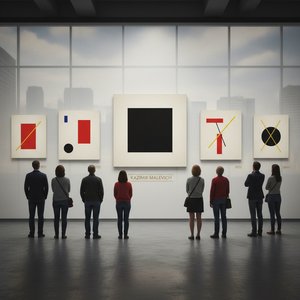
Kazimir Malevich: Pioneering Suprematism & the Quest for Non-Objective Art
Explore the revolutionary art of Kazimir Malevich & his groundbreaking Suprematism movement. Discover the origins, core principles, and lasting impact of this pivotal force in modern abstract painting.

Suprematism Explained: The Radical Geometry and Pure Feeling of Kazimir Malevich
Explore the radical world of Suprematism. Discover how Kazimir Malevich revolutionized modern art through pure geometric abstraction, non-objective form, and the supremacy of feeling. An essential guide for art students and collectors seeking deep historical context.

Cele mai importante 10 capodopere ale abstracției geometrice | Artă & Decor de lux pe OriginalUniqueArt.com
Descoperă cele mai importante 10 capodopere ale abstracției geometrice! Explorează istoria, artiștii (Mondrian, Kandinsky) și culorile vibrante care au definit arta modernă. Reproduceri de tablouri de lux pe OriginalUniqueArt.com pentru un decor interior rafinat. Explorează colecția online!

Beyond Form & Color: Geometric Abstraction's Evolution in 20th/21st Century Art
Explore the evolution of geometric abstraction from Cubism to contemporary art. Discover key artists like Malevich & Mondrian, investment insights, and expert collecting advice at OriginalUniqueArt.

Kazimir Malevich: Cele Mai Iconice 25 De Opere – Artă Abstractă pentru Decor Rafinat
Descoperă cele mai importante 25 de opere ale lui Kazimir Malevich, pionierul Suprematismului! Explorează istoria picturilor abstracte iconice precum 'Black Square' și 'White on White'. Găsește reproduceri artă de calitate muzeală pentru un decor rafinat pe OriginalUniqueArt.com.


