

 Vezi în context
 Trimite
 Distribuie
 Detalii
 Ghidul

 Descarcă
 Produse similare
 Radiografie
 Diaporama
 Statistici
Sin Titulo


 Citește mai mult
Giclée / Imprimare artistică
Printuri giclée sau pe canvas de calitate muzeală, cu proces de producție rapid și opțiuni flexibile de finisare. ( Comandă pictură realizată manual Treci la imagine digitală)




P118B lei10

P118H lei10

P118W lei10

P438Z lei10

P508JH lei12

P508YH lei12

P805H lei10

P805Z lei10

P919BZ lei10

P919G lei10

P919XJ lei10

P959ZH lei10

P968JZ lei12

W106C lei8

W218G lei10

W218JH lei8

W218Y lei10

W307PJ lei10

W316G lei10

W316PJ lei8

W316Y lei10

W398PJ lei8

W4111J lei10

W500HY lei15

W500JH lei15

W692G lei12

W849H lei8

W940BG lei15

W953PJ lei8




Alegeți dintre dimensiunile noastre prestabilite, care respectă proporțiile originale ale operei de artă.

Introduceți lățimea și înălțimea de care aveți nevoie, pentru a se potrivi ramei sau peretelui dumneavoastră. O printare poate fi doar tăiată, niciodată extinsă dincolo de dimensiunea imaginii originale, astfel încât o dimensiune cu o formă diferită va pierde o parte din imagine. Vă trimitem o simulare digitală pentru aprobare înainte de a imprima orice. Imaginea afișată pe această pagină nu prezintă tăierea reală — doar simularea arată acest lucru.
Livrare în întreaga lume () în 2 săptămâni, în loc de cele 4/5 săptămâni standard. (23 Octombrie)

Livrare expres gratuită la nivel mondial

Pânză de in premium

Asigurare completă pentru transport

Garanție de rambursare a taxelor vamale

Garanția fidelității culorilor

Politica de retur în 100 de zile (doar pentru defecte)

Garanție de rambursare 100%

Reducere pentru comenzi multiple
 Opțiunea cu sticlă este disponibilă doar pentru dimensiuni de sub 110 cm

Sin Titulo
Giclée / Imprimare artistică
Dimensiune reproducere
-


Preț total
lei 370
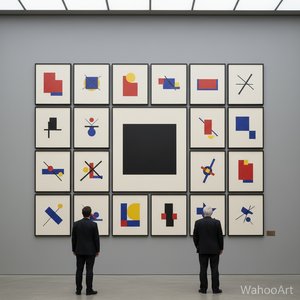
Sin titulo: Un Monumento al Sentimiento – Explorando la Obra Maestral Suprematista de Kazimir Malevich
Este impresionante lienzo de Kazimir Malevich, conocido como ‘Sin título’ (Untitled), constituye un ejemplo excepcional de su estilo suprematista revolucionario. Surgiendo en los primeros años del siglo XX, el Suprematismo buscó liberar el arte de representar el mundo visible, enfocándose en *el sentimiento puro* y la forma geométrica. Esta obra encarna esa ambición con una claridad sorprendente – una declaración audaz de abstracción que sigue resonando hoy en día. El lienzo presenta una dinámica interacción entre formas geométricas contra un fondo blanco impecable, creando una experiencia visual que es tanto austera como profundamente conmovedora. Deconstruyendo Forma y Color: Una Filosofía Radical ‘Sin título’ abandona por completo las convenciones tradicionales de temática artística. No hay figuras humanas, paisajes ni objetos reconocibles – solo los elementos esenciales de forma y color. Malevich emplea magistralmente una paleta limitada de colores primarios – rojo, azul, amarillo, negro y verde – junto con el blanco dominante. Estos tonos no se utilizan descriptivamente; más bien, funcionan como entidades independientes que interactúan entre sí para generar tensión y armonía. La composición se basa en líneas rectas y rectángulos superpuestos, creando una sensación de profundidad no mediante perspectiva sino por relaciones espaciales. El despliegue de formas invita al ojo a vagar, descubriendo nuevas conexiones visuales dentro del aparentemente sencillo arreglo. La técnica parece sencilla – pinceladas amplias o áreas planas de color aplicadas directamente sobre el lienzo – pero logra una precisión y claridad notables. Esta elección estética refleja la filosofía fundamental del Suprematismo: rechazar cualquier referencia al mundo natural en favor de una expresión basada únicamente en principios geométricos básicos. El Contexto Histórico y la Revolución Artística: Nacimiento de un Nuevo Lenguaje Visual Kazimir Malevich (1879-1935) fue una figura clave en el movimiento vanguardista ruso. Su viaje artístico comenzó con exploraciones del impresionismo, simbolismo y cubismo antes de culminar en la radical simplicidad del Suprematismo alrededor de 1915. Este cambio no fue simplemente estilístico; representó una ruptura filosófica con siglos de representación figurativa que buscaban trascender las limitaciones del pasado. Influenciado por el pensamiento ruso de principios del siglo XX, Malevich abrazó la idea de que el arte debía liberarse de cualquier vínculo con la naturaleza y buscar nuevos caminos expresivos. Este movimiento artístico fue impulsado por una profunda inquietud intelectual y una necesidad de renovación estética, reflejada en obras como ‘Black Square’ (Cuadrado Negro), considerada un punto de inflexión en la historia del arte moderno ruso. La obra fue creada durante el período tumultuoso de la Primera Guerra Mundial y la revolución rusa, marcando el nacimiento de una nueva sensibilidad artística que desafió las normas establecidas hasta entonces. Malevich buscó inspiración en artistas como Piet Mondrian y Oskar Kokoschka, cuyas obras también exploraban temas similares de abstracción y espiritualidad. El Significado Simbólico: Más Allá de la Forma – Una Exploración del Sentimiento Humano Más allá de su apariencia geométrica aparentemente fría y objetiva, ‘Sin título’ posee una carga simbólica profunda que invita a la reflexión sobre cuestiones fundamentales relacionadas con la condición humana. El uso del blanco como fondo representa la pureza espiritual y la búsqueda de lo esencial, mientras que las formas geométricas – especialmente los rectángulos – simbolizan orden, estabilidad y racionalidad. Estas figuras evocan ideas asociadas con el pensamiento occidental moderno, como la geometría euclidiana y la filosofía cartesiana. La composición en sí misma puede interpretarse como una representación del universo abstracto, donde todas las leyes físicas desaparecen para dejar paso a principios más elevados de armonía y equilibrio. El artista buscó transmitir emociones profundas mediante un lenguaje visual reducido al mínimo esencial, desafiando así las convenciones tradicionales de expresión artística. Esta obra sigue siendo relevante hoy en día porque nos recuerda que el arte puede ofrecer una vía hacia la comprensión del mundo interior humano y hacia la búsqueda de significado trascendental.Întrebări și răspunsuri
Ce configurare de imprimare este recomandată pentru "Sin Titulo" de Kazimir Malevici?
Dimensiunea Mare, orientarea Pătrat: aceasta este configurația de imprimare sugerată pentru "Sin Titulo" de Kazimir Malevici.
Ce atmosferă aduce "Sin Titulo" de Kazimir Malevici într-un interior?
Atmosfera Minimalist a operei "Sin Titulo" de Kazimir Malevici se potrivește perfect spațiului recomandat: un Living Room.
Pentru ce utilizare este recomandată "Sin Titulo" de Kazimir Malevici?
Utilizarea sugerată pentru "Sin Titulo" de Kazimir Malevici este Piesa de rezistență. Poate servi și alte scopuri.
Biografie artist
Kazimir Malevich: A Pioneer of Abstract Art
Kazimir Severinovich Malevich (1878-1935) stands as a monumental figure in Russian art history, recognized globally for establishing Suprematism – an avant-garde movement that fundamentally reshaped the visual landscape of the 20th century. His unwavering conviction in the primacy of pure feeling and geometric abstraction continues to inspire artists today, cementing his legacy as one of the most influential innovators of modernism.Early Life and Influences
Born near Kyiv Oblast, Ukraine, Kazimir Malevich’s formative years were deeply rooted in the traditions of rural Ukrainian culture. His upbringing instilled within him a profound appreciation for folk art—particularly vibrant embroidered textiles and stylized depictions of peasant life—which would subtly permeate his artistic vision throughout his career. The stark contrast between the tranquil landscapes of his childhood and the burgeoning dynamism of urban centers fueled his desire to explore new expressive possibilities. Formal training commenced in Kyiv, where he honed his drawing skills before embarking on a journey toward broader artistic horizons, culminating in studies at Moscow’s prestigious Stroganov School of Art. This formative period exposed him to influential artists like Ivan Rerberg, who championed Impressionistic techniques and encouraged Malevich to embrace experimentation.Artistic Development & Key Movements
Malevich's artistic trajectory began with explorations of Impressionism and Symbolism, mirroring the prevailing stylistic currents of his time. However, a pivotal encounter with Fernand Léger’s Cubist innovations in Paris during 1912 irrevocably altered his artistic course. Léger’s embrace of geometric abstraction—particularly the simplification of forms into spheres, cylinders, and cones—provided Malevich with a crucial conceptual framework for dismantling traditional representational conventions. Recognizing the transformative potential of this approach, he swiftly transitioned toward Cubism, absorbing its principles while simultaneously forging his own distinctive style. This decisive shift culminated in the birth of Suprematism around 1915 – an audacious movement predicated on the assertion that art should transcend objective depiction and prioritize “the supremacy of pure feeling.” Malevich articulated this revolutionary philosophy in his seminal manifesto, “From Cubism to Suprematism,” declaring that painting’s true essence resided not in mirroring reality but in expressing fundamental geometric forms—squares, circles, and rectangles—stripped bare of any extraneous ornamentation.Major Achievements & Notable Works
Malevich's artistic output is characterized by a remarkable consistency in its core aesthetic principles – unwavering dedication to abstraction and the exploration of pure geometric forms. Among his most iconic creations are *Black Square* (1915) and *White on White* (1918), works that represent watershed moments in the history of art. *Black Square*, arguably Malevich’s most celebrated masterpiece, embodies Suprematism's radical rejection of illusionism and its insistence on confronting viewers with a stark visual experience devoid of recognizable imagery. Its monumental scale and uncompromising simplicity serve as a testament to Malevich’s conviction that art could achieve profound spiritual significance through the reduction of form to its purest essence. Similarly, *White on White* – consisting of a square canvas painted entirely white—represents an equally daring experiment in minimalist aesthetics. By eliminating color and texture altogether, Malevich sought to distill painting down to its fundamental components, challenging conventional notions of beauty and prompting viewers to contemplate the relationship between perception and representation. Furthermore, his involvement in the Vitebsk Practical Art School under Anatoly Lunacharsky’s patronage fostered a collaborative environment where he championed Suprematism alongside fellow artists like Vladimir Tatlin and Aleksandr Exter—establishing Vitebsk as a crucible for avant-garde innovation.Historical Significance & Legacy
Kazimir Malevich's artistic legacy extends far beyond the confines of his own lifetime, profoundly influencing subsequent generations of artists and shaping the trajectory of modern art movements. His uncompromising commitment to abstraction served as an inspiration for Minimalism and Constructivism—movements that championed simplicity and geometric rigor in response to the excesses of Expressionism and Surrealism. Malevich’s theoretical pronouncements on art – particularly his assertion that painting should liberate itself from representational constraints—continue to resonate with artists grappling with questions of artistic expression and cultural identity. Despite facing political persecution under Stalin's regime—a period marked by censorship and suppression—Malevich persevered in his artistic practice and teaching, safeguarding the enduring significance of Suprematism as a beacon of creative freedom. His unwavering belief in the transformative power of art cemented his place as one of the most influential figures in 20th-century visual culture, ensuring that Kazimir Malevich’s pioneering vision would endure for decades to come.
Kazimir Malevici
1878 - 1935 , Ucraina
Informații rapide
- Artistic Movement Or Style: Suprematism, Art abstractă
- Artists Or Movements Influenced By This Artist:
- Minimalism
- Constructivism
- El Lissitzky
- Artists Who Influenced This Artist:
- Cubism
- Fauvizm
- Impresionism
- Date Of Birth: 1878
- Date Of Death: 1935
- Full Name: Kazimir Severinovich Malevich
- Nationality: Ucrainean/Rus
- Notable Artworks:
- Ciucea Neagră
- Alb pe Alb
- Casă în construcție
- Place Of Birth: Kiev, Ucraina
Articole conexe

Top 10 Capodopere Alb-Negru: Frumusețe Atemporală în Artă | OriginalUniqueArt.ro
Descoperă top 10 picturi celebre dominate de alb, de la Monet la Kandinsky! Explorează istoria artei, tehnicile artistice și frumusețea atemporală a capodoperelor clasice. Reproduceri de calitate muzeală pe OriginalUniqueArt.com – inspiră-ți decorul!

Beyond Form & Color: Geometric Abstraction's Evolution in 20th/21st Century Art
Explore the evolution of geometric abstraction from Cubism to contemporary art. Discover key artists like Malevich & Mondrian, investment insights, and expert collecting advice at OriginalUniqueArt.

Cele mai importante 10 capodopere ale abstracției geometrice | Artă & Decor de lux pe OriginalUniqueArt.com
Descoperă cele mai importante 10 capodopere ale abstracției geometrice! Explorează istoria, artiștii (Mondrian, Kandinsky) și culorile vibrante care au definit arta modernă. Reproduceri de tablouri de lux pe OriginalUniqueArt.com pentru un decor interior rafinat. Explorează colecția online!
Kazimir Malevich: Cele Mai Iconice 25 De Opere – Artă Abstractă pentru Decor Rafinat
Descoperă cele mai importante 25 de opere ale lui Kazimir Malevich, pionierul Suprematismului! Explorează istoria picturilor abstracte iconice precum 'Black Square' și 'White on White'. Găsește reproduceri artă de calitate muzeală pentru un decor rafinat pe OriginalUniqueArt.com.

Suprematism Explained: The Radical Geometry and Pure Feeling of Kazimir Malevich
Explore the radical world of Suprematism. Discover how Kazimir Malevich revolutionized modern art through pure geometric abstraction, non-objective form, and the supremacy of feeling. An essential guide for art students and collectors seeking deep historical context.


