
 Previzualizare
 Trimite prin felicitare
 Distribuie
 Detalii despre lucrare
 Ghid
Ghid

 Descarcă imaginea
 Produse similare
 Radiografie
 Galerie foto
 Întrebări și răspunsuri
 Statistici
Demon


 Vezi mai mult
Giclée / Imprimare artistică
Printuri giclée sau pe canvas de calitate muzeală, cu proces de producție rapid și opțiuni flexibile de finisare. ( Comandă pictură realizată manual Comută pe Imagine Digitală)




P118B lei10

P118H lei10

P118W lei10

P438Z lei10

P508JH lei12

P508YH lei12

P805H lei10

P805Z lei10

P919BZ lei10

P919G lei10

P919XJ lei10

P959ZH lei10

P968JZ lei12

W106C lei8

W218G lei10

W218JH lei8

W218Y lei10

W307PJ lei10

W316G lei10

W316PJ lei8

W316Y lei10

W398PJ lei8

W4111J lei10

W500HY lei15

W500JH lei15

W692G lei12

W849H lei8

W940BG lei15

W953PJ lei8




Alegeți dintre dimensiunile noastre prestabilite, care respectă proporțiile originale ale operei de artă.

Introduceți lățimea și înălțimea necesare pentru a se potrivi ramei sau peretelui dumneavoastră. O printare poate fi doar tăiată, niciodată extinsă dincolo de dimensiunea imaginii originale, astfel încât o dimensiune cu o formă diferită va pierde o parte din imagine. Vă trimitem o simulare digitală pentru aprobare înainte de a imprima orice. Imaginea afișată pe această pagină nu prezintă tăierea reală — doar simularea arată acest lucru.
Livrare în întreaga lume () în 2 săptămâni, în loc de cele 4/5 săptămâni standard. (5 Noiembrie)

Livrare expres gratuită la nivel mondial

Pânză de in de înaltă calitate

Asigurare completă pentru transport

Garanție de rambursare a taxelor vamale

Garanția fidelității culorilor

Politica de retur în 100 de zile (doar pentru defecte de fabricație)

Garanție de rambursare 100%

Ofertă pentru comenzi multiple
 Opțiunea cu sticlă este disponibilă doar pentru dimensiuni de sub 110 cm

Demon
Giclée / Imprimare artistică
Dimensiune reproducere
-


Preț total calculat
lei 387
A Stark Vision of the Unseen: Kazimir Malevich's 'Demon'
Kazimir Malevich’s 1914 painting, “Demon,” is not merely a depiction of a monstrous figure; it’s a visceral exploration of primal fear and the unsettling power of suggestion. Rendered in a deceptively simple style—bold black outlines against a bleached-white backdrop—the artwork immediately commands attention with its raw intensity. This isn't the polished, idealized representation of art history; instead, we encounter a world stripped bare to its essential elements, echoing the nascent principles of Suprematism and hinting at the anxieties simmering beneath the surface of early 20th-century Europe.
The composition is dominated by the central demon itself. Its elongated form, with disproportionately large head, pointed ears, and a gaping mouth, evokes a sense of grotesque power. Malevich’s deliberate use of thick black lines doesn't simply define the figure; they pulsate with energy, creating an immediate and unsettling visual impact. The simplification of features—the vacant eyes, the sharp angles—heightens the feeling of otherworldliness, as if we are glimpsing a being from beyond our comprehension. Crucially, the painting’s stark palette – primarily black and off-white – amplifies this effect, creating an atmosphere of profound isolation and dread.
The Language of Symbols: Cyrillic Text and Spiritual Weight
What initially appears as a minimalist composition is profoundly enriched by the dense field of Cyrillic text that dominates the right side of the canvas. This isn’t mere decoration; it's integral to understanding the artwork’s meaning. While the exact translation remains debated, scholars believe this incantation or narrative likely served as a key to unlocking the demon’s nature and purpose within Malevich’s artistic vision. The inclusion of text adds layers of mystery, suggesting a connection between the visual image and a deeper spiritual or occult context – reflecting the prevalent interest in mysticism and the supernatural during that period.
The choice of Cyrillic script is particularly significant given Malevich's Ukrainian heritage and the painting’s creation during a time of shifting national identities. It subtly connects the artwork to Eastern European folklore and traditions, hinting at ancient beliefs surrounding demons and spirits. The text acts as a conduit, inviting the viewer to actively participate in deciphering the demon’s story – transforming the image from a static representation into an interactive experience.
Roots in Expressionism and the Dawn of Suprematism
“Demon” sits at a fascinating crossroads within art history. While undeniably influenced by the raw emotionality of Expressionism—evident in its distorted forms and unsettling subject matter—it also anticipates the revolutionary principles of Suprematism, which Malevich would later fully develop. The painting’s emphasis on pure form, reduced to its essential elements, foreshadows his later explorations of geometric abstraction. Malevich's early exposure to folk art, combined with a desire for modern expression, formed the foundation of his unique style. This piece demonstrates that journey—a deliberate move away from representational forms towards a purely abstract and spiritual realm.
Considering Malevich’s biography – born in Kyiv Oblast, Ukraine – adds another layer of complexity to the work. The painting can be viewed as a reflection on the anxieties and uncertainties of a nation undergoing rapid change and grappling with its identity. The demon, therefore, becomes not just a supernatural entity but also a symbol of internal conflict and the darker aspects of human nature.
A Legacy of Shadow and Form
“Demon” is more than simply a depiction of a frightening figure; it’s a profound meditation on fear, spirituality, and the power of visual language. Reproductions of this artwork offer a unique opportunity to experience Malevich's groundbreaking vision – a stark reminder that art can be both unsettling and deeply evocative. Its enduring appeal lies in its ability to tap into our primal anxieties while simultaneously pushing the boundaries of artistic expression.
Întrebări și răspunsuri
Ce emoție transmite "Demon" de Kazimir Malevici?
"Demon" este asociată cu un sentiment Mysterious. Tonul emoțional descrie impresia pe care o transmite lucrarea.
Cât de accentuat este contrastul în "Demon" de Kazimir Malevici?
Contrastul lumină-umbră din "Demon" este înregistrat ca Statement. Contrastul descrie cât de puternic diferă zonele luminoase de cele întunecate.
Ce nivel de saturație a culorilor are "Demon" de Kazimir Malevici?
Culorile din "Demon" de Kazimir Malevici au o saturație de Muted. Saturația descrie cât de vii sau de tenue sunt culorile.
Biografie artist
Kazimir Malevich: A Pioneer of Abstract Art
Kazimir Severinovich Malevich (1878-1935) stands as a monumental figure in Russian art history, recognized globally for establishing Suprematism – an avant-garde movement that fundamentally reshaped the visual landscape of the 20th century. His unwavering conviction in the primacy of pure feeling and geometric abstraction continues to inspire artists today, cementing his legacy as one of the most influential innovators of modernism.Early Life and Influences
Born near Kyiv Oblast, Ukraine, Kazimir Malevich’s formative years were deeply rooted in the traditions of rural Ukrainian culture. His upbringing instilled within him a profound appreciation for folk art—particularly vibrant embroidered textiles and stylized depictions of peasant life—which would subtly permeate his artistic vision throughout his career. The stark contrast between the tranquil landscapes of his childhood and the burgeoning dynamism of urban centers fueled his desire to explore new expressive possibilities. Formal training commenced in Kyiv, where he honed his drawing skills before embarking on a journey toward broader artistic horizons, culminating in studies at Moscow’s prestigious Stroganov School of Art. This formative period exposed him to influential artists like Ivan Rerberg, who championed Impressionistic techniques and encouraged Malevich to embrace experimentation.Artistic Development & Key Movements
Malevich's artistic trajectory began with explorations of Impressionism and Symbolism, mirroring the prevailing stylistic currents of his time. However, a pivotal encounter with Fernand Léger’s Cubist innovations in Paris during 1912 irrevocably altered his artistic course. Léger’s embrace of geometric abstraction—particularly the simplification of forms into spheres, cylinders, and cones—provided Malevich with a crucial conceptual framework for dismantling traditional representational conventions. Recognizing the transformative potential of this approach, he swiftly transitioned toward Cubism, absorbing its principles while simultaneously forging his own distinctive style. This decisive shift culminated in the birth of Suprematism around 1915 – an audacious movement predicated on the assertion that art should transcend objective depiction and prioritize “the supremacy of pure feeling.” Malevich articulated this revolutionary philosophy in his seminal manifesto, “From Cubism to Suprematism,” declaring that painting’s true essence resided not in mirroring reality but in expressing fundamental geometric forms—squares, circles, and rectangles—stripped bare of any extraneous ornamentation.Major Achievements & Notable Works
Malevich's artistic output is characterized by a remarkable consistency in its core aesthetic principles – unwavering dedication to abstraction and the exploration of pure geometric forms. Among his most iconic creations are *Black Square* (1915) and *White on White* (1918), works that represent watershed moments in the history of art. *Black Square*, arguably Malevich’s most celebrated masterpiece, embodies Suprematism's radical rejection of illusionism and its insistence on confronting viewers with a stark visual experience devoid of recognizable imagery. Its monumental scale and uncompromising simplicity serve as a testament to Malevich’s conviction that art could achieve profound spiritual significance through the reduction of form to its purest essence. Similarly, *White on White* – consisting of a square canvas painted entirely white—represents an equally daring experiment in minimalist aesthetics. By eliminating color and texture altogether, Malevich sought to distill painting down to its fundamental components, challenging conventional notions of beauty and prompting viewers to contemplate the relationship between perception and representation. Furthermore, his involvement in the Vitebsk Practical Art School under Anatoly Lunacharsky’s patronage fostered a collaborative environment where he championed Suprematism alongside fellow artists like Vladimir Tatlin and Aleksandr Exter—establishing Vitebsk as a crucible for avant-garde innovation.Historical Significance & Legacy
Kazimir Malevich's artistic legacy extends far beyond the confines of his own lifetime, profoundly influencing subsequent generations of artists and shaping the trajectory of modern art movements. His uncompromising commitment to abstraction served as an inspiration for Minimalism and Constructivism—movements that championed simplicity and geometric rigor in response to the excesses of Expressionism and Surrealism. Malevich’s theoretical pronouncements on art – particularly his assertion that painting should liberate itself from representational constraints—continue to resonate with artists grappling with questions of artistic expression and cultural identity. Despite facing political persecution under Stalin's regime—a period marked by censorship and suppression—Malevich persevered in his artistic practice and teaching, safeguarding the enduring significance of Suprematism as a beacon of creative freedom. His unwavering belief in the transformative power of art cemented his place as one of the most influential figures in 20th-century visual culture, ensuring that Kazimir Malevich’s pioneering vision would endure for decades to come.
Kazimir Malevici
1878 - 1935 , Ucraina
Detalii rapide
- Artistic Movement Or Style: Suprematism, Art abstractă
- Artists Or Movements Influenced By This Artist:
- Minimalism
- Constructivism
- El Lissitzky
- Artists Who Influenced This Artist:
- Cubism
- Fauvizm
- Impresionism
- Date Of Birth: 1878
- Date Of Death: 1935
- Full Name: Kazimir Severinovich Malevich
- Nationality: Ucrainean/Rus
- Notable Artworks:
- Ciucea Neagră
- Alb pe Alb
- Casă în construcție
- Place Of Birth: Kiev, Ucraina
Articole similare

Kazimir Malevich: Cele Mai Iconice 25 De Opere – Artă Abstractă pentru Decor Rafinat
Descoperă cele mai importante 25 de opere ale lui Kazimir Malevich, pionierul Suprematismului! Explorează istoria picturilor abstracte iconice precum 'Black Square' și 'White on White'. Găsește reproduceri artă de calitate muzeală pentru un decor rafinat pe OriginalUniqueArt.com.

Cele mai importante 10 capodopere ale abstracției geometrice | Artă & Decor de lux pe OriginalUniqueArt.com
Descoperă cele mai importante 10 capodopere ale abstracției geometrice! Explorează istoria, artiștii (Mondrian, Kandinsky) și culorile vibrante care au definit arta modernă. Reproduceri de tablouri de lux pe OriginalUniqueArt.com pentru un decor interior rafinat. Explorează colecția online!

Wassily Kandinsky: Cele Mai Iconice 25 De Opere – Artă Abstractă pentru Decor Rafinat
Descoperă cele mai emblematice 25 de opere ale lui Wassily Kandinsky, pionierul artei abstracte! Explorează culorile vibrante, compozițiile unice și istoria fascinantă din spatele fiecărei picturi. Reproduceri de calitate muzeală pe OriginalUniqueArt.com – inspiră-ți decorul cu artă modernă!

Top 10 Capodopere ale Expresionismului Abstract: Artă, Artiști și Decorațiuni de Lux | OriginalUniqueArt.ro
Descoperă Top 10 capodopere ale Expresionismului Abstract! Explorează poveștile lui Pollock, Rothko și De Kooning. Reproduceri de artă de lux & inspirație decor pe OriginalUniqueArt.ro. Găsește pictura perfectă pentru spațiul tău!
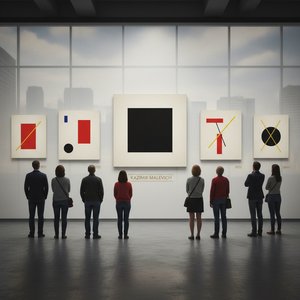
Kazimir Malevich: Pioneering Suprematism & the Quest for Non-Objective Art
Explore the revolutionary art of Kazimir Malevich & his groundbreaking Suprematism movement. Discover the origins, core principles, and lasting impact of this pivotal force in modern abstract painting.


