Comută pe versiunea Print
 Vezi mai mult







































 Pentru opere de artă sau reproduceri care depășesc 105 cm (aproximativ 41 de inch) pe oricare dintre laturi, cadrul va fi livrat demontat, sub formă de kit. Această metodă asigură o livrare sigură și previne deteriorarea în timpul transportului.


Karl Otto Götz: The Explosive Legacy of German Art Informel
Karl Otto Götz (1914 – 2017) stands as an unparalleled figure in twentieth-century art, a titan whose influence reverberates through the corridors of modern sculpture and artistic exploration. More than simply a sculptor; he was a visionary filmmaker, draughtsman, printmaker, writer and professor who fundamentally reshaped the aesthetic landscape of his era—a legacy that continues to inspire artists striving for innovation and emotional resonance.
Born in Aachen, Germany on February 22nd, 1914, Götz’s artistic journey began amidst the turbulent backdrop of post-war Europe. He swiftly embraced the burgeoning movement known as Art Informel—a radical departure from traditional representational art—characterized by spontaneous gesture and textural experimentation. This stylistic commitment wouldn't just define his oeuvre; it would propel him to international prominence, securing a place among the luminaries of Documenta II in 1959.
Götz’s artistic method was as distinctive as his vision. He eschewed meticulous planning and embraced chance encounters with materials—particularly iron—allowing these elements to dictate the form and expression of his sculptures. This approach, rooted in Surrealist influences and informed by a fascination with geological forces, resulted in monumental works that convey both immense power and profound vulnerability.
- Key Characteristics: Götz’s sculptures are instantly recognizable for their explosive forms—often resembling fractured rock formations or volcanic eruptions—created through the forceful hammering of iron sheets.
- Technique: The sculptor meticulously controlled the heat applied to the metal, manipulating its plasticity and achieving remarkable surface textures that capture the essence of natural processes.
- Historical Context: Götz’s work emerged during a period of intense artistic debate concerning abstraction versus figuration, reflecting the broader anxieties surrounding postwar trauma and the desire for new modes of expression.
The impact of Götz's contribution to Art Informel extends far beyond his individual creations. He championed a collaborative spirit within the movement, fostering dialogues between artists and scientists—a testament to his belief in the transformative potential of interdisciplinary inquiry. His sculptures continue to captivate audiences worldwide, serving as enduring symbols of artistic courage and unwavering dedication to exploring the boundaries of sculptural form.
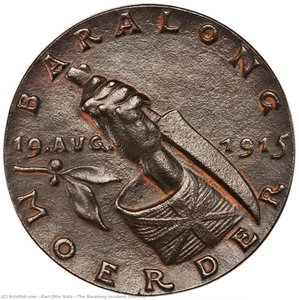
Consider Götz’s “The Baralong Incident Obverse,” a striking piece embodying these principles. The sculpture depicts a hand gripping a knife poised over another blade—a potent visual metaphor for confrontation and resistance—set against a backdrop of textured iron sheets reminiscent of volcanic rock. Its deliberate simplicity underscores the sculptor's commitment to conveying emotion through elemental materiality, cementing Götz’s place as one of Germany’s most influential sculptors.
Further Research: Image Reference:
Întrebări și răspunsuri
Care este nuanța dominantă în "Incidentul Baralongului Obvers" de Karl Otto Götz?
O nuanță de Gamă de galben auriu traversează întregul "Incidentul Baralongului Obvers" de Karl Otto Götz.
Cum se îmbină suportul și mișcarea în "Incidentul Baralongului Obvers"?
"Incidentul Baralongului Obvers" de Karl Otto Götz îmbină tehnica Acrilic pe pânză întinsă cu stilul German Art Informel. Tehnica și mișcarea definesc modul de execuție și estetica operei.
Ce nivel de contrast prezintă "Incidentul Baralongului Obvers" de Karl Otto Götz?
"Incidentul Baralongului Obvers" de Karl Otto Götz prezintă un contrast Contrast maxim între zonele luminoase și cele întunecate.
Mai multe detalii despre această pictură
 Previzualizare
 Trimite prin felicitare
 Distribuie
 Detalii despre lucrare
 Ghid
Ghid

 Descarcă imaginea
 Produse similare
 Radiografie
 Galerie foto
 Întrebări și răspunsuri
 Statistici