Previzualizare
 Trimite
 Distribuie
 Detalii despre lucrare

 Descarcă
 Produse similare
 Radiografie
 Diapozitive automate
 Statistici
German Reply to Wilson, Either, Or Obverse


 Vezi mai mult
Reproducere pictată manual în ulei
Pictură în ulei pe pânză, realizată manual de artiștii noștri la dimensiunea și ramele dorite de dumneavoastră, pe comandă. ( Comută pe Print Comută pe Imagine Digitală)




P118B $10

P118H $10

P118W $10

P438Z $10

P508JH $12

P508YH $12

P805H $10

P805Z $10

P919BZ $10

P919G $10

P919XJ $10

P959ZH $10

P968JZ $12

W106C $8

W218G $10

W218JH $8

W218Y $10

W307PJ $10

W316G $10

W316PJ $8

W316Y $10

W398PJ $8

W4111J $10

W500HY $15

W500JH $15

W692G $12

W849H $8

W940BG $15

W953PJ $8




Alegeți dintre dimensiunile noastre prestabilite, care respectă proporțiile originale ale operei de artă.

Puteți introduce propriile dimensiuni pentru a se potrivi unui anumit cadru sau spațiu. Dacă dimensiunea selectată nu corespunde proporțiilor imaginii originale, vom decupa opera de artă sau vom extinde pictura cu elemente suplimentare pictate manual. O simulare digitală vă va fi trimisă pentru aprobare înainte de începerea producției.
Vă rugăm să rețineți că previzualizarea de pe ecran nu reflectă decuparea sau extinderea reală. Doar macheta va arăta cu exactitate compoziția finală.
Deși sunt disponibile dimensiuni personalizate, vă recomandăm să selectați o dimensiune din lista predefinită pentru a păstra proporțiile originale.
După plasarea comenzii, echipa OriginalUniqueArt.com va contacta clientul prin e-mail pentru instrucțiuni și îi va furniza o previzualizare a machetei
Livrare în întreaga lume () în 3-4 săptămâni, în loc de cele 5 săptămâni standard. (13 Septembrie). Fără compromisuri în ceea ce privește calitatea.

Livrare expres gratuită la nivel mondial

Pânză de in de înaltă calitate

Asigurare completă pentru transport

Garanție de rambursare a taxelor vamale

Garanția fidelității culorilor

Politica de retur de 100 de zile (doar pentru defecte)

Garanție de rambursare 100%

Ofertă pentru comenzi multiple
 Opțiunea cu sticlă este disponibilă doar pentru dimensiuni de sub 110 cm

German Reply to Wilson, Either, Or Obverse
Tehnică de reproducere
Dimensiune reproducere
-


Preț total calculat
$ 300
German Reply to Wilson, Either, Or Obverse – A Bold Statement Against Neutrality
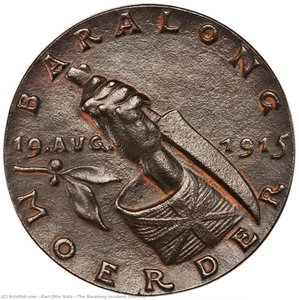
Karl Otto Götz’s “German Reply to Wilson, Either, Or Obverse” stands as a pivotal emblem of German Art Informel, encapsulating the spirit of defiance and artistic experimentation that characterized the mid-century movement. Created in 1916 during the tumultuous period of World War I, this bronze medal transcends mere commemoration; it’s a forceful critique of American policy regarding the conflict—a stance Götz deemed unacceptable and demanded immediate cessation of unrestricted submarine warfare by Germany. The artwork's genesis lies within a climate of intense political debate and national pride, reflecting anxieties about maintaining independence amidst global pressures.- Subject Matter: The medal confronts the viewer with a stark depiction of American neutrality—a position Götz vehemently opposed. It’s not simply a historical record but an assertion of moral conviction.
- Style & Technique: Götz employed Art Informel, prioritizing expressive gesture and spontaneous action over meticulous realism. The bronze casting process itself contributes to the artwork's textural richness, emphasizing surface irregularities and conveying a sense of dynamism.
- Symbolism: Central figures embody powerful symbols—Wilson represents diplomatic leadership grappling with ethical dilemmas, while Justice, depicted as a naked figure clutching a scale, symbolizes impartiality and moral accountability. The “Either, Or” inscription underscores the ultimatum presented to Germany: compliance or severing ties with the United States.
- Historical Context: Issued in 1916, amidst escalating tensions between Britain and Germany—particularly following the sinking of RMS Falaba—the medal served as a visual manifesto against perceived weakness and inaction. Götz’s intention was to provoke reflection on America's role in shaping the course of the war.
- Emotional Impact: The artwork evokes feelings of urgency, conviction, and moral seriousness. Its bold composition and textured surface communicate an impassioned response to geopolitical events—a testament to Götz’s ability to translate complex ideas into visceral artistic expression.
Detailed Description & Artistic Considerations
The bronze medal showcases meticulous craftsmanship. The central figure of Wilson, rendered in profile facing left, exudes solemnity and intellectual contemplation—his glasses reflecting the gravity of his responsibility. To his right is a stylized humanoid form embodying Justice, characterized by a simplified face and body, holding a scale from which hangs a sheet of paper bearing the date 20.April 1915. The surrounding Latin phrases – “ENTWEDER-ODER” – powerfully convey the ultimatum issued to Germany: adherence to international law or complete diplomatic rupture. Götz’s masterful use of embossing techniques creates a palpable sense of depth and texture, mirroring the turbulent atmosphere of the era.Provenance & Significance
The medal's provenance traces back to the American Numismatic Society in New York City, where it resides today—a testament to its enduring artistic merit and historical importance. Götz’s work aligns with broader trends within Art Informel – a rejection of academic conventions favoring emotive expression over precise representation. It exemplifies the movement’s commitment to confronting societal issues through unconventional visual language.Contemporary Relevance & Artistic Legacy
“German Reply to Wilson, Either, Or Obverse” continues to resonate with artists and collectors alike—serving as a reminder of Art Informel's boldness and its engagement with pressing political concerns. Götz’s legacy extends beyond the medal itself; he established himself as a prolific filmmaker, draughtsman, printmaker, writer and professor who profoundly shaped the artistic landscape of his time—inspiring generations of artists to pursue innovative forms of visual communication.Biografie artist
The Explosive Legacy of Karl Otto Götz
Karl Otto Götz (1914 – 2017) stands as an unparalleled figure in the annals of twentieth-century art, a creator whose remarkable longevity—reaching over a century—was matched only by the sheer intensity and complexity of his artistic vision. Born in Aachen, Germany, Götz was far more than a mere painter; he was a filmmaker, draughtsman, printmaker, writer, and professor who profoundly shaped the artistic landscape of his era. His career was defined by explosive abstract forms that earned him international acclaim, most notably during his appearance at Documenta II in 1959, which cemented his place as one of the most vital members of the German Art Informel movement.
His journey began amidst the avant-garde currents of his youth, where he cultivated a deep fascination with Surrealism and Expressionism. The works of masters such as Max Ernst, Juan Gris, Wassily Kandinsky, and Paul Klee served as crucial early inspirations, shaping his initial stylistic explorations. While attending the School of Applied Arts in Aachen between 1932 and 1933, he honed the technical skills that would later serve his more radical experiments. However, the looming shadow of Nazism cast a profound darkness over his early trajectory; because the regime viewed abstract art with intense disapproval, Götz was banned from exhibiting. Yet, in an act of quiet defiance, he persevered, secretly continuing to create works that challenged the ideological constraints of the time.
The Spirit of Art Informel and Spontaneous Gesture
The post-war era brought a resurgence of artistic experimentation in Germany, fueled by a widespread disillusionment with traditional aesthetics and a desperate yearning for new forms of expression. It was within this fertile ground that Götz emerged as a pivotal champion of Deutsches Informel, or German Informal Art. This movement prioritized the raw power of gesture and spontaneity over the meticulous, controlled representation of the past. Götz’s work became a vessel for this energy, characterized by a rhythmic, almost frenetic application of paint that captured the psychological turbulence of the post-war period.
His mastery extended beyond the canvas into diverse mediums, where he explored the intersection of movement and image. His contributions to television art and his ability to translate the kinetic energy of painting into other formats demonstrated a relentless pursuit of innovation. This period of his life was marked by a refusal to be tethered to a single style, as he moved fluidly between:
- Abstract Expressionism: Utilizing rapid, gestural strokes to convey emotion.
- Printmaking and Medallion Work: Creating symbolic bronze pieces that reflected historical tensions and political symbolism.
- Experimental Film: Exploring the temporal dimension of visual abstraction.
Historical Significance and Lasting Influence
The significance of Karl Otto Götz lies not only in his individual achievements but in his role as a bridge between the early twentieth-century avant-garde and the contemporary era. His work provided a vital link for subsequent generations of artists, influencing titans of German art such as Sigmar Polke and Gerhard Richter. By championing an aesthetic that embraced the unpredictable and the unrefined, he helped redefine the boundaries of what painting could achieve in a modern, fractured world.
Even when working in more structured mediums, such as his striking bronze medallions, Götz infused his subjects with the bold, symbolic language of Art Informel. Whether depicting historical figures or commemorating naval incidents through powerful, symbolic imagery, his hand remained unmistakably his own—dynamic, authoritative, and deeply connected to the pulse of history. His legacy remains a testament to the power of artistic resilience, proving that even under the most restrictive regimes, the impulse toward abstract freedom can never be truly extinguished.

karl otto götz
1914 - 2017 , Germany
Detalii rapide
- Artistic Movement Or Style: Art Informel
- Artists Or Movements Influenced By This Artist:
- Sigmar Polke
- Nam June Paik
- Gerhard Richter
- Artists Who Influenced This Artist:
- Max Ernst
- Juan Gris
- Wassily Kandinsky
- Paul Klee
- Date Of Birth: February 22nd, 1914
- Date Of Death: August 19th, 2017
- Full Name: Karl Otto Götz
- Nationality: German
- Notable Artworks:
- The King Stephen Incident Obverse
- The Sinking of the Lusitania Obverse
- German U-boats in America
- Place Of Birth: Aachen, Germany
Articole similare

Expresionismul German: 10 Capodopere Iconice pentru Decoruri de Artă
Descoperă cele mai importante 10 capodopere ale Expresionismului German! Explorează poveștile din spatele picturilor Kandinsky, Munch și Kirchner. Reproduceri de artă premium pentru un decor unic pe OriginalUniqueArt.com

Otto Dix: Trauma, Society & Artistic Rebellion in Weimar Germany
Explore the powerful and unsettling art of Otto Dix, a key figure of Neue Sachlichkeit. Discover his unflinching depictions of Weimar Germany's trauma, society, and war through insightful analysis & iconic masterpieces.
Richard Wilson: Deconstructing Landscape & Memory in Contemporary Installation Art
Explore Richard Wilson's groundbreaking landscape paintings & his enduring influence on contemporary installation art. Discover investment opportunities, provenance insights & the materiality of memory in this expert analysis.

Anton von Werner: Imperial Painter, Historical Witness & Shifting German Identity
Explore the life & work of Anton von Werner, Imperial Germany's leading painter. Discover his dramatic depictions of war, unification, and court life – a fascinating insight into 19th-century German history & art.
Neue Sachlichkeit: The Unflinching Realism and Social Critique of German New Objectivity
Explore the raw realism of Neue Sachlichkeit. Discover how German New Objectivity artists like Otto Dix and George Grosz captured the turbulent Weimar Republic through unflinching social critique and precise detail. A definitive guide for art historians and collectors.