
 Previzualizare
 Trimite
 Distribuie
 Detalii despre lucrare

 Descarcă
 Produse similare
 Radiografie
 Diapozitive automate
Allegory
 Oil On Canvas
- WallArt
- Dutch Golden Age
 1663
1663 116.0 x 97.0 cm
 Statens Museum For Kunst
 Vezi mai mult
Giclée / Imprimare artistică
Printuri giclée sau pe canvas de calitate muzeală, cu proces de producție rapid și opțiuni flexibile de finisare. ( Comandă pictură lucrată manual Cumpără imaginea)




P118B $10

P118H $10

P118W $10

P438Z $10

P508JH $12

P508YH $12

P805H $10

P805Z $10

P919BZ $10

P919G $10

P919XJ $10

P959ZH $10

P968JZ $12

W106C $8

W218G $10

W218JH $8

W218Y $10

W307PJ $10

W316G $10

W316PJ $8

W316Y $10

W398PJ $8

W4111J $10

W500HY $15

W500JH $15

W692G $12

W849H $8

W940BG $15

W953PJ $8




Alegeți dintre dimensiunile noastre prestabilite, care respectă proporțiile originale ale operei de artă.

Puteți introduce propriile dimensiuni pentru a se potrivi unui anumit cadru sau spațiu. Dacă dimensiunea selectată nu corespunde proporțiilor imaginii originale, vom decupa lucrarea de artă sau vom extinde imaginea cu margini oglindite sau cu o culoare uniformă. Un mockup digital va fi trimis pentru aprobarea dumneavoastră înainte de începerea producției.
Vă rugăm să rețineți că previzualizarea de pe ecran nu reflectă decuparea sau extinderea reală. Doar mockup-ul va arăta cu exactitate compoziția finală.
Deși dimensiunile personalizate sunt disponibile, vă recomandăm să selectați o dimensiune din lista predefinită pentru a păstra proporțiile originale.
Livrare în întreaga lume () în 2 săptămâni, în loc de cele 4/5 săptămâni standard. (13 August)

Livrare expres gratuită la nivel mondial

Pânză de in de înaltă calitate

Asigurare completă pentru transport

Garanție de rambursare a taxelor vamale

Garanția fidelității culorilor

Politica de retur în 60 de zile (doar pentru defecte)

Garanție de rambursare 100%

Ofertă pentru comenzi multiple
 Opțiunea cu sticlă este disponibilă doar pentru dimensiuni de sub 110 cm

Allegory
Giclée / Imprimare artistică
Dimensiune reproducere
-


Preț total calculat
$ 80
Descriere obiect de colecție
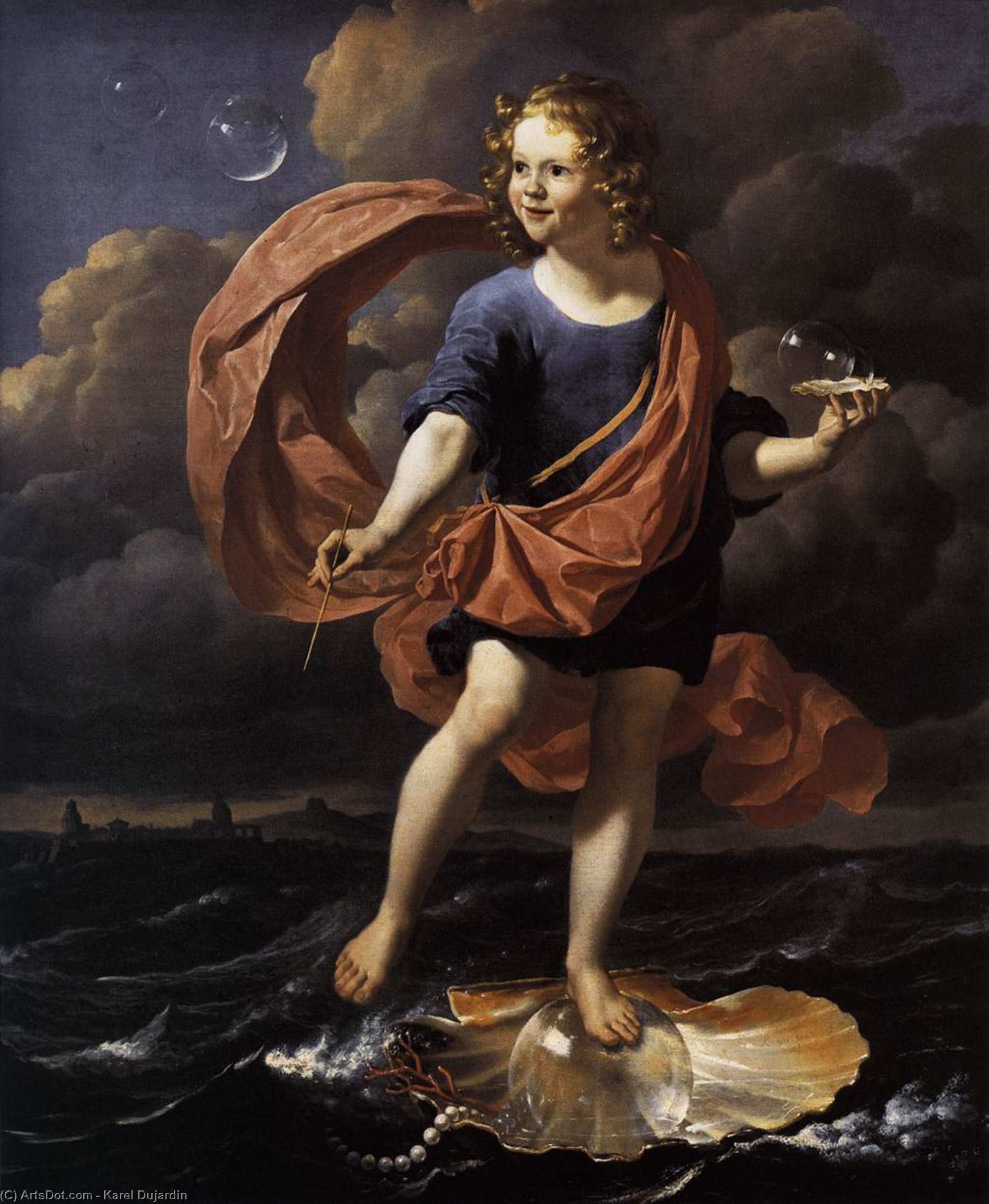
Karel Dujardin’s “Allegory”: A Fleeting Beauty Captured in Light
Karel Dujardin's "Allegory," painted in 1663, is more than just a picturesque scene; it’s a poignant meditation on the ephemeral nature of life and beauty. Born in Amsterdam during the height of the Dutch Golden Age, Dujardin was a master of capturing fleeting moments – particularly those involving light, animals, and idyllic landscapes. This particular work, housed within the National Gallery in London, exemplifies his signature style: a delicate balance between realism and idealized vision, imbued with a subtle melancholy that speaks to the transience of all things.
The painting depicts a young boy, dressed in a vibrant blue tunic and a flowing pink cloak, standing on the back of what appears to be a large sea creature – perhaps a whale or dolphin. He holds a small wand aloft, releasing a flurry of iridescent bubbles into the air. The backdrop is a hazy, cloudy sky, lending an atmospheric quality that enhances the sense of dreamlike serenity. Scattered throughout the scene are other figures, engaged in various activities—a woman tending to flowers, a man sailing a boat, and others enjoying the leisurely pace of life by the water’s edge. The inclusion of these secondary figures subtly underscores the central theme: a shared appreciation for beauty amidst the inevitable passage of time.
A Symbol of Transience: The Bubbles as Metaphor
At first glance, “Allegory” might seem simply a charming depiction of childhood play and a beautiful landscape. However, Dujardin deliberately employs symbolism to elevate the scene beyond mere representation. The bubbles themselves are the key to unlocking the painting’s deeper meaning. In 17th-century Dutch art, blowing bubbles was a well-established motif, representing the fleeting nature of life – much like the delicate spheres themselves. Each bubble rises briefly into the air before bursting, mirroring the transient beauty and joy that characterize human existence.
The boy’s posture—relaxed, almost carefree—suggests an acceptance of this ephemeral quality. He isn't striving to hold onto the bubbles; he simply enjoys their brief appearance. This mirrors a philosophical stance: embracing the present moment rather than clinging to illusions of permanence. The artist masterfully uses light and shadow to further emphasize this theme. The soft, diffused sunlight bathes the scene in a gentle glow, creating an atmosphere of tranquility while simultaneously reminding us that all beauty is ultimately subject to decay.
Dujardin’s Technique: Light, Color, and Detail
Dujardin's skill lies not only in his ability to capture a fleeting moment but also in his meticulous technique. He was known for his incredibly detailed renderings of animals and landscapes, often employing a technique called “grisaille,” where he would build up layers of thin paint to create subtle gradations of tone and texture. This is evident in the rendering of the sea creature’s skin, the delicate folds of the boy's clothing, and the shimmering surface of the bubbles themselves.
The color palette is restrained yet luminous—primarily blues, greens, and browns—creating a sense of harmony and balance. Dujardin expertly utilizes light to model forms and create depth, drawing the viewer’s eye into the scene. The subtle variations in tone suggest a mastery of chiaroscuro, a technique that employs strong contrasts between light and dark to heighten drama and create a sense of realism.
A Window into 17th-Century Dutch Life
"Allegory" offers a fascinating glimpse into 17th-century Dutch life. The scene is populated with figures engaged in typical activities—fishing, sailing, gardening—reflecting the prosperity and leisure enjoyed by many during this period. The inclusion of these everyday details grounds the allegorical theme in a tangible reality, making it all the more poignant. Dujardin’s work also reflects the influence of Italianate art, particularly the idealized landscapes favored by artists working in Rome at the time.
Today, “Allegory” remains a captivating masterpiece—a testament to Dujardin's artistic skill and his profound understanding of human nature. It serves as a beautiful reminder that even the most fleeting moments of beauty are worth cherishing, and that embracing the transience of life is an essential part of finding joy and fulfillment.
Biografie artist
A Life Immersed in Light and Landscape
Karel Dujardin, a name resonating softly within the pantheon of Dutch Golden Age masters, was born in Amsterdam in 1626 – though some records suggest 1622. His life unfolded during a period of unprecedented artistic flourishing in the Netherlands, yet his path wasn’t one of immediate acclaim but rather a gradual unfolding of talent nurtured by careful study and extensive travel. Details surrounding his early years remain somewhat elusive, shrouded in the mists of time, however it is widely accepted that he received foundational training under Nicolaes Berchem, a painter celebrated for his idyllic landscapes populated with animals. This mentorship proved pivotal, instilling in Dujardin a deep appreciation for naturalism and a keen eye for capturing the subtle nuances of light and atmosphere. He diligently absorbed Berchem’s techniques—particularly his masterful use of atmospheric perspective—which would become hallmarks of Dujardin's own artistic style.The Bentvueghels and Roman Influences
But Dujardin’s artistic journey wasn’t confined to the studios of Amsterdam; he possessed an adventurous spirit that led him to Rome, where he became a member of the *Bentvueghels*, a society of predominantly Dutch and Flemish painters who embraced a bohemian lifestyle and often adopted satirical nicknames. In Rome, he was known as “Barba di Becco” or "Goat-Beard," a moniker likely referencing his distinctive facial hair, and it was here that his artistic voice truly began to mature. The Bentvueghels fostered an environment of intellectual curiosity and playful experimentation, encouraging Dujardin to push boundaries and challenge conventions. This Roman experience profoundly impacted his artistic sensibilities, exposing him to the grandeur of Italian architecture and the vibrancy of its cultural landscape—influences that would subtly permeate his later works. He embraced the society’s penchant for caricature and theatrical presentation, honing his skills in capturing expressive gestures and conveying emotion with remarkable accuracy.Painting Landscapes with Soul
Dujardin's artistic style is characterized by meticulous detail and a remarkable ability to depict scenes of everyday life – rural landscapes brimming with animals, peasants engaged in their daily routines, and tranquil pastoral settings. He possessed an exceptional talent for capturing the play of light and shadow, imbuing his canvases with a sense of warmth and realism. Unlike many artists of his time who focused on grand historical narratives or idealized portraits, Dujardin prioritized observation—capturing the beauty of the natural world and portraying human figures with compassion and dignity. His landscapes are not merely decorative; they are imbued with psychological depth, conveying moods and emotions as effectively as any portrait. Consider Farm Animals in the Shade of a Tree – the artist’s careful rendering of light filtering through foliage creates an atmosphere of serenity and invites contemplation. He achieved this remarkable feat by meticulously studying the effects of weather conditions on color and texture—a testament to his dedication to artistic craftmanship.Notable Works and Artistic Legacy
Among Dujardin's most celebrated paintings are Woman Milking a Red Cow, which exemplifies his masterful depiction of rural life; *Rest at an Italian Inn*, showcasing the influence of Roman landscapes; and The Regents of the Spinhuis and Nieuwe Werkhuis, Amsterdam—a group portrait demonstrating his skill in capturing individual likenesses within a larger composition. These works stand as enduring symbols of the Dutch Golden Age’s artistic achievements—testaments to Dujardin's unwavering commitment to realism and his ability to convey profound emotion through visual imagery. His influence can be seen in subsequent generations of artists who sought to emulate his technique and capture the essence of the natural world. Karel Dujardin remains a pivotal figure in Dutch art history, embodying the spirit of observation, craftsmanship, and artistic sensitivity—a legacy that continues to inspire admiration and scholarly study today. He solidified his place as one of the most important landscape painters of his era, securing his reputation for capturing light and emotion with unparalleled precision.
Karel Dujardin
1626 - 1678 , Olanda
Detalii rapide
- Artistic Movement Or Style: Pictură Aurului Dutch
- Artists Who Influenced This Artist:
- Nicolaes Berchem
- Rembrandt van Rijn
- Date Of Birth: 27 septembrie 1626
- Full Name: Karel Dujardin
- Nationality: Olandez
- Notable Artworks:
- Milcoarea unei vaci roșii
- Animale țărănesti în umbra unui arbore
- Odihnă la un ospăț italian
- Autoportret (1662)
- Regele Spinhuis și Nieuwe Werkhuis
- Place Of Birth: Amsterdam, Olanda
Articole similare

Golden Light & Dutch Skies: The Timeless Magic of Dutch Golden Age Landscapes
Discover the breathtaking beauty of Dutch Golden Age landscapes. Explore the mastery of light, chiaroscuro, and 17th-century realism through an expert art history lens, celebrating the enduring legacy of the Dutch Masters for discerning collectors and art lovers.

Epoca de Aur Olandeză: 10 Capodopere Care Au Definit Arta și Decorațiunea Interioară
Descoperiți Epoca de Aur Olandeză prin 10 capodopere Rembrandt, Vermeer și alți pictori olandezi. Aflați poveștile din spatele acestor tablouri baroce iconice și inspirați-vă pentru decorațiuni interioare unice. Explorează colecția completă pe OriginalUniqueArt.com!

Golden Light & Dutch Skies: Bringing the Magic of Dutch Golden Age Landscapes into Your Home
Transform your home with the breathtaking light of Dutch Golden Age landscapes. Discover how hand-painted oil reproductions of masterworks like Ruisdael and Vermeer bring timeless elegance, atmosphere, and soulful texture to modern interiors. Elevate your space with museum-quality art.
Nicolaes Berchem: Dutch Golden Age Pastoralism & the Evolution of Landscape Painting
Explore the captivating world of Nicolaes Berchem, a leading Dutch Golden Age painter. Discover his idyllic landscapes, masterful technique & lasting influence on art history. Learn more at OriginalUniqueArt.
Charles Leickert: Capturing the Dutch Golden Age Light – A Comprehensive Study of Technique, Context, and Legacy
Explore the captivating winter landscapes of Charles Leickert, a master of Dutch Golden Age light & atmosphere. Discover his techniques, symbolism, and lasting legacy – a comprehensive study for art enthusiasts and collectors.


