
 Previzualizare
 Trimite prin felicitare
 Distribuie
 Detalii despre lucrare
 Ghid
Ghid

 Descarcă imaginea
 Produse similare
 Radiografie
 Galerie foto
 Q&A
Q&A Statistici
Violin and Guitar

- 60.0 x 81.0 cm


 Vezi mai mult
Giclée / Imprimare artistică
Printuri giclée sau pe canvas de calitate muzeală, cu proces de producție rapid și opțiuni flexibile de finisare. ( Comandă pictură realizată manual Comută pe Imagine Digitală)




P118B lei10

P118H lei10

P118W lei10

P438Z lei10

P508JH lei12

P508YH lei12

P805H lei10

P805Z lei10

P919BZ lei10

P919G lei10

P919XJ lei10

P959ZH lei10

P968JZ lei12

W106C lei8

W218G lei10

W218JH lei8

W218Y lei10

W307PJ lei10

W316G lei10

W316PJ lei8

W316Y lei10

W398PJ lei8

W4111J lei10

W500HY lei15

W500JH lei15

W692G lei12

W849H lei8

W940BG lei15

W953PJ lei8




Alegeți dintre dimensiunile noastre prestabilite, care respectă proporțiile originale ale operei de artă.

Introduceți lățimea și înălțimea necesare pentru a se potrivi ramei sau peretelui dumneavoastră. O printare poate fi doar tăiată, niciodată extinsă dincolo de dimensiunea imaginii originale, astfel încât o dimensiune cu o formă diferită va pierde o parte din imagine. Vă trimitem o simulare digitală pentru aprobare înainte de a imprima orice. Imaginea afișată pe această pagină nu prezintă tăierea reală — doar simularea arată acest lucru.
Livrare în întreaga lume () în 2 săptămâni, în loc de cele 4/5 săptămâni standard. (2 Noiembrie)

Livrare expres gratuită la nivel mondial

Pânză de in de înaltă calitate

Asigurare completă pentru transport

Garanție de rambursare a taxelor vamale

Garanția fidelității culorilor

Politica de retur în 100 de zile (doar pentru defecte de fabricație)

Garanție de rambursare 100%

Ofertă pentru comenzi multiple
 Opțiunea cu sticlă este disponibilă doar pentru dimensiuni de sub 110 cm

Violin and Guitar
Giclée / Imprimare artistică
Dimensiune reproducere
-


Preț total calculat
lei 380
A Fragmented Harmony: Juan Gris’s “Violin and Guitar”
Juan Gris’s “Violin and Guitar,” painted in 1913, isn't merely a still life; it’s a meticulously constructed exploration of perception and the very nature of representation. Emerging from the fertile ground of early Cubism, this work embodies the movement’s revolutionary shift away from traditional perspective and towards a fractured, multi-faceted view of reality. More than just depicting musical instruments, Gris offers us a glimpse into his innovative approach to visual language – a deliberate dismantling and reassembling of form that speaks volumes about the artist's intellectual rigor and artistic vision.
The canvas is dominated by the assertive presence of a guitar and violin, rendered with an almost startling degree of realism despite their fragmented composition. However, these recognizable objects are not presented in a straightforward manner. Instead, they’re broken down into geometric planes – sharp angles, interlocking rectangles, and subtly curved lines—that suggest multiple viewpoints simultaneously. This is the hallmark of Synthetic Cubism, where elements from various perspectives are layered upon one another to create an illusion of depth and volume within a flattened space. The background, hinted at through a suggestion of a window and curtain, further reinforces this sense of spatial ambiguity, inviting the viewer to actively participate in constructing the image.
The Language of Cubism: Deconstruction and Reconstruction
Gris’s approach is deeply rooted in the principles pioneered by Picasso and Braque. He embraced the analytical cubist method – a process of dissecting objects into their constituent parts, analyzing them from multiple angles, and then reconstructing them on the canvas. Yet, “Violin and Guitar” marks a significant departure from the purely analytical style. It’s a prime example of Synthetic Cubism, where pre-existing elements—fragments of color, texture, and form—are collaged together to create a new, unified image. The use of *papier collé*, or pasted paper, is subtly present in the background, adding another layer of complexity and visual interest.
Noticeably absent is the dense, monochromatic palette often associated with early Cubism. Instead, Gris employs a vibrant and carefully considered color scheme – cool blues and grays juxtaposed against warm reds and greens. These colors aren’t merely decorative; they contribute to the overall sense of dynamism and visual tension within the composition. The deliberate use of contrasting hues draws attention to specific areas of the painting, guiding the viewer's eye through the intricate network of lines and shapes.
Symbolism and Emotional Resonance
While “Violin and Guitar” is undeniably a formal masterpiece, it also carries a subtle layer of symbolic meaning. Music itself has long been associated with harmony, emotion, and creativity. The instruments depicted—the violin and guitar—represent these concepts in tangible form. The fragmentation of the objects can be interpreted as reflecting the complexities of human experience – the way we perceive reality through multiple lenses and the challenges of integrating disparate elements into a cohesive whole.
Furthermore, the painting’s overall mood is one of quiet contemplation. The muted colors, the fragmented forms, and the sense of spatial ambiguity create an atmosphere of detachment and introspection. It's not a celebratory or overtly emotional work; rather, it invites the viewer to engage in a process of careful observation and interpretation. The deliberate lack of strong shadows contributes to this feeling of flatness and abstraction, emphasizing the painting’s formal qualities over its representational ones.
A Legacy of Innovation
“Violin and Guitar” stands as a pivotal work in Juan Gris's artistic development and a cornerstone of Cubist innovation. It demonstrates his mastery of geometric form, his innovative use of color, and his ability to create complex visual narratives through seemingly simple compositions. Gris’s unique approach—combining rigorous analytical study with a poetic sensibility—established him as one of the most influential artists of the 20th century, leaving an indelible mark on the development of modern art.
Întrebări și răspunsuri
Cine este autorul și din ce an este "Violin and Guitar"?
Juan Gris a creat "Violin and Guitar" în 1913.
Care este nuanța dominantă în "Violin and Guitar" de Juan Gris?
Culoarea dominantă a operei "Violin and Guitar" de Juan Gris este Green to Violet Spectrum. Această nuanță constituie tonul de bază al paletei cromatice.
Ce dimensiune și orientare sunt recomandate pentru o printare a lucrării "Violin and Guitar" de Juan Gris?
Dimensiunea Medium, orientarea Portrait: aceasta este configurația de imprimare recomandată pentru "Violin and Guitar" de Juan Gris.
Biografie artist
A Spanish Visionary of Cubism: The Life and Art of Juan Gris
Born José Victoriano González-Pérez in Madrid in 1887, the artist who would become known as Juan Gris embarked on a journey that would place him among the most significant figures of early 20th-century art. His initial path wasn’t one immediately leading to canvas and brush; he pursued engineering at the School of Arts and Sciences, demonstrating an analytical mind that would later profoundly influence his artistic approach. Even during these formative years, a creative spark flickered – contributing drawings to local periodicals hinted at a burgeoning visual talent. It was in 1905 that he adopted the pseudonym Juan Gris, a name resonating with a newfound sense of identity and purpose as he began formal painting studies under José Moreno Carbonero. This marked a pivotal shift, setting him on a course toward artistic innovation.Parisian Awakening and the Embrace of Cubism
The year 1906 witnessed a transformative relocation to Paris, a city then pulsating with artistic energy. Gris immersed himself in this vibrant milieu, forging friendships with luminaries like Henri Matisse, Georges Braque, and Fernand Léger. He initially engaged in satirical illustration for publications such as *L'Assiette au Beurre*, honing his observational skills and developing a keen sense of visual wit. However, the magnetic pull of Pablo Picasso proved particularly influential. Around 1910, Gris began to seriously dedicate himself to painting, moving away from caricature towards the burgeoning language of Cubism. This wasn’t mere imitation; he embarked on a quest to distill the essence of form and space, seeking a new visual order. His early explorations were marked by a deliberate departure from traditional representation, embracing abstraction as a means of capturing reality's underlying structure. Picasso’s influence was undeniable, yet Gris quickly developed his own distinct style, characterized by a remarkable clarity and intellectual rigor.The Geometry of Perception: Style and Key Works
Juan Gris’s artistic output is characterized by an exceptional clarity and intellectual rigor. He didn’t simply deconstruct objects; he reconstructed them with deliberate precision, emphasizing geometric forms and a carefully considered palette. This approach led to what became known as his “crystal period,” exemplified in masterpieces like *Still Life Before an Open Window* and *Place Ravignan* (1915). These works showcase a remarkable interplay of planes and angles, creating a sense of depth and solidity while simultaneously challenging conventional notions of perspective. The influence of Cézanne is evident in Gris’s use of flattened forms and simplified spatial relationships. After 1913, Gris wholeheartedly embraced Synthetic Cubism, pioneering the use of *papier collé* – collage – incorporating real-world materials like newspaper clippings and textured papers into his compositions. This technique added another layer of complexity and tactility to his work, blurring the boundaries between painting and sculpture. Notable examples include *Guitar in front of the sea* (1925), a testament to his simplified forms and adherence to cubist principles, and *Homage à Pablo Picasso* (1912), which signaled his growing recognition within the avant-garde art world.The Development of His Style: From Analytic to Synthetic Cubism
Gris’s artistic journey wasn't a sudden shift but a gradual evolution. Initially exploring the analytical phase of Cubism, characterized by fragmented forms and overlapping planes—a technique heavily influenced by Picasso—he moved towards the more constructive and colorful approach of synthetic cubism. This transition involved a deliberate simplification of shapes, an increased use of color, and the incorporation of collage elements. He sought to represent objects not as they appear in reality but as they are perceived – broken down into their essential geometric components. The introduction of *papier collé* was a crucial step, allowing him to integrate textures and patterns into his paintings, creating a richer and more dynamic visual experience. His work during this period reflects a growing confidence and experimentation, pushing the boundaries of Cubism while retaining its core principles.Legacy and Lasting Influence
Juan Gris’s contribution to Cubism extends beyond mere stylistic innovation; he brought a unique intellectual depth and structural clarity to the movement. He moved past the analytical phase, towards a more organized and synthetic approach, emphasizing order and precision. His work profoundly influenced the Purist style championed by Amédée Ozenfant and Charles Edouard Jeanneret (Le Corbusier), advocating for a return to classical principles of form and composition. Gris’s emphasis on geometric forms, harmonious color palettes, and the integration of everyday objects into his art established him as a pivotal figure in 20th-century art. His legacy continues to inspire artists today, demonstrating the enduring power of Cubism and the visionary genius of Juan Gris – a Spanish master who reshaped our understanding of perception and representation.
Juan Gris
1887 - 1927 , Spania
Detalii rapide
- Artistic Movement Or Style: Cubism, Sintetic Cubism
- Artists Or Movements Influenced By This Artist:
- Purism
- Ozenfant
- Le Corbusier
- Artists Who Influenced This Artist:
- Picasso
- Matisse
- Braque
- Date Of Birth: 23 martie 1887
- Date Of Death: 11 mai 1927
- Full Name: José Victoriano González-Pérez
- Nationality: Spaniol
- Notable Artworks:
- Guitar în fața mării
- Homaj către Pablo Picasso
- Place Of Birth: Madrid, Spania
Articole similare
Redefining Nature: A Collector's Guide to the Geometric Beauty of Cubist Landscapes
Explore the revolutionary world of Cubist landscapes. Discover how masters like Picasso and Braque redefined nature through geometric beauty, and learn expert tips for curating these transformative masterpieces in your modern home collection.

Cele mai importante 10 capodopere ale abstracției geometrice | Artă & Decor de lux pe OriginalUniqueArt.com
Descoperă cele mai importante 10 capodopere ale abstracției geometrice! Explorează istoria, artiștii (Mondrian, Kandinsky) și culorile vibrante care au definit arta modernă. Reproduceri de tablouri de lux pe OriginalUniqueArt.com pentru un decor interior rafinat. Explorează colecția online!
Cubist Expression: A Professional Guide to Integrating Geometric Abstraction into Modern Hospitality Design
Elevate hospitality interiors with Cubist art. Our expert guide explores integrating geometric abstraction into hotel design through high-quality, large-scale oil reproductions and custom multi-panel commissions tailored for professional designers and procurement managers.
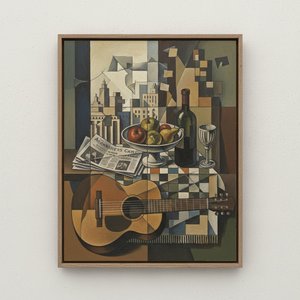
Juan Gris: Cubist Deconstruction & Synthesis – A Comprehensive Exploration
Explore the revolutionary art of Juan Gris – a master of Cubism. Discover his unique approach to deconstruction, vibrant Synthetic Cubist works, and lasting influence on modern art. Expert analysis for collectors.
Deconstructing Identity: A Comprehensive Exploration of Cubist Portraiture
Explore the revolutionary world of Cubist portraiture with our comprehensive guide. Discover Picasso, Braque, Gris & the movement's impact on modern art. Expert analysis for collectors and enthusiasts.


