

 Vezi în context
 Trimite
 Distribuie
 Detalii
 Ghidul

 Descarcă
 Produse similare
 Radiografie
 Diaporama
 Statistici
Crib Goch
 Acrylic On Canvas
- WallArt
- Welsh Landscape Painting
 Modern
 122.0 x 122.0 cm
 Gwynedd County Council Collection
 Citește mai mult
Reproducere pictată manual în ulei
Pictură în ulei pe pânză, realizată manual de artiștii noștri la dimensiunea și ramele dorite de dumneavoastră, pe comandă. ( Comută pe versiunea Print Treci la imagine digitală)




P118B lei10

P118H lei10

P118W lei10

P438Z lei10

P508JH lei12

P508YH lei12

P805H lei10

P805Z lei10

P919BZ lei10

P919G lei10

P919XJ lei10

P959ZH lei10

P968JZ lei12

W106C lei8

W218G lei10

W218JH lei8

W218Y lei10

W307PJ lei10

W316G lei10

W316PJ lei8

W316Y lei10

W398PJ lei8

W4111J lei10

W500HY lei15

W500JH lei15

W692G lei12

W849H lei8

W940BG lei15

W953PJ lei8




Alegeți dintre dimensiunile noastre prestabilite, care respectă proporțiile originale ale operei de artă.

Puteți introduce propriile dimensiuni pentru a se potrivi unui anumit cadru sau spațiu. Dacă dimensiunea selectată nu corespunde proporțiilor imaginii originale, vom decupa opera de artă sau vom extinde pictura cu elemente suplimentare pictate manual. O simulare digitală vă va fi trimisă pentru aprobare înainte de începerea producției.
Vă rugăm să rețineți că previzualizarea de pe ecran nu reflectă decuparea sau extinderea reală. Doar macheta va arăta cu exactitate compoziția finală.
Deși sunt disponibile dimensiuni personalizate, vă recomandăm să selectați o dimensiune din lista predefinită pentru a păstra proporțiile originale.
După plasarea comenzii, echipa OriginalUniqueArt.com va contacta clientul prin e-mail pentru instrucțiuni și îi va furniza o previzualizare a machetei
Livrare în întreaga lume () în 3-4 săptămâni, în loc de cele 5 săptămâni standard. (4 Octombrie). Fără compromisuri în ceea ce privește calitatea.

Livrare expres gratuită la nivel mondial

Pânză de in premium

Asigurare completă pentru transport

Garanție de rambursare a taxelor vamale

Garanția fidelității culorilor

Politica de retur în 100 de zile (doar pentru defecte)

Garanție de rambursare 100%

Reducere pentru comenzi multiple
 Opțiunea cu sticlă este disponibilă doar pentru dimensiuni de sub 110 cm

Crib Goch
Tip de reproducere
Dimensiune reproducere
-


Preț total
lei 1356
A Rugged Psalm of Snowdonia: Exploring John Kyffin Williams’ “Crib Goch”
John Kyffin Williams, a name now inextricably linked with the soul of Wales, possessed an extraordinary ability to translate the raw, elemental power of his homeland onto canvas. “Crib Goch,” painted in 1978-79, is not merely a landscape; it’s a visceral experience – a captured moment of drama and sublime beauty etched into oil on canvas. The painting depicts the iconic Crib Goch, a knife-edged arête rising dramatically from the Snowdonia National Park, its jagged silhouette dominating a twilight sky ablaze with the last vestiges of sunset. It's a scene that speaks to both the grandeur of nature and the inherent vulnerability within it.
Williams’ connection to this particular mountain was deeply personal, rooted in his upbringing on Anglesey. He frequently returned to the area throughout his life, sketching and absorbing its essence before translating those observations into his distinctive style. This wasn't simply a painter documenting a view; he was conveying a profound sense of belonging, a quiet reverence for the land that shaped his identity. The painting’s emotional core lies in this intimate relationship – a feeling of being both awestruck by and profoundly connected to the mountain’s formidable presence.
The Language of Impasto: Technique and Texture
Williams' technique is immediately arresting, characterized by thick, expressive impasto. He doesn’t shy away from applying paint with considerable force, building up layers of color that create a palpable sense of texture and depth. The ruggedness of the mountain face isn’t rendered through smooth gradients but rather through a deliberate manipulation of brushstrokes – short, decisive marks that mimic the jagged edges of rock and the swirling patterns of wind-blown clouds. Notice how he uses varying shades of ochre, umber, and burnt sienna to capture the warmth of the setting sun, while cooler blues and purples hint at the approaching night.
The use of palette knife is particularly notable, adding a sculptural quality to the surface of the painting. This technique allows Williams to build up areas of color with incredible intensity, creating highlights that seem to shimmer and catch the light. It’s as if you could reach out and feel the rough texture of the stone beneath your fingertips. The layering also contributes to the sense of atmosphere – a feeling of being enveloped by the vastness of the landscape.
Symbolism in the Welsh Landscape
“Crib Goch” is rich with symbolic resonance, deeply intertwined with Welsh folklore and identity. The mountain itself represents resilience, strength, and perhaps even a touch of danger—a challenge to be overcome. The arête, that precarious ridge line, embodies vulnerability alongside its majesty, mirroring the complexities inherent in the Welsh experience – a history marked by both triumph and hardship. The sunset, a recurring motif in Williams’ work, often symbolizes transition, closure, or perhaps even a longing for the past.
Furthermore, the painting's setting within Snowdonia, a region steeped in myth and legend, adds another layer of meaning. The mountains have long been considered sacred spaces in Welsh culture, imbued with spiritual significance. Williams’ depiction taps into this ancient connection, suggesting that “Crib Goch” is more than just a mountain; it’s a portal to the heart of Wales itself.
A Legacy of Landscape: Reproduction and Beyond
Reproductions of "Crib Goch" capture much of the original's power, but nothing truly replicates the tactile quality of Williams’ impasto technique. High-quality reproductions offer an excellent way to bring this iconic Welsh landscape into your home or office, serving as a constant reminder of the beauty and drama of the natural world. Consider framing options that complement the painting’s rich colors and textures – a simple wooden frame will allow the artwork to stand out, while a more ornate frame can add a touch of elegance.
For those seeking an authentic experience, exploring the Oriel Kyffin Williams Gallery in Llangefni, Anglesey, is highly recommended. It’s here that you can witness the original painting firsthand and gain a deeper appreciation for Williams' artistic vision. “Crib Goch” remains a powerful testament to his skill as a landscape painter and a poignant reflection of the enduring spirit of Wales.
Întrebări și răspunsuri
Care este dimensiunea de imprimare recomandată pentru "Crib Goch" de John Kyffin Williams?
Dimensiunea de imprimare recomandată pentru "Crib Goch" de John Kyffin Williams este Medium.
Care este tonul emoțional al operei "Crib Goch" de John Kyffin Williams?
"Crib Goch" este asociată cu un sentiment Calm. Tonul emoțional descrie impresia pe care o transmite lucrarea.
Din ce motive statutul drepturilor de autor pentru "Crib Goch" este cel actual?
Statutul drepturilor de autor pentru "Crib Goch" - încă protejată de drepturile de autor - derivă din decesul artistului în anul 2006.
Unde pot cumpăra o reproducere pictată manual a operei "Crib Goch" de John Kyffin Williams?
"Crib Goch" este disponibil sub formă de o reproducere pictată manual în ulei pe pânză de in. Comanda poate fi plasată pe această pagină, având la dispoziție mai multe dimensiuni.
„Crib Goch” este disponibil(ă) sub formă de print de fine art?
Pentru a achiziționa o printă a lucrării "Crib Goch" de John Kyffin Williams, trebuie doar să o comandați pe această pagină: o printă de fine art pe canvas din bumbac sau pe hârtie canvas arhivistică.
Care este culoarea dominantă în "Crib Goch" de John Kyffin Williams?
Culoarea care iese cel mai mult în evidență în "Crib Goch" este Phthalo Green (#1d1e1c). Culoarea dominantă este utilă atunci când asortați o operă de artă cu un interior.
Cine a creat "Crib Goch"?
„Crib Goch” a fost creat de John Kyffin Williams. Informațiile de pe această pagină descriu opera originală a lui John Kyffin Williams.
Biografie artist
A Defining Voice of Welsh Landscape
Sir John “Kyffin” Williams, a name inextricably linked to the very essence of Wales, stands as one of the most significant figures in 20th-century British art. More than just a painter, he was a cultural chronicler, an interpreter of the rugged beauty and profound emotional depth of his homeland—a storyteller who translated its landscapes onto canvas with unparalleled skill and sensitivity. Born in Llangefni, on the Isle of Anglesey, in 1918, Williams’s life journey mirrored the textured complexity of the Welsh terrain itself: a blend of quiet resilience, unexpected challenges, and an unwavering dedication to capturing the spirit of his birthplace. His connection to Wales wasn't merely geographical; it was deeply ingrained within his being—a heritage nurtured by family history and shaped by early experiences that would ultimately fuel his artistic vision.Early Life and Unexpected Challenges
Williams’s path to becoming Wales’s foremost artist wasn’t paved with ease or certainty. Educated initially at Moreton Hall School near Chirk and later at Shrewsbury, a period marked by feelings of isolation and dissatisfaction, his life took an unexpected turn following a bout of polio encephalitis in 1924. This illness left him with epilepsy, a condition that would profoundly impact his life and, paradoxically, become a catalyst for artistic exploration. Doctors advised him to pursue art as a form of therapy—a suggestion that proved transformative. It was during this period that he encountered the works of Piero della Francesca, an encounter that ignited within him a lifelong passion for capturing light, atmosphere, and emotion on canvas. A brief but formative stint in the 6th Battalion Royal Welch Fusiliers was cut short due to his medical condition, yet it wasn’t a detour; rather, it provided a temporary respite before he enrolled at London's Slade School of Fine Art during its wartime relocation to Oxford. At the Slade, under the guidance of influential figures like Randolph Schwabe and Allan Gwynne-Jones, Williams honed his technical skills and developed his distinctive style—a style characterized by bold brushstrokes, rich colors, and a masterful use of impasto. He won the prestigious Slade Portrait Prize in 1944, a remarkable achievement that established him as a promising young artist. The war years brought further challenges, including the loss of friends and colleagues, but also deepened his commitment to art as a means of understanding and expressing the human condition.Teaching, Travel, and Artistic Evolution
Following his time at the Slade, Williams dedicated many years to teaching art at Highgate School in London from 1944 until 1973—a role that not only sustained him financially but also allowed him to nurture the artistic talents of countless young students. However, it was a Winston Churchill Fellowship awarded in 1968 that dramatically shifted the trajectory of his artistic life. This opportunity enabled him to travel to Y Wladfa, the Welsh settlement in Patagonia—a remote and windswept region in Argentina—an experience that profoundly shaped his palette, subject matter, and overall artistic vision. The vast, dramatic landscapes of Patagonia, so strikingly different yet echoing the spirit of Wales, infused his work with a new sense of scale, light, and emotional intensity. He meticulously documented this journey through paintings, sketches, and a compellingly anecdotal book titled “Across the Straits.”Technique, Themes, and Recognition
Kyffin Williams’s artistic technique was instantly recognizable—a bold departure from traditional landscape painting. He employed thick oil paint applied with a palette knife, creating textured surfaces that seemed to shimmer with light and movement. This wasn't merely a stylistic choice; it was a deliberate attempt to capture the ruggedness of the Welsh mountains, the weight of its history, and the emotional resonance of its landscapes. His subjects ranged from intimate portraits of rural life to sweeping vistas of Snowdonia National Park, capturing both the grandeur and the quiet beauty of Wales. He also explored the evocative atmosphere of Venice, Italy, translating the city’s light, color, and architectural details onto canvas with remarkable sensitivity. Throughout his career, Williams received numerous accolades—an OBE in 1982 and a KBE in 1999 for his contributions to the arts in Wales—testaments to his enduring influence and artistic merit.A Lasting Legacy
Sir John Kyffin Williams’s legacy extends far beyond the canvases he created. He was a cultural ambassador, a chronicler of Welsh identity, and an inspiration to generations of artists. His paintings continue to resonate with viewers today, evoking a sense of place, history, and emotional depth—a testament to his extraordinary talent and unwavering dedication to capturing the soul of Wales. The Oriel Ynys Môn on Anglesey houses a permanent exhibition dedicated to his work, ensuring that his artistic vision will be cherished and celebrated for years to come. Kyffin Williams wasn’t simply a painter; he was a poet of the landscape—a master who transformed the beauty of Wales into enduring works of art.
John Kyffin Williams
1918 - 2006 , Marea Britanie
Informații rapide
- Artistic Movement Or Style: Pictură de peisaj
- Artists Or Movements Influenced By This Artist: ['Artă modernă']
- Artists Who Influenced This Artist: ['Piero della Francesca']
- Date Of Birth: 1918
- Date Of Death: 2006
- Full Name: John Kyffin Williams
- Nationality: Welsh
- Notable Artworks:
- Storm Approaching
- View from Pwllfanogl
- Place Of Birth: Llangefni, UK
Articole conexe
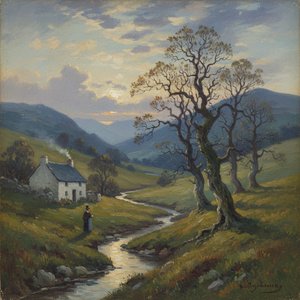
Penry Williams: Evoking Welsh Nostalgia Through Impressionistic Landscapes
Explore the captivating world of Penry Williams (1802-1885), a Welsh artist renowned for his evocative Impressionistic landscapes and scenes of Italy. Discover his life, style & legacy with OriginalUniqueArt.

Evocations of Place: A Historical Journey Through Landscape Art
Explore the rich history of landscape art with OriginalUniqueArt. Discover renowned artists, movements like Impressionism & Romanticism, and expert guidance for collecting timeless pieces. Find your perfect serene escape today!

Evocations of Place: A Historical Journey Through Landscape Art
Explore the rich history of landscape art with OriginalUniqueArt. Discover renowned artists, movements like Impressionism & tonalism, and expert guidance for collecting timeless pieces. Find your perfect serene escape today!

Peisaje Romantice Iconice: 10 Capodopere Artistice pentru Decorul de Lux
Descoperă 10 capodopere romantice iconice de Caspar David Friedrich, Turner și alți maeștri. Explorează istoria artei, emoțiile din peisaje și găsește tablouri canvas perfecte pentru decorul tău pe OriginalUniqueArt.com!

John Constable: Cele Mai Frumoase 25 de Capodopere – Artă Clasică pentru Decorul Casei Tale
Descoperă cele mai frumoase 25 de picturi ale lui John Constable, maestru al peisajului englezesc! Explorează stilul romantic, Dedham Vale și capodopere precum The Hay Wain. Reproduceri artă clasică pentru decorul casei tale – OriginalUniqueArt.com.


