Previzualizare
 Trimite
 Distribuie
 Detalii despre lucrare

 Descarcă
 Produse similare
 Radiografie
 Diapozitive automate
Four Panels from Untitled C/D


 Vezi mai mult
Giclée / Imprimare artistică
Printuri giclée sau pe canvas de calitate muzeală, cu proces de producție rapid și opțiuni flexibile de finisare. ( Comandă pictură lucrată manual Cumpără imaginea)




P118B $10

P118H $10

P118W $10

P438Z $10

P508JH $12

P508YH $12

P805H $10

P805Z $10

P919BZ $10

P919G $10

P919XJ $10

P959ZH $10

P968JZ $12

W106C $8

W218G $10

W218JH $8

W218Y $10

W307PJ $10

W316G $10

W316PJ $8

W316Y $10

W398PJ $8

W4111J $10

W500HY $15

W500JH $15

W692G $12

W849H $8

W940BG $15

W953PJ $8




Alegeți dintre dimensiunile noastre prestabilite, care respectă proporțiile originale ale operei de artă.

Puteți introduce propriile dimensiuni pentru a se potrivi unui anumit cadru sau spațiu. Dacă dimensiunea selectată nu corespunde proporțiilor imaginii originale, vom decupa lucrarea de artă sau vom extinde imaginea cu margini oglindite sau cu o culoare uniformă. Un mockup digital va fi trimis pentru aprobarea dumneavoastră înainte de începerea producției.
Vă rugăm să rețineți că previzualizarea de pe ecran nu reflectă decuparea sau extinderea reală. Doar mockup-ul va arăta cu exactitate compoziția finală.
Deși dimensiunile personalizate sunt disponibile, vă recomandăm să selectați o dimensiune din lista predefinită pentru a păstra proporțiile originale.
Livrare în întreaga lume () în 2 săptămâni, în loc de cele 4/5 săptămâni standard. (17 August)

Livrare expres gratuită la nivel mondial

Pânză de in de înaltă calitate

Asigurare completă pentru transport

Garanție de rambursare a taxelor vamale

Garanția fidelității culorilor

Politica de retur în 60 de zile (doar pentru defecte)

Garanție de rambursare 100%

Ofertă pentru comenzi multiple
 Opțiunea cu sticlă este disponibilă doar pentru dimensiuni de sub 110 cm

Four Panels from Untitled C/D
Giclée / Imprimare artistică
Dimensiune reproducere
-


Preț total calculat
$ 80
Descriere obiect de colecție
A Symphony of Monochrome and Form
In the quiet, commanding presence of Jasper Johns’ Four Panels from Untitled C/D, one finds an intricate puzzle that transcends mere visual representation. This work stands as a profound testament to the transformative era of American art following World War II, capturing the very essence of experimentation that bridged the gap between the raw emotion of Abstract Expressionism and the cool, calculated precision of Pop Art. The painting invites the viewer into a monochromatic realm where texture and shape perform a delicate dance. Through his masterful manipulation of light and shadow, Johns achieves an austere beauty, presenting a composition that is simultaneously stark and deeply layered, demanding a slow, contemplative gaze to uncover its hidden complexities.
The Tension Between the Organic and the Ideal
At the heart of this piece lies a deliberate dialogue between two seemingly disparate elements: the rock and the diamond. Johns utilizes these symbols to explore the fundamental duality of existence. The rocks, with their irregular, organic textures, evoke a sense of grounding and stability, connecting the viewer to primal, earthly forces. In striking contrast, the scattered diamonds introduce a geometric precision that symbolizes aspiration, brilliance, and an idealized vision of perfection. This juxtaposition creates a palpable visual tension, as the weight of the stone meets the ethereal light of the gem. For the discerning collector or interior designer, this interplay offers a sophisticated focal point, where the ruggedness of nature meets the refined elegance of geometry, making it a versatile masterpiece for any curated space.
A Legacy of Perception and Presence
Beyond its striking aesthetics, Four Panels from Untitled C/D is an intellectual journey into how we perceive the world around us. By choosing to depict "what he sees," Johns moved away from the purely emotive outbursts of his predecessors, opting instead for a visual language rooted in concrete, recognizable references. This shift toward a more rational, observational approach laid the groundwork for Minimalism and redefined the boundaries of modern art. To possess or display a reproduction of this work is to engage with a pivotal moment in art history—a moment where the artist stripped away the unnecessary to reveal the profound essence of form and materiality. It remains an enduring icon of intellectual engagement, offering a timeless elegance that resonates within the contemporary soul.
Biografie artist
A Life Painted in Symbols: The World of Jasper Johns
Jasper Johns emerged as a pivotal figure in the landscape of American art, bridging the emotive intensity of Abstract Expressionism with the burgeoning Pop Art movement that would soon redefine artistic boundaries. Born in Augusta, Georgia, in 1930, his early life was marked by a sense of displacement following his parents’ divorce, an experience that perhaps subtly informed his later explorations of identity and belonging within the context of American iconography. His formative years unfolded across various schools before he briefly attended the University of South Carolina, but it wasn't until his move to New York City in 1949 that Johns truly began to forge his artistic path. A period of service during the Korean War further shaped his perspective, exposing him to a world far removed from the burgeoning art scene he was eager to embrace upon his return.Breaking with Abstraction: The Dawn of a New Visual Language
The post-war American art world was dominated by Abstract Expressionism—a style characterized by spontaneous gesture and deeply personal emotional expression. While initially influenced by this movement, Johns felt compelled to move beyond its purely non-representational approach. He sought a new visual language, one that incorporated recognizable imagery not as illustrations but as vehicles for deeper contemplation. This wasn’t simply about *depicting* the world; it was about questioning how we perceive and interpret symbols within it. Key influences guided his departure: Marcel Duchamp's radical readymades challenged conventional notions of art-making, demonstrating that ordinary objects could be elevated to the status of art through their presentation, while the emphasis on materiality in Abstract Expressionism informed Johns’ early techniques. However, it was the everyday objects and potent symbols of American culture—flags, targets, maps, numbers—that truly became central to his artistic vocabulary. He wasn’t interested in escaping representation; he wanted to dissect it, layer it with meaning, and ultimately reveal its inherent ambiguities. This deliberate shift away from pure abstraction signaled a profound change in the way art was conceived and created.Iconic Images: Flags, Targets, and the Language of Symbols
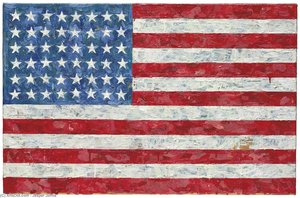
Johns' breakthrough works arrived in the mid-1950s, instantly establishing him as a force to be reckoned with. His paintings of flags, most notably *Flag* (1954–55), were not patriotic declarations but rather investigations into the very nature of representation. Rendered in a semi-abstract style, using encaustic—pigment mixed with hot wax—and collage techniques, these flags weren’t simply images; they were textured surfaces laden with symbolic weight. The image of the flag itself became a complex symbol, representing not just American identity but also notions of order, authority, and even the act of painting itself. The target series, beginning in 1958, further explored this fascination with recognizable forms, questioning perception and meaning through the seemingly straightforward image of a bullseye. *Map* (1961), with its fragmented and layered depictions of the United States, delved into themes of geography, identity, and the complexities of national representation. Works like *False Start* (1959) demonstrated his experimentation with language and visual codes, creating complex compositions that challenged viewers to decipher their underlying meanings. Even *White Flag* (1955), a seemingly simple monochrome canvas, prompted profound questions about absence, surrender, and the very act of seeing. These recurring motifs weren’t presented as literal depictions but rather as invitations to engage in a deeper, more critical examination of visual language.Technique and Materials: Encaustic, Collage, and Layering
Jasper Johns' artistic process was characterized by meticulous attention to detail and a willingness to experiment with various materials and techniques. He frequently employed encaustic—a mixture of pigment and hot wax—to create textured surfaces and layered effects, lending his paintings a tactile quality that contrasted sharply with the smooth surfaces often associated with Abstract Expressionism. Collage played a crucial role in many of his early works, incorporating elements such as newspaper clippings, maps, and photographs to disrupt traditional notions of representation and introduce layers of meaning. Johns’ use of these materials wasn't merely decorative; it was integral to his conceptual approach, forcing viewers to consider the relationship between image, object, and context. He often worked on multiple canvases simultaneously, revisiting and reworking elements over time—a process that reflected his deliberate and contemplative artistic practice. The layering of paint, collage, and other materials created a complex visual tapestry, inviting repeated viewing and encouraging viewers to uncover hidden meanings within each work.Recognition and Enduring Impact
Jasper Johns has received numerous accolades throughout his illustrious career. He was awarded the Golden Lion at the Venice Biennale in 1988, the National Medal of Arts in 1990, and the Presidential Medal of Freedom in 2011—recognizing his profound contribution to American art. His works are held in major museum collections worldwide—the Museum of Modern Art, the Whitney Museum of American Art, the Metropolitan Museum of Art in New York, and Tate Modern in London, to name just a few. Johns’ influence extends beyond individual artworks; he fundamentally shifted the boundaries of artistic practice, paving the way for subsequent generations of artists who embraced pop culture imagery and challenged traditional notions of representation. His legacy continues to inspire artists today, solidifying his position as one of the most important figures in 20th-century art. He remains an active artist, constantly evolving his approach and solidifying his place within the canon of modern masters.
Jasper Johns
1930 - , Statele Unite ale Americii
Detalii rapide
- Artistic Movement Or Style: Pop Art, Abstract Exp.
- Artists Or Movements Influenced By This Artist: ['Andy Warhol']
- Artists Who Influenced This Artist: ['Marcel Duchamp']
- Date Of Birth: 15 mai 1930
- Full Name: Jasper Johns
- Nationality: American
- Notable Artworks:
- Flag
- Target
- Map
- Place Of Birth: Augusta, USA
Articole similare

Cele mai importante 10 capodopere ale abstracției geometrice | Artă & Decor de lux pe OriginalUniqueArt.com
Descoperă cele mai importante 10 capodopere ale abstracției geometrice! Explorează istoria, artiștii (Mondrian, Kandinsky) și culorile vibrante care au definit arta modernă. Reproduceri de tablouri de lux pe OriginalUniqueArt.com pentru un decor interior rafinat. Explorează colecția online!

Wassily Kandinsky: Cele Mai Iconice 25 De Opere – Artă Abstractă pentru Decor Rafinat
Descoperă cele mai emblematice 25 de opere ale lui Wassily Kandinsky, pionierul artei abstracte! Explorează culorile vibrante, compozițiile unice și istoria fascinantă din spatele fiecărei picturi. Reproduceri de calitate muzeală pe OriginalUniqueArt.com – inspiră-ți decorul cu artă modernă!

Neo-Abstract Art: The High-Impact Evolution of Modern Visual Energy and Geometric Sophistication
Discover the power of Neo-Abstract art. Explore how bold geometric forms and high-impact visual energy are redefining modern design. Learn to curate sophisticated, high-energy spaces with the latest trends in contemporary abstraction and structural color.

Beyond Form & Color: Geometric Abstraction's Evolution in 20th/21st Century Art
Explore the evolution of geometric abstraction from Cubism to contemporary art. Discover key artists like Malevich & Mondrian, investment insights, and expert collecting advice at OriginalUniqueArt.
Beyond Form & Color: Geometric Abstraction's Enduring Legacy in Art History
Explore the captivating world of geometric abstraction! Discover its origins, key artists like Malevich & Mondrian, and why this movement remains highly valued by art collectors today. Expert insights at OriginalUniqueArt.