
 Previzualizare
 Trimite prin felicitare
 Distribuie
 Detalii despre lucrare
 Ghid
Ghid

 Descarcă imaginea
 Produse similare
 Radiografie
 Galerie foto
 Întrebări și răspunsuri
 Statistici
Alessandro de' Medici


 Vezi mai mult
Giclée / Imprimare artistică
Printuri giclée sau pe canvas de calitate muzeală, cu proces de producție rapid și opțiuni flexibile de finisare. ( Comandă pictură realizată manual Comută pe Imagine Digitală)




P118B lei10

P118H lei10

P118W lei10

P438Z lei10

P508JH lei12

P508YH lei12

P805H lei10

P805Z lei10

P919BZ lei10

P919G lei10

P919XJ lei10

P959ZH lei10

P968JZ lei12

W106C lei8

W218G lei10

W218JH lei8

W218Y lei10

W307PJ lei10

W316G lei10

W316PJ lei8

W316Y lei10

W398PJ lei8

W4111J lei10

W500HY lei15

W500JH lei15

W692G lei12

W849H lei8

W940BG lei15

W953PJ lei8




Alegeți dintre dimensiunile noastre prestabilite, care respectă proporțiile originale ale operei de artă.

Introduceți lățimea și înălțimea necesare pentru a se potrivi ramei sau peretelui dumneavoastră. O printare poate fi doar tăiată, niciodată extinsă dincolo de dimensiunea imaginii originale, astfel încât o dimensiune cu o formă diferită va pierde o parte din imagine. Vă trimitem o simulare digitală pentru aprobare înainte de a imprima orice. Imaginea afișată pe această pagină nu prezintă tăierea reală — doar simularea arată acest lucru.
Livrare în întreaga lume () în 2 săptămâni, în loc de cele 4/5 săptămâni standard. (7 Noiembrie)

Livrare expres gratuită la nivel mondial

Pânză de in de înaltă calitate

Asigurare completă pentru transport

Garanție de rambursare a taxelor vamale

Garanția fidelității culorilor

Politica de retur în 100 de zile (doar pentru defecte de fabricație)

Garanție de rambursare 100%

Ofertă pentru comenzi multiple
 Opțiunea cu sticlă este disponibilă doar pentru dimensiuni de sub 110 cm

Alessandro de' Medici
Giclée / Imprimare artistică
Dimensiune reproducere
-


Preț total calculat
lei 386
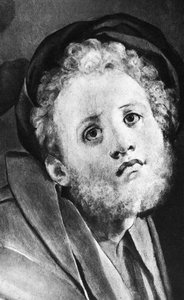
The Soul Beneath the Crown: A Study in Mannerist Melancholy
In the quiet, tension-filled corridors of 16th-century Florence, a new kind of portraiture began to emerge—one that sought not to flatter the sitter with outward glory, but to expose the profound psychological tremors beneath their skin. Jacopo Carucci, known more evocatively as Pontormo, achieved this feat masterfully in his 1535 masterpiece, Alessandro de' Medici. This is not merely a record of a ruler’s likeness; it is an intimate encounter with a soul caught in the crosswinds of political instability and personal introspection. As one gazes upon the face of the first Duke of Florence, there is an immediate sense of being drawn into a private moment of contemplation, where the weight of a turbulent reign is visible in the very shadows of the eyes.
The composition eschews the grand, sweeping landscapes and opulent backdrops typical of High Renaissance portraiture. Instead, Pontormo employs a deliberate simplicity, focusing the viewer’s entire attention on the upper torso and the hauntingly expressive face of Alessandro. By stripping away the distractions of worldly wealth, the artist forces an encounter with the subject's humanity. The minimal background serves to isolate the Duke, creating a vacuum of space that amplifies his sense of solitude. This stylistic choice is quintessential to the Mannerist movement, where the goal was to move beyond mere anatomical accuracy toward a more heightened, expressive, and often unsettling emotional truth.
Technique and the Language of Light
To behold this work is to witness the exquisite technical prowess of Pontormo’s brush. Utilizing oil on canvas, the artist layered pigments with a meticulous sensitivity that allows for breathtaking tonal gradations. The lighting is soft, almost diffused, as if filtered through the heavy atmosphere of a Tuscan twilight. This gentle illumination does not strike the subject with dramatic force; rather, it caresses the contours of the face, creating subtle transitions between light and shadow that lend a startling three-dimensional vitality to the skin. Such mastery of sfumato and tonal modulation allows the viewer to perceive the slight tension in the brow and the reflective depth within the gaze.
The color palette is a sophisticated arrangement of muted earth tones—deep browns, creamy highlights, and somber blacks, punctuated by subtle, bruised reds. These colors do not shout; they whisper of gravity and importance. The textures, though appearing smooth to the eye, possess an underlying complexity that suggests the heavy, fine fabrics of ducal attire. For the discerning collector or interior designer, this painting offers a profound sense of gravitas. It is a piece that does not demand attention through garishness but commands it through its quiet, undeniable presence, making it an ideal centerpiece for spaces designed for reflection, study, or sophisticated conversation.
A Legacy of Emotional Resonance
Beyond the technical brilliance lies the historical and symbolic heartbeat of the piece. Alessandro de' Medici lived a life defined by transition and uncertainty, and Pontormo captures this zeitgeist with uncanny precision. The elongated forms and slightly distorted perspectives characteristic of Mannerism serve as visual metaphors for a world where the stable proportions of the Renaissance were fracturing. There is an inherent ambiguity in the subject’s expression—is it pride, or is it sorrow? Is it the composure of a leader, or the mask of a man burdened by his station?
This ambiguity is precisely what gives the portrait its enduring power. It invites the viewer to participate in the interpretation, making every encounter with the artwork a new discovery. For those seeking to adorn their homes or galleries with works of significant intellectual and emotional depth, a high-quality reproduction of this Pontormo masterpiece offers more than just aesthetic beauty; it offers a window into the complexities of the human condition. It is an invitation to dwell in the presence of greatness, even in its most vulnerable and melancholic moments.
Întrebări și răspunsuri
Care este atmosfera generală a operei "Alessandro de' Medici" de Jacopo Pontormo?
Ambianta generală a operei "Alessandro de' Medici" de Jacopo Pontormo este Dramatic. Această stare descrie atmosfera generală a lucrării.
Există o prezentare de diapozitive pentru "Alessandro de' Medici" de Jacopo Pontormo?
Diaporama pentru "Alessandro de' Medici" poate fi vizualizată pe pagina Galerie foto a operei de artă.
Care sunt drepturile de reproducere pentru "Alessandro de' Medici" la Institutul de Artă din Chicago?
"Alessandro de' Medici" de Jacopo Pontormo, păstrat la Institutul de Artă din Chicago, este în domeniul public – drepturile de autor au expirat. Acest statut determină dacă pot fi realizate reproduceri ale imaginii.
Biografie artist
Jacopo Pontormo (1494 – 1557/7): Bridging Renaissance and Baroque Expression
Jacopo Pontormo, născut Jacopo Carucci în Pontorme, Toscana, circa 1494, reprezintă o figură unică în cadrul mișcării artistice florentine Manneristă – un pictor care a sfidat convențiile și a creat propriul drum către inovație artistică. Spre deosebire de mulți contemporani care se strădau să atingă o frumusețe idealizată, ancorată în idealurile clasice, Pontormo a îmbrățișat intensitatea emoțională și complexitatea psihologică, devenind astfel unicul mediator între grația solemnă a Renașterii înalte și dinamismul dramatic al perioadei Barocului. Viața sa a fost marcată de talent prodigios și de tragedie personală, modelând operele sale într-un testament al viziunii artistice temperată de o tristețe profundă. Formarea Timpurie și Influențele: Anii de formare ai lui Pontormo au fost petrecuți sub îndrumarea lui Domenico del Pollaiuolo și Michelangelo Buonarroti – artiști ale căror măiestrii în realismul anatomic și forma sculpturală au avut un impact profund asupra dezvoltării sale stilistice. Deși recunoștea moștenirea Renașterii, Pontormo s-a distanțat rapid de formalismul său rigid, orientându-se către o abordare mai expresivă, influențată de tradițiile artistice nord-europene. În mod deosebit, a studiat gravurile lui Albrecht Dürer, absorbind tehnici pentru a exprima emoția prin imagini stilizate și inovații compoziționale. Această expunere la Mannerismul nordic s-a dovedit a fi instrumentală în modelarea limbajului său vizual distinctiv. Influența lui Dürer este evidentă în atenția acordată detaliilor, expresiilor faciale și compozițiilor complexe. Stilul Mannerist: Crizisul artistic al lui Pontormo a avut loc în jurul anului 1515 cu comisia “Vizitarea”, o altă pictură monumentală pentru Santissima Annunziata din Arezzo – o operă de artă care l-a consacrat imediat drept un champion al esteticilor Manneriste. Caracterizată de figuri întinse, perspective aplatizate și draperii învolburate îmbibate cu palete vibrante de culori, stilul lui Pontormo a respins obsesia Renașterii pentru acuratețea anatomică și proporțiile armonioase. În schimb, el a pus accent pe transmiterea stărilor psihologice – disperare, durere, extaz – prin forme distorsionate și relații spațiale ambigue. Această abatere deliberată de la convențiile stabilite a semnalat o reînțelegere radicală a reprezentării artistice, anticipând inovațiile dramatice care ar defini perioada Barocului. Alți pictori influențați de Pontormo au fost Rosso Fiorentino și Bartolomeo Bonfiglioni. Lucrări Notabile și Moștenirea: Operele lui Pontormo au cuprins o gamă diversă de subiecte – scene religioase, portrete și compoziții mitologice – fiecare impregnată cu sensibilitatea sa Manneristă distinctivă. Printre cele mai renumite picturi se numără “Joseph’s Coat Sold to the Egyptians”, “Depunerea” și “Sfântul Francisc primind stigmatul” – opere care exemplifică manipularea sa magistrală a culorilor, luminii și texturii pentru a evoca o rezonanță emoțională profundă. Portretele sale, în special cele pictate pentru curtea florentină a familiei Medici, dezvăluie o înțelegere perspicace a nuanțelor psihologice și o implicare subtilă a convențiilor stilistice Manneriste. Pontormo nu numai că a fost un artist prolific, ci și un maestru al desenului, creând numeroase schițe și studiouri care au influențat generațiile următoare de pictori florentini. Dezvoltarea Stilistică: În anii următori, stilul lui Pontormo s-a perfecționat, caracterizat de o utilizare intensivă a culorilor vii, a formelor distorsionate și a compozițiilor dinamice. A fost un maestru al expresiei emoționale, folosind tehnici inovatoare pentru a crea imagini puternice și memorabile. În special, picturile sale din perioada târziei Renașteri au fost influențate de stilul lui Michelangelo, în special prin utilizarea culorilor vii și a formelor distorsionate.Principalele Lucrări
- Vizitarea (1528) – O operă emblematică care ilustrează intensitatea emoțională și inovațiile compoziționale ale lui Pontormo.
- Depunerea (1504) – Un alt exemplu al stilului său caracteristic, cu figuri întinse și o paletă de culori vibrante.
- Sfântul Francisc primind stigmatul (1528-1530) – O pictură care demonstrează abilitatea lui Pontormo de a exprima emoții profunde prin forme distorsionate și compoziții dinamice.
Influențe
- Albrecht Dürer – Gravurile sale au influențat modul în care Pontormo a folosit stilizarea și expresia emoțională în pictură.
- Michelangelo Buonarroti – Stilizarea figurilor, compozițiile dinamice și utilizarea culorilor vii ale lui Michelangelo au avut un impact asupra dezvoltării stilului lui Pontormo.
Moștenirea Artistică
- Pontormo a fost un pionier al Mannerismului, care a influențat generații de artiști florentini.
- Operele sale au fost admirate pentru expresivitatea lor emoțională, inovațiile compoziționale și utilizarea culorilor vibrante.
Legături Utile
- Vizitarea: Admirați fresca impresionantă „Vizitarea” de Jacopo Pontormo, un simbol al devotamentului renascentist! Reproducere artistică realizată manual pentru iubitorii de artă și colecționarii.
- Tintoretto: Descoperi măiestria lui Tintoretto (Jacopo Comin), un maestru venețian al Renașterii, renumit pentru compoziții dramatice, tehnica expresivă ('Il Furioso') și utilizarea inovatoare a luminii & perspectivei. Explorează operele sale iconice și moștenirea sa!
- Pontormo (Jacopo Carucci) - Getty Museum: Explorează colecția Muzeului Getty din Los Angeles, care include operele lui Pontormo.
Jacopo Pontormo
1494 - 1557 , Italia
Detalii rapide
- Artistic Movement Or Style: Mannerismo
- Artists Or Movements Influenced By This Artist:
- Michelangelo
- Rosso Fiorentino
- Artists Who Influenced This Artist:
- Leonardo da Vinci
- Andrea del Sarto
- Date Of Birth: 1494
- Date Of Death: 1557/7
- Full Name: Jacopo Pontormo
- Nationality: Italian
- Notable Artworks:
- Vizitarea
- Depozitia
- Halberdier
- Place Of Birth: Pontorme, Italia
Articole similare

Cu privire la noi
Descoperă povestea noastră! Aduceți arta de talie mondială în viața dumneavoastră prin selecție expertă, creații personalizate și previzualizări gratuite. Aprobate de persoane fizice și companii din 2000.

Goya: Cele Mai Iconice Capodopere – Artă Spaniolă pentru Decor Rafinat | OriginalUniqueArt.ro
Descoperă cele mai frumoase 25 de picturi ale lui Francisco Goya! Explorează capodoperele romantice, portretele impresionante și gravurile puternice. Reproduceri artă spaniolă de calitate muzeală pentru un decor rafinat. Explorează colecția completă online pe OriginalUniqueArt.com

The Enduring Legacy of Fine Art Prints: Technique, History & Aesthetic Impact
Explore the rich history & techniques of fine art prints. Discover investment potential, assess authenticity, and learn how to preserve your collection with expert guidance. Trusted insights for discerning collectors.

Jacopo Pontormo: A Bridge Between Renaissance Tradition & Mannerist Emotion
Explore the captivating world of Jacopo Pontormo, a pivotal Italian Mannerist painter. Discover his unique style, influences & masterpieces – and find museum-quality reproductions at OriginalUniqueArt.

Giclée Prints: Archival Quality & Aesthetic Nuances for the Discerning Collector
Explore the world of giclée prints with OriginalUniqueArt. Learn about archival quality, aesthetic nuances & investment potential. Expert guidance for discerning art collectors seeking museum-quality reproductions and lasting value.


