
 Previzualizare
 Trimite
 Distribuie
 Detalii despre lucrare

 Descarcă
 Produse similare
 Radiografie
 Diapozitive automate
Landscape


 Vezi mai mult
Achiziționați o imagine digitală de înaltă rezoluție, îmbunătățită, mult superioară previzualizării online.
Fiecare fișier este pregătit cu meticulozitate de specialiștii noștri interni, utilizând instrumente avansate și retușare manuală expertă. Ne asigurăm că fiecare imagine beneficiază de o claritate excepțională, o acuratețe precisă a culorilor și detalii fine.
Fișierul final este livrat prin e-mail în termen de 72 de ore, optimizat pentru utilizare imediată în medii profesionale, editoriale și de imprimare. Aceasta este aceeași calitate în care au încredere studiouri de design, edituri și galerii de top.
Imagine Digitală
Descărcați un fișier la rezoluție înaltă pentru afișare personală, imprimare și proiecte creative. ( Comandă printul Comandă pictură lucrată manual)
Inclus în fiecare comandă de imagini digitale
Livrare digitală de expertiză, garantată
Când alegeți OriginalUniqueArt.com, nu primiți doar o simplă imagine – primiți o operă de artă digitală îmbunătățită profesional, creată cu precizie și susținută de o garanție de satisfacție. Iată tot ceea ce primești odată cu comanda ta, în mod automat:

Livrare rapidă prin e-mail
Fișierul imaginii digitale la rezoluție înaltă vă va fi trimis prin e-mail în termen de 72 de ore de la finalizarea comenzii – gata pentru utilizare imediată.

Fișier digital optimizat prin IA
Opera ta de artă este optimizată profesional prin intermediul unor instrumente AI avansate și al editării manuale, asigurând un nivel maxim de detalii, claritate și acuratețe a culorilor.

Retransmitere gratuită pe viață
Ai șters sau ai pierdut din greșeală fișierul? Nu îți face griji – ți-l vom retrimite oricând, gratuit.

Fără taxe de import – Întotdeauna
Bucură-te instant de noua ta operă de artă, fără taxe vamale, taxe de import sau costuri de livrare – descărcările digitale sunt întotdeauna fără taxe.

Garanția acurateții culorilor
Asigurăm o reflectare cât mai fidelă a culorilor originale în imaginea ta digitală, prin utilizarea unor instrumente profesionale și a proceselor de gestionare a culorii.

Garanție de satisfacție de 60 de zile
Dacă nu sunteți mulțumit de imaginea digitală achiziționată, o vom revizui sau vă vom returna 100% în termen de 60 de zile – fără nicio explicație necesară.

Garanție de returnare 100% a banilor
Nu ești mulțumit? Obține o rambursare completă în termen de 60 de zile de la primirea fișierului tău digital – fără întrebări.

Reduceri pentru comenzi în volum
Cumpără 3 imagini, economisește 10% - Cumpără 5, economisește 15% - Cumpără 10+, economisește 20%. Ideal pentru proiecte creative, galerii și agenții.
Descriere obiect de colecție
A Moment Frozen: The Poetic Landscape of Homer Dodge Martin
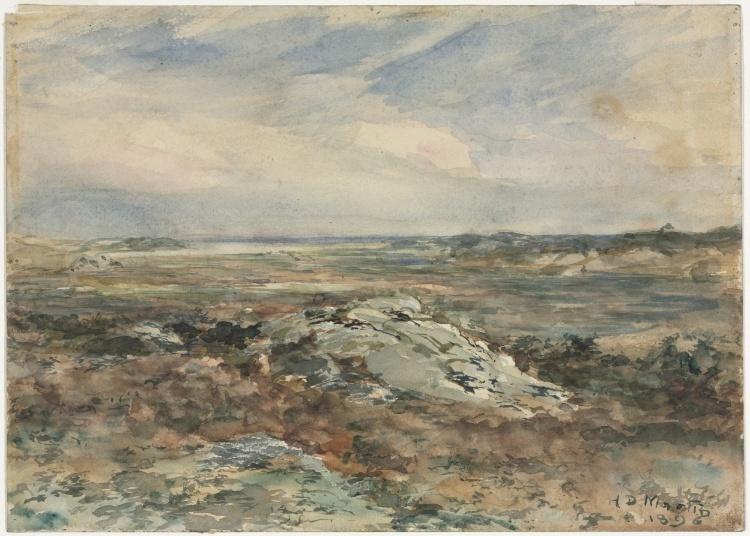
Homer Dodge Martin's "Landscape," painted circa 1865, isn’t merely a depiction of a vista; it’s an immersion into a specific mood—a quiet contemplation of the vastness and solitude of nature. Born in Albany, New York, in 1836, Martin navigated the shifting currents between the established realism of the Hudson River School and the burgeoning possibilities of Impressionism, forging a unique style characterized by a profound sensitivity to light, atmosphere, and the emotional resonance of the natural world. This particular work exemplifies his mastery of capturing fleeting impressions, prioritizing feeling over precise representation – a hallmark of his artistic journey.
The scene unfolds across rolling hills that recede into a hazy horizon, dominated by an overcast sky pregnant with suggestion rather than explicit detail. There’s no dramatic sun or sharp delineation of form; instead, Martin employs a masterful use of wet-on-wet watercolor techniques, allowing colors to bleed and mingle seamlessly. The brushstrokes are loose and expressive, creating a sense of movement and fluidity that mirrors the gentle undulations of the landscape itself. The foreground is particularly textured, utilizing dry brushwork to suggest the roughness of rocks and vegetation – tangible elements grounding the viewer in this imagined space.
Echoes of the Barbizon School: Light, Color, and a Sense of Place
Martin’s approach bears a clear kinship with the Barbizon school of French landscape painters, who sought to capture the essence of nature through direct observation and a focus on atmospheric effects. Like his contemporaries, he eschewed meticulous detail in favor of conveying the *feeling* of a place – its light, its air, its inherent stillness. The muted palette—dominated by browns, greens, grays, and subtle blues—contributes significantly to this effect. The colors aren’t vibrant or saturated; they are subdued and atmospheric, creating a sense of depth and distance through the application of *atmospheric perspective*. Distant elements appear paler and less distinct, reinforcing the illusion of vastness.
Furthermore, Martin's work reflects a growing interest in capturing the ephemeral qualities of light. The overcast sky casts a diffuse glow across the landscape, softening edges and lending an air of melancholy to the scene. The lack of strong highlights or shadows creates a sense of quiet contemplation, inviting the viewer to lose themselves in the atmosphere. It’s a deliberate choice that elevates the painting beyond a simple topographical representation, transforming it into a meditation on light, color, and the sublime beauty of nature.
Symbolism and Emotional Resonance: Solitude and the Vastness of Nature
“Landscape” isn't simply a pretty picture; it’s imbued with a subtle sense of symbolism. The solitary hills and distant horizon evoke feelings of solitude, introspection, and perhaps even a touch of melancholy. The vastness of the landscape can be interpreted as a metaphor for the power and indifference of nature – a reminder of humanity’s smallness in the face of the immense forces that shape our world. The painting's quietude speaks to a deeper longing for connection with something larger than oneself, a sentiment deeply resonant within the Romantic tradition.
Considered alongside Martin’s biography—a man who sought to bridge the gap between traditional and modern artistic approaches—this work becomes more than just a landscape; it's a testament to his artistic vision. It invites us to pause, breathe, and contemplate the beauty and mystery of the natural world, offering a moment of quiet reflection in an increasingly complex world.
Biografie artist
A Bridge Between Worlds: The Life and Art of Homer Dodge Martin
Born in Albany, New York, in 1836, Homer Dodge Martin emerged as a pivotal figure in American landscape painting – an artist who skillfully navigated the evolving artistic currents between the established traditions of the Hudson River School and the burgeoning innovations of Impressionism. His early life was deeply rooted in artistic promise; he received brief instruction from William Hart, quickly absorbing the prevailing aesthetic of his time: a reverence for detailed realism and the sublime beauty of the American wilderness. Martin’s formative years were also shaped by a vibrant community of artists in Albany, including George Boughton and Edward Gay, fostering an environment of creative exchange that proved crucial to his artistic development. These early landscapes, meticulously rendered, reflected the Hudson River School's commitment to capturing the majesty of nature, yet even then, subtle hints of a more personal and atmospheric vision began to surface – a nascent desire to convey not just what he saw, but also *how* he felt about it. He spent summers sketching in the Adirondacks, Catskills, and White Mountains, translating those plein air studies into finished works within his New York City studio—a common practice among artists seeking both inspiration from nature and the convenience of urban life. This dedication garnered him recognition; his election as an associate, and later a full academician, of the National Academy of Design solidified his standing within the art world of the late 19th century.European Awakening and Artistic Transformation
A watershed moment in Martin’s artistic journey arrived with a transformative trip to Europe in 1876. This was not merely a sightseeing excursion; it was an immersion into the heart of avant-garde art. Exposure to the Barbizon School – with its emphasis on direct observation and naturalistic depictions of rural life – and the nascent Impressionist movement profoundly altered his artistic sensibilities. The carefully constructed compositions and polished surfaces of his earlier work began to yield to a looser brushstroke, a more evocative use of color, and a heightened sensitivity to atmospheric effects. He wasn’t simply adopting these new techniques; he was internalizing them, filtering them through his own unique vision. This shift didn't happen overnight; it was a gradual evolution, a subtle but significant departure from the established norms of American landscape painting. The influence is not one of imitation, but rather of inspiration – a broadening of horizons that allowed Martin to explore new possibilities in his art. Artists like Camille Corot and the Barbizon painters served as key models, demonstrating how to capture fleeting moments of light and color with a focus on direct observation.Years in Normandy and the Essence of Place
The culmination of this artistic awakening occurred during a four-year residency in France, from 1882 to 1886, primarily in Normandy. He became part of the vibrant artist colony at Étaples, exchanging ideas with fellow painters and immersing himself in the French countryside. This period proved remarkably fruitful, yielding some of his most celebrated works. *The Harbour at Étaples*, for example, is a compelling topographical view that captures the bustling energy of shipbuilding and maritime activity – a testament to his ability to depict not just the physical landscape but also its social and economic context. *Cottage in the Forest* showcases his growing mastery of atmospheric perspective and his ability to convey mood through subtle shifts in light and color, evoking a sense of quiet solitude and rustic charm. However, it was Harp of the Winds, painted at Villerville on the Seine, that truly cemented his reputation. Now housed in the Metropolitan Museum of Art, this painting exemplifies Martin’s mature style – a harmonious blend of observation and emotion, capturing not just a scene but a feeling, an essence of place. The use of broken color and loose brushwork, reminiscent of the Impressionists, creates a shimmering effect that captures the fleeting beauty of the moment.Later Years, Legacy, and Enduring Appeal
Despite his artistic achievements, Martin faced hardship in his later years. Poverty and failing eyesight forced him to relocate to St. Paul, Minnesota, in 1893, where he lived with relatives. Remarkably, even as his vision diminished, his creative spirit remained undeterred. *Adirondack Scenery*, painted from memory while nearly blind, stands as a poignant testament to his enduring passion and artistic skill – a powerful reminder that true artistry transcends physical limitations. This painting, created during a period of significant personal struggle, demonstrates an extraordinary level of sensitivity and emotional depth. Shortly after his death in 1897, *Adirondack Scenery* sold for an impressive $5500, signaling a belated recognition of his talent. Today, Martin’s paintings are held in numerous prestigious American museums – the Metropolitan Museum of Art, the Smithsonian American Art Museum, the Addison Gallery of American Art, and many others – ensuring that his work continues to inspire and captivate audiences. Homer Dodge Martin is now rightfully recognized as a transitional figure, a bridge between the Hudson River School’s meticulous realism and the atmospheric poetry of American Impressionism. His innovative approach to landscape painting, characterized by its evocative moodiness and loose brushwork, secures his place as a significant and enduring voice in 19th-century American art.Influences and Key Characteristics
Martin's artistic development was shaped by several key influences. Initially aligned with the Hudson River School’s emphasis on detailed realism and dramatic landscapes, he gradually incorporated elements of Impressionism, particularly from the Barbizon School and French artists like Camille Corot. His work is characterized by:- Spacious Design: Martin often created expansive compositions that captured vast vistas and emphasized the scale of nature.
- Brilliant Color: He utilized a vibrant palette, employing broken color techniques to create luminous effects.
- Underlying Gravity or Gentle Melancholy: Many of his landscapes evoke a sense of quiet contemplation and subtle sadness – a reflection of the beauty and transience of nature.

Homer Dodge Martin
1836 - 1897 , Statele Unite ale Americii
Detalii rapide
- Artistic Movement Or Style: Hudson River & Imp.
- Artists Or Movements Influenced By This Artist:
- Impressionism
- Hudson School
- Artists Who Influenced This Artist:
- Hart
- Barbizon
- Corot
- Date Of Birth: 28 Oct 1836
- Date Of Death: 12 Feb 1897
- Full Name: Homer Dodge Martin
- Nationality: American
- Notable Artworks:
- Harp Winds
- Cottage
- Harbor
- Place Of Birth: Albany, USA

