Comută pe versiunea Print
 Vezi mai mult







































 Pentru opere de artă sau reproduceri care depășesc 105 cm (aproximativ 41 de inch) pe oricare dintre laturi, cadrul va fi livrat demontat, sub formă de kit. Această metodă asigură o livrare sigură și previne deteriorarea în timpul transportului.


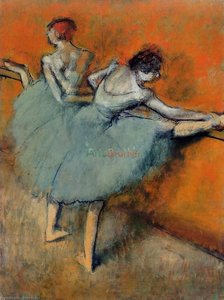
A Glimpse Behind the Curtain: Edgar Degas’s “Dancers” (1898)
This captivating pastel work by Edgar Degas offers a rare and intimate look beyond the dazzling spectacle of the ballet stage. Created in 1898, *Dancers* isn't about grand performances or poised perfection; it’s a study of movement, anticipation, and the quiet moments that define a dancer’s life. It exemplifies Degas’s lifelong fascination with capturing fleeting expressions and unconventional perspectives within modern Parisian society.Impressionism & Realism: A Unique Artistic Blend
Though often categorized as an Impressionist, Degas resisted this label, identifying instead as a realist. This distinction is crucial to understanding his work. While he embraced the vibrant color palettes and loose brushwork associated with Impressionism—influences from artists like Camille Pissarro—his focus remained firmly rooted in observing and meticulously depicting real life – not simply its surface appearance, but its underlying structure and energy. In *Dancers*, this manifests through his masterful use of pastel, a medium allowing for both delicate blending and bold strokes to convey the ethereal quality of fabric and the dynamism of motion. The pastel technique itself—thin washes layered upon each other—creates a luminous effect that captures the subtle nuances of light and shadow, mirroring Degas’s dedication to capturing authentic visual experience.Composition & The Language of Movement
The composition is deliberately asymmetrical and dynamic. Several women, adorned in varying costumes, are caught mid-movement – one raising her arms, another seemingly twirling. Degas doesn’t present a static scene; he captures a *moment* within a continuous flow of activity. Figures are cropped at the edges, mirroring how they might be glimpsed during rehearsals or from the audience's perspective. This compositional choice underscores the artist’s intention to portray not idealized beauty but rather the immediacy and energy of performance. Furthermore, Degas utilizes negative space—the areas surrounding the dancers—to heighten this sense of movement and breath within the frame. It’s as if he invites us to step into the backstage world alongside these performers.Historical Context: Paris & The Belle Époque
*Dancers* emerges from the vibrant cultural landscape of late 19th-century Paris, known as the *Belle Époque*. This era witnessed a blossoming of artistic innovation and social optimism—a period captivated by ballet’s elegance and grandeur. Degas frequented the opera's rehearsal rooms, gaining privileged access to spaces typically hidden from public view. He meticulously documented these scenes, reflecting the broader societal fascination with capturing fleeting moments of beauty and emotion. His work speaks to a desire for truthfulness amidst the decorative excesses of the time—a counterpoint to more opulent artistic endeavors.Symbolism & Emotional Resonance
Beyond its technical brilliance, *Dancers* resonates with deeper symbolic meanings. The pastel’s muted hues evoke a sense of vulnerability and contemplation, mirroring the dancers' quiet anticipation before their performance. Degas doesn’t offer judgment or narrative; he presents observation—leaving room for viewers to ponder the complexities of artistic dedication and the subtle beauty found in everyday life. Consider how *Dancers* captures not just physical movement but also an inner state of readiness—a testament to Degas's profound understanding of human psychology and his ability to translate emotion onto canvas.- Explore more of Degas’ masterpieces at OriginalUniqueArt for high-quality reproductions – bringing the spirit of Impressionism into your home!
- Discover how *Dancers* exemplifies Degas’s commitment to realism, capturing authentic visual experience with remarkable precision.
Întrebări și răspunsuri
Din ce curent artistic face parte "Dancers" de Hilaire-Germain-Edgar Degas?
Mișcarea asociată cu "Dancers" de Hilaire-Germain-Edgar Degas este impressionism. Această clasificare plasează lucrarea printre artiști și opere de artă conexe.
Cât de intense sunt culorile în "Dancers" de Hilaire-Germain-Edgar Degas?
"Dancers" de Hilaire-Germain-Edgar Degas prezintă o intensitate a culorii Monocromatic.
Cine a creat "Dancers" și în ce an?
„Dancers” a fost creat de Hilaire-Germain-Edgar Degas în 1898.
Mai multe detalii despre această pictură
 Previzualizare
 Trimite prin felicitare
 Distribuie
 Detalii despre lucrare
 Ghid
Ghid

 Descarcă imaginea
 Produse similare
 Radiografie
 Galerie foto
 Întrebări și răspunsuri
 Statistici