Previzualizare
 Trimite prin felicitare
 Distribuie
 Detalii despre lucrare
 Ghid
Ghid

 Descarcă imaginea
 Produse similare
 Radiografie
 Galerie foto
 Întrebări și răspunsuri
 Statistici
Seara la Karnaval

- 117.0 x 90.0 cm


 Vezi mai mult
Giclée / Imprimare artistică
Printuri giclée sau pe canvas de calitate muzeală, cu proces de producție rapid și opțiuni flexibile de finisare. ( Comandă pictură realizată manual Comută pe Imagine Digitală)




P118B lei10

P118H lei10

P118W lei10

P438Z lei10

P508JH lei12

P508YH lei12

P805H lei10

P805Z lei10

P919BZ lei10

P919G lei10

P919XJ lei10

P959ZH lei10

P968JZ lei12

W106C lei8

W218G lei10

W218JH lei8

W218Y lei10

W307PJ lei10

W316G lei10

W316PJ lei8

W316Y lei10

W398PJ lei8

W4111J lei10

W500HY lei15

W500JH lei15

W692G lei12

W849H lei8

W940BG lei15

W953PJ lei8




Alegeți dintre dimensiunile noastre prestabilite, care respectă proporțiile originale ale operei de artă.

Introduceți lățimea și înălțimea necesare pentru a se potrivi ramei sau peretelui dumneavoastră. O printare poate fi doar tăiată, niciodată extinsă dincolo de dimensiunea imaginii originale, astfel încât o dimensiune cu o formă diferită va pierde o parte din imagine. Vă trimitem o simulare digitală pentru aprobare înainte de a imprima orice. Imaginea afișată pe această pagină nu prezintă tăierea reală — doar simularea arată acest lucru.
Livrare în întreaga lume () în 2 săptămâni, în loc de cele 4/5 săptămâni standard. (8 Noiembrie)

Livrare expres gratuită la nivel mondial

Pânză de in de înaltă calitate

Asigurare completă pentru transport

Garanție de rambursare a taxelor vamale

Garanția fidelității culorilor

Politica de retur în 100 de zile (doar pentru defecte de fabricație)

Garanție de rambursare 100%

Ofertă pentru comenzi multiple
 Opțiunea cu sticlă este disponibilă doar pentru dimensiuni de sub 110 cm

Seara la Karnaval
Giclée / Imprimare artistică
Dimensiune reproducere
-


Preț total calculat
lei 386
A Carnival Evening: A Dreamscape of Mystery & Naive Brilliance
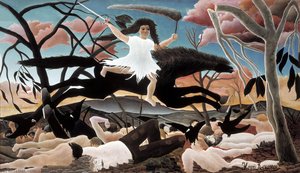
Henri Rousseau’s 1885 masterpiece, “A Carnival Evening,” transcends mere visual representation; it's an invitation to step into a world where reality dissolves into the ethereal realm of dreams. Situated at the Philadelphia Museum of Art, this captivating painting continues to intrigue viewers with its enigmatic atmosphere and subtly unsettling beauty—a contemplation on desire, escape, and the complexities inherent in human experience. ### The Allure of Naïve Art & Rousseau’s Unique Vision Executed in the distinctive style of Naïve or Primitivist art, “A Carnival Evening” exemplifies Henri Rousseau's self-taught approach. Rejecting the formal training dictated by the Académie des Beaux-Arts, he deliberately eschewed convention—a conscious decision to perceive and depict the world through a singular lens. This isn’t simply a lack of skill; it’s an intentional stylistic choice – a profound departure from academic norms that yielded a visual language characterized by meticulous detail, flattened perspective, and an almost childlike simplicity. Remarkably, Rousseau's rendering of foliage and fabric possesses striking precision, creating a captivating tension against the painting’s surreal elements. He deliberately avoided mastering traditional techniques, prioritizing instead capturing raw emotion and unfiltered observation. ### Decoding the Symbolic Landscape Upon initial viewing, we observe a formally dressed couple strolling along a path through a stark, leafless landscape bathed in the luminescence of a colossal moon. However, beneath this seemingly straightforward depiction lies a rich tapestry woven with symbolism. Dominating the scene is a hot air balloon—a potent emblem representing aspiration, liberation from earthly constraints, or perhaps a detachment from tangible reality itself. Conversely, the dark and imposing forest embodies the unknown, the subconscious mind, and potentially, feelings of isolation. The moon, an enduring symbol of mystery, intuition, and feminine energy, casts its gentle glow upon the entire composition, amplifying the painting’s pervasive sense of enigma. Rousseau skillfully utilizes these elements to convey deeper meanings beyond their literal appearance—a hallmark of Symbolist art. ### Technique & Emotional Impact Rousseau's technique is characterized by oil paint application on canvas, resulting in vibrant colors and impressive textural detail. The artist meticulously renders textures with remarkable accuracy, capturing the nuances of bark, fabric, and foliage—creating a palpable sense of presence within the dreamlike setting. This deliberate attention to detail contributes significantly to the painting’s emotional impact, fostering contemplation about themes of solitude and transformation. “A Carnival Evening” isn't merely a depiction; it’s an experience—a journey into Rousseau’s inner vision and his ability to translate emotion onto canvas. The resulting artwork resonates with viewers long after initial observation, prompting reflection on the human condition and the allure of uncharted territories. ### Historical Context & Legacy Created in 1885 during the Impressionist era, “A Carnival Evening” stands apart from its contemporaries due to Rousseau’s uncompromising adherence to Naïve art principles. This stylistic choice reflects a broader artistic movement that sought inspiration in primitive cultures and rejected academic conventions—a reaction against the prevailing aesthetic standards of the time. Rousseau's work profoundly influenced subsequent generations of artists, establishing him as a pivotal figure in Primitivist art and cementing his place within the canon of modern painting. Its enduring fascination testifies to its ability to capture universal themes of longing and wonder—themes that continue to captivate audiences today.Întrebări și răspunsuri
Ce atmosferă transmite "Seara la Karnaval"?
"Seara la Karnaval" de Henri Emilien Rousseau este descris prin atmosfera sa Mistic. Această clasificare poate ajuta la integrarea lucrării într-un anumit decor.
Din ce materiale este realizată "Seara la Karnaval" și în ce stil?
"Seara la Karnaval" de Henri Emilien Rousseau îmbină tehnica Ulei pe pânză cu stilul Naive Surrealism. Tehnica și mișcarea definesc modul de execuție și estetica operei.
Care este tehnica de execuție și dimensiunile pentru „Seara la Karnaval”?
Originalul "Seara la Karnaval" de Henri Emilien Rousseau este o lucrare de tip Ulei pe pânză, cu dimensiunile de 117 x 90 cm. Tehnica și dimensiunea descriu obiectul original.
Biografie artist
Henri Emile Rousseau (1875 – 1933): The Enchanted Vision of Primitive Beauty
Henri Emile Rousseau, born in Lyon, France, in 1875, defied the conventions of Impressionism and Post-Impressionism to forge a singular artistic path—one characterized by an uncompromising embrace of Naïve Art. His canvases depict fantastical landscapes populated by animals and humans rendered with childlike simplicity and vibrant color palettes, transporting viewers into dreamlike realms brimming with symbolic resonance. Rousseau’s upbringing in a working-class family instilled in him a deep appreciation for the natural world and folklore, influences that would profoundly shape his artistic vision. Despite facing considerable skepticism from critics of his time—who dismissed his style as amateurish—Rousseau persevered, establishing himself as one of France's most distinctive painters and securing a place among the pioneers of Modern Art.- Early Life & Artistic Beginnings: Rousseau’s formal artistic training was minimal; he largely self-taught, honing his skills through sketching outdoors and studying prints. He initially pursued commercial illustration work to support himself, but his passion for painting remained unwavering.
- The Influence of Primitive Art: Rousseau's fascination with African masks and tribal art—particularly those collected by Alexandre Cabanel—served as a catalyst for his stylistic evolution. These artworks captivated him with their bold colors, stylized forms, and rejection of academic realism, inspiring him to abandon traditional techniques in favor of a more direct and expressive approach.
- Key Paintings & Artistic Style: Rousseau’s oeuvre is dominated by monumental landscapes infused with mythological elements and populated by animals imbued with spiritual significance. Notable works include “The Sleeping Venus” (1890), “The Promised Land” (1893), “The Concert” (1897), and “The Shepherdess,” which exemplifies his signature style—characterized by flattened perspectives, luminous colors, and a deliberate blurring of outlines.
- Recognition & Legacy: Despite initial rejection by the Parisian avant-garde, Rousseau gained recognition in 1905 thanks to the patronage of Ambroise Vollard, who championed his work and secured exhibitions at Galerie Bernheim-Jeune. His paintings gradually attracted admirers among artists like Picasso and Matisse, cementing his reputation as a visionary artist whose uncompromising vision anticipated Surrealism.
- Death & Enduring Influence: Rousseau died in Étampes in 1933, leaving behind a legacy of approximately 800 paintings—a remarkable achievement considering his unconventional methods. His distinctive Naïve Art style continues to inspire artists today, demonstrating the enduring power of imagination and the beauty found in unfiltered observation.
Exploring Rousseau’s Palette & Technique
Rousseau's artistic technique was remarkably simple yet profoundly effective. He eschewed meticulous detail, opting instead for bold brushstrokes and vibrant hues—often achieved through layering thin glazes of color onto a toned ground. This method allowed him to capture the essence of his subjects with remarkable immediacy and luminosity, conveying emotion and atmosphere as much as visual representation. His use of complementary colors—such as reds and greens—created striking contrasts that heightened the dramatic impact of his compositions. Furthermore, Rousseau’s deliberate flattening of perspective—a technique borrowed from African art—reinforced the dreamlike quality of his landscapes and contributed to their captivating allure.
Henri Emilien Rousseau
1875 - 1933
Detalii rapide
- Full Name: Henri Émile Rousseau
- Nationality: French
- Date Of Birth: 1875
- Date Of Death: 1933
- Place Of Birth: Nancy, France
- Notable Artworks:
- A Carnival Evening
- War or The Ride of Discord
- Fantasia de mariage
- Artistic Movement Or Style: Naive Art
- Artists Who Influenced This Artist:
- Gustave Moreau
- Pierre Puvis de Chavannes
- Artists Or Movements Influenced By This Artist: ['Symbolism']
Articole similare

Naive Art Unveiled: The Charming Beauty of Simple Masterpieces
Discover the enchanting world of Naive Art. Explore the profound beauty of self-taught masters like Henri Rousseau through an art-history lens, uncovering how simple forms and vibrant colors create timeless, soulful masterpieces for the discerning collector.
Henri Rousseau: Primitivism, Paradox & Subversion of Academic Tradition
Explore the captivating world of Henri Rousseau, the celebrated Naïve artist who challenged academic traditions with his unique jungle scenes & dreamlike symbolism. Discover his lasting influence on modern art and collecting today.

The Untamed Vision: Exploring Naïve Art & Primitivism's Rejection of Convention
Explore the revolutionary world of Naïve Art & Primitivism! Discover how artists challenged academic traditions with raw emotion & unique styles. Learn about Picasso, Rousseau & more at OriginalUniqueArt.
Top 10 Capodopere Fauviste: Explozie de Culoare și Expresivitate în Artă | OriginalUniqueArt.ro
Descoperă Top 10 capodopere fauviste – Matisse, Derain și alți maeștri ai culorii! Explorează istoria, tehnicile și expresivitatea picturilor fauve. Reproduceri de artă de calitate muzeală pe OriginalUniqueArt.com. Inspiră-te pentru decorul tău!

Henri Matisse: Cele Mai Iconice 25 De Opere – Artă, Decorațiuni și Inspirație
Descoperă cele mai emblematice 25 de opere ale lui Henri Matisse! Explorează fauvismul, culorile vibrante și stilul unic al artistului francez. Reproduceri tablouri de calitate muzeală & inspirație pentru decor pe OriginalUniqueArt.com.