Comută pe versiunea Print
 Vezi mai mult







































 Pentru opere de artă sau reproduceri care depășesc 105 cm (aproximativ 41 de inch) pe oricare dintre laturi, cadrul va fi livrat demontat, sub formă de kit. Această metodă asigură o livrare sigură și previne deteriorarea în timpul transportului.


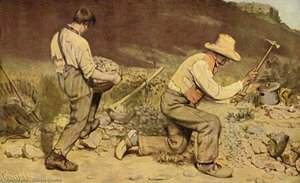
The Quarry (La Curée): A Pioneer’s Vision of Rural Life
Gustave Courbet's “The Quarry” (La Curée), completed in 1856, stands as a cornerstone of Realist art—a defiant rejection of Romantic idealism and an unwavering commitment to portraying the world with unflinching honesty. More than just a depiction of hunting activity, it’s a profound meditation on humanity’s relationship with nature and its societal implications, cementing Courbet's legacy as one of the most influential artists of his era.
- Subject Matter: The painting captures a pivotal moment in the hunt—the aftermath of a successful pursuit. A dead roe deer hangs from a pine tree, awaiting consumption by the hunters’ dogs and their companions. This scene isn't staged for aesthetic pleasure; it aims to document reality with meticulous detail.
- Style & Technique: Courbet employed a bold approach characteristic of Realism—a technique that prioritized observation over artistic embellishment. Thick impasto brushstrokes dominate the canvas, conveying texture and immediacy. The artist meticulously rendered every element, from the weathered faces of the hunters to the dappled sunlight filtering through the forest canopy.
- Historical Context: Painted during a period of significant social upheaval in France—the Second Industrial Revolution—“The Quarry” reflects anxieties about urbanization and the decline of rural traditions. Courbet deliberately challenged academic conventions by rejecting idealized landscapes and heroic narratives, aligning himself with a burgeoning movement advocating for artistic truthfulness.
- Symbolism: The deer itself serves as a potent symbol – representing both sustenance and sacrifice. Its hanging carcass underscores the brutal realities of survival within the natural world, mirroring broader societal tensions surrounding class distinctions and economic disparities. Courbet’s deliberate choice to portray this gruesome scene wasn't intended to shock viewers but rather to provoke contemplation about human behavior.
- Influence & Legacy: “The Quarry” exerted considerable influence on subsequent artistic movements, notably Cubism. Artists like Albert Gleizes drew inspiration from Courbet’s uncompromising realism, experimenting with fractured perspectives and geometric forms—a stylistic departure that foreshadowed the avant-garde sensibilities of the early 20th century.
Its enduring appeal lies in its ability to transport viewers back to a time when art sought to confront uncomfortable truths. Today, reproductions of “The Quarry” offer an opportunity to appreciate Courbet’s genius—a testament to his unwavering belief that art should serve as a mirror reflecting the complexities of human experience.
Întrebări și răspunsuri
„The Quarry (La Curée)” este mai degrabă o lucrare luminoasă sau întunecată în ansamblu?
"The Quarry (La Curée)" de Gustave Courbet este înregistrat cu o deep_shadow, având o luminanță de Dark.
Din ce stil face parte "The Quarry (La Curée)"?
„The Quarry (La Curée)” este o operă de Realism. Acest curent indică tradiția artistică din care face parte lucrarea.
Ce reprezintă "The Quarry (La Curée)" și ce atmosferă transmite?
"The Quarry (La Curée)" de Gustave Courbet înfățișează hunting, landscape, realism, painter, dog, horse, rural life, într-o atmosferă Elegant. Subiectul și atmosfera definesc împreună opera.
Mai multe detalii despre această pictură
 Previzualizare
 Trimite prin felicitare
 Distribuie
 Detalii despre lucrare
 Ghid
Ghid

 Descarcă imaginea
 Produse similare
 Radiografie
 Galerie foto
 Întrebări și răspunsuri
 Statistici