Comută pe versiunea Print
 Vezi mai mult







































 Pentru opere de artă sau reproduceri care depășesc 105 cm (aproximativ 41 de inch) pe oricare dintre laturi, cadrul va fi livrat demontat, sub formă de kit. Această metodă asigură o livrare sigură și previne deteriorarea în timpul transportului.


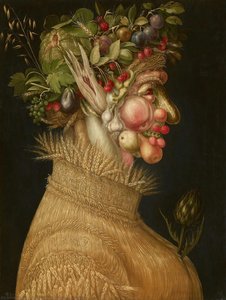
Summer 1: A Surreal Symphony of Nature and Humanity
Giuseppe Arcimboldo’s “Summer 1,” completed in 1563, stands as an unparalleled achievement in Renaissance art—a daring departure from conventional portraiture that elevates it into a profound meditation on the interconnectedness of life and the passage of time. More than just a visual spectacle, this artwork invites contemplation, prompting viewers to decipher its intricate layers of symbolism and marvel at Arcimboldo’s masterful technique.
- Subject Matter: The centerpiece is undeniably a human face meticulously crafted from an astonishing array of fruits, vegetables, flowers, and other organic elements. This audacious conceit immediately establishes a dialogue between the natural world and human representation—a core theme prevalent in Arcimboldo’s oeuvre and reflecting the humanist spirit of his era.
- Style & Technique: Arcimboldo's style firmly anchors itself within Mannerism, characterized by exaggerated detail and realism reminiscent of Baroque still life paintings. He employed a painstaking approach, layering pigments with meticulous precision to achieve textures that convincingly mimic the surfaces of his chosen materials—the rough bark of trees, the velvety petals of blossoms, and the glistening skins of fruits.
- Color Palette & Composition: The artwork’s color scheme is deliberately dramatic, utilizing deep greens juxtaposed against vibrant reds and yellows, creating a visual contrast that draws attention to the luminous hues of the produce. Arcimboldo skillfully arranges these elements within a dark background, maximizing their impact and reinforcing the sense of depth.
- Historical Context & Symbolism: “Summer 1” belongs to Arcimboldo’s celebrated "The Four Seasons" series—a commission from Maximilian II and Rudolf II—and embodies the Renaissance fascination with Neo-Platonism. The inclusion of both ripe and decaying produce serves as a poignant reminder of mortality, yet simultaneously celebrates the fecundity of nature and the cyclical renewal inherent in life itself.
A Masterpiece of Detail & Illusion
Arcimboldo’s dedication to realism is undeniable; he painstakingly rendered individual plant elements—leaves, stems, thorns—with astonishing accuracy. However, this meticulous observation isn't merely descriptive; it’s transformative. By reconstructing a human face from disparate organic forms, Arcimboldo challenges viewers to reconsider the boundaries between art and nature, creating an illusion that captivates the senses and stimulates intellectual curiosity.
Beyond Decoration: An Allegory of Time & Transformation
“Summer 1” transcends its decorative function—it’s a complex allegory designed to communicate profound ideas about human existence. Arcimboldo's artistic vision speaks to the enduring questions posed by Renaissance thinkers regarding beauty, mortality, and the relationship between humanity and the cosmos. This artwork continues to inspire awe and provoke discussion centuries after its creation.
Întrebări și răspunsuri
Care sunt tehnica și data creației pentru "Vara 1" de Giuseppe Arcimboldo?
Tehnica utilizată pentru "Vara 1" de Giuseppe Arcimboldo este Ulei pe pânză, iar lucrarea datează din 1563.
La ce artist este atribuită opera „Vara 1”?
„Vara 1” a fost creat de Giuseppe Arcimboldo. Informațiile de pe această pagină descriu opera originală a lui Giuseppe Arcimboldo.
Care este utilizarea recomandată pentru o printă a lucrării "Vara 1"?
O reproducere a operei "Vara 1" de Giuseppe Arcimboldo este recomandată pentru Dialog. Această sugestie derivă din subiectul, atmosfera și culorile lucrării.
Mai multe detalii despre această pictură
 Previzualizare
 Trimite prin felicitare
 Distribuie
 Detalii despre lucrare
 Ghid
Ghid

 Descarcă imaginea
 Produse similare
 Radiografie
 Galerie foto
 Întrebări și răspunsuri
 Statistici