Text size

() ·

A painting made for you, by hand

Three Philosophers

Reproducere pictată manual în ulei

Pictură în ulei pe pânză, pictată manual de artiștii noștri la dimensiunea și ramele dorite de dumneavoastră, pe comandă. ( Comută pe versiunea Print Comută pe Imagine Digitală)

Descriere obiect de colecție

Biografie artist

Descoperă Giorgione (1477/8-1510), pictorul venețian emblematic al Renașterii! Admira opere impresionante precum "Tempesta" și "Concert pastoral", caracterizate de culoare vibrantă și atmosferă poetică.

from ·

Chapter 1

How large should it be?

Slide to change the size; the picture on the left shows the frame at its real width. The proportions of the original are kept.

Standard
personalizat
CM
INCH

Alegeți dintre dimensiunile noastre prestabilite, care respectă proporțiile originale ale operei de artă.

lățime
înălțime

Introduceți lățimea și înălțimea necesare pentru a se potrivi ramei sau peretelui dumneavoastră. Această lucrare este pictată manual, așa că, pentru o dimensiune cu o formă diferită, artistul poate picta puțin mai mult în jurul imaginii sau poate tăia puțin din margini — dumneavoastră decideți. Vă vom trimite o simulare digitală pentru aprobare înainte de a începe pictarea. Imaginea afișată pe această pagină nu reprezintă rezultatul real — doar simularea este reprezentativă.

Chapter 2

How should it arrive?

Choose the edges of the stretched canvas

Choose your frame

Corner sample of the WhiteWrap canvas edge finish, stretched on lemn masiv bars
White lei1
Corner sample of the BlurSideWrap canvas edge finish, stretched on lemn masiv bars
Blurside lei1
Corner sample of the ExtendedWrap canvas edge finish, stretched on lemn masiv bars
Extended lei1
Corner sample of the P118B picture frame: polistiren turnat, 5 cm wide and 3 cm thick
P118B lei10
Corner sample of the P118H picture frame: polistiren turnat, 5 cm wide and 3 cm thick
P118H lei10
Corner sample of the P118W picture frame: polistiren turnat, 5 cm wide and 3 cm thick
P118W lei10
Corner sample of the P438Z picture frame: polistiren turnat, 5.5 cm wide and 3.5 cm thick
P438Z lei10
Corner sample of the P508JH picture frame: polistiren turnat, 7 cm wide and 3.5 cm thick
P508JH lei12
Corner sample of the P508YH picture frame: polistiren turnat, 7 cm wide and 3.5 cm thick
P508YH lei12
Corner sample of the P805H picture frame: polistiren turnat, 5 cm wide and 3.5 cm thick
P805H lei10
Corner sample of the P805Z picture frame: polistiren turnat, 5 cm wide and 3.5 cm thick
P805Z lei10
Corner sample of the P919BZ picture frame: polistiren turnat, 7 cm wide and 3.5 cm thick
P919BZ lei10
Corner sample of the P919G picture frame: polistiren turnat, 7 cm wide and 3.5 cm thick
P919G lei10
Corner sample of the P919XJ picture frame: polistiren turnat, 7 cm wide and 3.5 cm thick
P919XJ lei10
Corner sample of the P959ZH picture frame: polistiren turnat, 5 cm wide and 3 cm thick
P959ZH lei10
Corner sample of the P968JZ picture frame: polistiren turnat, 6 cm wide and 4 cm thick
P968JZ lei12
Corner sample of the W106C picture frame: lemn masiv, 5 cm wide and 3 cm thick
W106C lei8
Corner sample of the W218G picture frame: lemn masiv, 5 cm wide and 3 cm thick
W218G lei10
Corner sample of the W218JH picture frame: lemn masiv, 5 cm wide and 3 cm thick
W218JH lei8
Corner sample of the W218Y picture frame: lemn masiv, 5 cm wide and 3 cm thick
W218Y lei10
Corner sample of the W307PJ picture frame: lemn masiv, 6 cm wide and 3 cm thick
W307PJ lei10
Corner sample of the W316G picture frame: lemn masiv, 6 cm wide and 3 cm thick
W316G lei10
Corner sample of the W316PJ picture frame: lemn masiv, 6 cm wide and 3 cm thick
W316PJ lei8
Corner sample of the W316Y picture frame: lemn masiv, 6 cm wide and 3 cm thick
W316Y lei10
Corner sample of the W398PJ picture frame: lemn masiv, 5 cm wide and 3 cm thick
W398PJ lei8
Corner sample of the W4111J picture frame: lemn masiv, 6.5 cm wide and 3.5 cm thick
W4111J lei10
Corner sample of the W500HY picture frame: lemn masiv, 7 cm wide and 5 cm thick
W500HY lei15
Corner sample of the W500JH picture frame: lemn masiv, 7 cm wide and 5 cm thick
W500JH lei15
Corner sample of the W692G picture frame: lemn masiv, 8 cm wide and 4 cm thick
W692G lei12
Corner sample of the W849H picture frame: lemn masiv, 5 cm wide and 3 cm thick
W849H lei8
Corner sample of the W940BG picture frame: lemn masiv, 7.5 cm wide and 4.5 cm thick
W940BG lei15
Corner sample of the W953PJ picture frame: lemn masiv, 6 cm wide and 3.5 cm thick
W953PJ lei8
Corner sample of the H24-GOLD picture frame: lemn sculptat cu gesso, 10 cm wide and 6 cm thick
H24-GOLD lei30
Corner sample of the H24-SILVER picture frame: lemn sculptat cu gesso, 10 cm wide and 6 cm thick
H24-SILVER lei30
Corner sample of the H36-GOLD picture frame: lemn sculptat cu gesso, 15 cm wide and 6.5 cm thick
H36-GOLD lei45
Corner sample of the H36-SILVER picture frame: lemn sculptat cu gesso, 15 cm wide and 6.5 cm thick
H36-SILVER lei45

Moulding: . Overall size with the frame: .

Chapter 3

Who paints it, and should anything change?

Examples of what can be changed: Replace face with customer photo; Add pet (e.g., replace cat with dog); Include hidden message in background; Change background landscape or elements.
After order, OriginalUniqueArt.com team will email client for instructions and provide a mockup preview

Livrare în întreaga lume () în 3-4 săptămâni, în loc de cele 5 săptămâni standard. (2 Noiembrie). Fără compromisuri în ceea ce privește calitatea.

Chapter 4

The finishing touches

A nameplate, as in a museum?

Detalii plăcuță din bronz gravat

This elegant plaque features the artist's name and the title of the artwork, finely engraved for a timeless presentation.

It is made from bronze with a refined, elegant finish. The text is precisely laser-engraved for a sharp and permanent result. Measuring 9x2 cm, the plaque is compact yet easy to read. It's built to be durable and scratch-resistant, offering a professional, museum-quality look. Mounting is simple thanks to the included adhesive backing.

Detalii plăcuță din acril transparent

The plaque includes essential engraved details such as the artist's name, the title of the artwork, the date it was created, the type of media used-like oil on canvas or watercolor-a brief description of the piece, and a QR code that links to the complete artwork information.

It is crafted from clear acrylic, offering a sleek, modern appearance. The text is UV-engraved in black to ensure strong visual contrast. With a size of 10x15 cm, it ensures optimal readability. It comes equipped with two metal hooks for secure wall mounting. The plaque is designed to be weather-resistant, making it suitable for various environments, and it includes interactive features that work seamlessly with smartphone scanning.

Detalii placă din acril negru

This elegant plaque includes engraved information such as the artist's name, the title of the artwork, the date it was created, the type of media used (like oil on canvas or watercolor), a short description of the artwork, and a QR code for quick access to more information.

The plaque itself is made from refined black acrylic with a premium finish. The text is laser-engraved in white for high contrast and readability. Its size is 10x15 cm, designed to be easy to read. It comes with two metal hooks for professional mounting. The design is sleek and fits any interior style. It is also weather-resistant and durable, with built-in digital integration for mobile compatibility.

A protective varnish?

When do you need it?

Chapter 5

Your painting, as you ordered it

Three Philosophers

Tehnică de reproducere

Dimensiune reproducere

-

Selecție de artiști de elită

Mai multe detalii, rafinament și timp suplimentar de execuție

-

Ramă pentru reproducere artistică

-

-

Pentru opere de artă sau reproduceri care depășesc 105 cm (aproximativ 41 de inch) pe oricare dintre laturi, cadrul va fi livrat demontat, sub formă de kit. Această metodă asigură o livrare sigură și previne deteriorarea în timpul transportului.

Este necesară asamblarea profesională – acest produs nu este de tip DIY (de făcut singur).
Kitul trebuie asamblat, iar pânza întinsă, de către un legător de cadre experimentat, utilizând adeziv pentru lemn (neinclus în colet), o cheie pentru întinderea pânzei și cleme pentru a menține barele la unghi drept în timp ce adezivul se usucă. Asamblarea incorectă sau tensiunea neuniformă a pânzei pot deteriora permanent opera de artă și nu sunt acoperite de garanția noastră.

  • Toate barele din lemn masiv sunt incluse, tăiate cu precizie la dimensiunea necesară.

  • Asamblat cu șuruburile incluse, plus adeziv pentru lemn pentru îmbinările de colț, care nu este furnizat și trebuie achiziționat de către tâmplarul dumneavoastră.

  • Sunt necesare unelte profesionale care nu sunt incluse: o șipte de întindere a pânzei (tensionator) și cleme pentru a menține barele la unghi drept în timp ce adezivul se usucă.

Important:
Îmbinările de colț necesită adeziv pentru lemn, barele trebuie fixate cu clești de strângere până când adezivul este complet uscat, iar întinderea pânzei pe cadrul asamblat necesită un clește pentru întins pânza. Niciunul dintre aceste elemente nu este inclus în kit. Vă rugăm să consultați un încadrator profesionist cu experiență înainte de a comanda această dimensiune.

Etichetă de prezentare

-

-

Lac de protecție

Lac lucios (intensifică nuanțele și oferă protecție împotriva luminii și a umidității)

-

Personalizează opera mea de artă

Exemple de elemente ce pot fi personalizate: Înlocuirea feței cu fotografia clientului; Adăugarea unui animal de companie (de exemplu, înlocuirea unei pisici cu un câine); Includerea unui mesaj ascuns în fundal; Modificarea peisajului sau a elementelor din fundal.

-

Livrare rapidă

Livrare la nivel mondial () în 3-4 săptămâni, în loc de cele 5 săptămâni standard. (2 Noiembrie). Fără compromisuri când vine vorba de calitate.

-

Livrare rapidă

Livrare la nivel mondial () în 5 săptămâni. (9 Noiembrie).

Inclus

Preț total calculat

lei 1426

Preț total lei 1426

Opțiunea cu sticlă este disponibilă doar pentru dimensiuni de sub 110 cm

Included with every order

  • Livrare expres gratuită la nivel mondial
  • Pânză de in de înaltă calitate
  • Asigurare completă pentru transport
  • Garanție de rambursare a taxelor vamale
  • Garanția fidelității culorilor
  • Politica de retur în 100 de zile (doar pentru defecte de fabricație)
  • Garanție de rambursare 100%
  • Ofertă pentru comenzi multiple

A Venetian Enigma: Unraveling the Layers of “Three Philosophers”

Giorgione’s “Three Philosophers,” painted around 1509, isn't merely a portrait; it’s an invitation to a silent conversation across centuries. The painting, shrouded in mystery and speculation, resides within a captivating web of historical accounts, artistic interpretations, and tantalizing symbolism. Originally conceived as a monumental work for the Venetian merchant Taddeo Contarini, its journey through time – from the opulent collections of Venice to the Brussels court – has subtly altered its appearance, notably with a significant reduction on the left side, diminishing the original expansive landscape but intensifying the focus on the figures themselves. This deliberate alteration speaks volumes about the artist’s intent and the evolving tastes of his patrons.

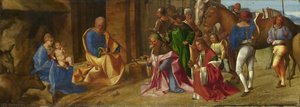
The scene unfolds within a carefully constructed space: three men, rendered in a palette dominated by earthy tones – ochre, umber, and subtle greens – stand before a rugged cliff face, its weathered rocks providing a dramatic backdrop. The figures are dressed in rich, crimson robes, a striking contrast to the muted landscape, drawing immediate attention to their presence. The youngest man, seated and holding compasses and a square—tools of a painter, perhaps?—suggests an engagement with artistic practice itself. His posture is contemplative, his gaze directed inward, while the central figure, clad in a dark robe, gestures towards the horizon, seemingly lost in thought. The eldest, identifiable by his flowing garments and the book he clutches, exudes an air of learned authority.

The Allure of *Sfumato* and Giorgione’s Unique Style

Giorgione's mastery lies not just in his subject matter but also in his revolutionary technique. He employed a masterful use of *sfumato*, a subtle blurring of lines and edges, creating an atmospheric haze that softens the forms and imbues the scene with a dreamlike quality. This is particularly evident in the rendering of the landscape – the rocks are not sharply defined but rather emerge from the mist, contributing to the painting’s overall sense of mystery. The figures themselves possess a remarkable softness, their features rendered with an almost ethereal grace. Giorgione's approach departed significantly from the more linear and precise styles prevalent at the time, prioritizing mood and atmosphere over strict anatomical accuracy.

The interplay of light and shadow is crucial to the painting’s impact. Giorgione expertly manipulates chiaroscuro – the dramatic contrast between light and dark – to sculpt the forms and create a sense of depth. The figures are bathed in a diffused, golden light that seems to emanate from an unseen source, casting long shadows across the landscape and highlighting their contemplative postures. This masterful use of light not only enhances the painting’s visual appeal but also contributes to its evocative atmosphere.

Decoding the Symbols: Who Are These Philosophers?

The enduring fascination with “Three Philosophers” stems from the persistent debate surrounding the identity of the figures depicted. While initially identified as "philosophers," a multitude of interpretations have been proposed over the centuries, each offering a compelling narrative. The most common theories suggest they represent the Three Kings, astronomers, or even representatives of three distinct religions. More recently, the Pythagorean school – Pythagoras, Thales, and Pherecydes—has gained traction, fueled by the presence of the painter’s tools and astronomical texts.

The compasses and square, undeniably significant, have been interpreted as symbols of artistic creation, but their placement also hints at a deeper intellectual engagement. The varied attire of the figures – suggesting origins from different lands—could represent diverse philosophical schools or cultural influences. The book held by the eldest figure further reinforces this notion of learned discourse and contemplation. Ultimately, Giorgione’s deliberate ambiguity invites viewers to project their own interpretations onto the scene, transforming it into a mirror reflecting the viewer's own intellectual curiosity.

A Timeless Masterpiece: Reproduction and Artistic Legacy

"Three Philosophers" remains a testament to Giorgione’s genius—a painting that transcends its historical context and continues to captivate audiences today. OriginalUniqueArt offers meticulously crafted, hand-painted reproductions of this iconic work, allowing you to experience the depth, nuance, and emotional resonance of Giorgione's masterpiece in your own space. Our reproductions faithfully capture the *sfumato* technique, the atmospheric lighting, and the subtle symbolism that define this enigmatic portrait. Whether for a grand salon or a personal study, a OriginalUniqueArt reproduction of “Three Philosophers” is an investment in art history, a celebration of Venetian artistry, and a window into a world of timeless contemplation.

Întrebări și răspunsuri

Cine este autorul operei "Three Philosophers" și din ce curent artistic face parte?

Giorgione a creat "Three Philosophers", parte a mișcării Venetian Renaissance.

Care este atmosfera generală a operei "Three Philosophers" de Giorgione?

"Three Philosophers" emană o atmosferă Calm.

Unde pot cumpăra o ediție print a lucrării "Three Philosophers" de Giorgione?

O ediție print a lucrării "Three Philosophers" de Giorgione poate fi comandată direct pe pagina sa de Print Fine Art: o printă fine art pe canvas din bumbac sau pe hârtie canvas arhivistică.

More about this painting

Previzualizare Previzualizare AR Comută pe versiunea Print Comută pe Imagine Digitală Trimite prin felicitare
Detalii despre lucrare Ghid Adaugă la favorite Descarcă imaginea Produse similare Radiografie Galerie foto Q&A Statistici

In numbers

  • 1509the year it was painted
  • 29frames to choose from
  • standard sizes, in its own proportions
  • 5weeks to paint and deliver it
Giorgione

Giorgione

1477 - 1510, Italia

Quick facts about Giorgione

  • Artistic Movement Or Style: Renașterea venețiană
  • Artists Or Movements Influenced By This Artist: ['Titian']
  • Artists Who Influenced This Artist:
    • Giovanni Bellini
    • Mantegna
  • Date Of Birth: 1477/78 sau 1473/74
  • Date Of Death: 1510
  • Full Name: Giorgio Barbarelli da Castelfranco Zorzo
  • Nationality: Italian
  • Notable Artworks:
    • Tempestă
    • Apusul
    • Magna Domenă a Castelfranco
  • Place Of Birth: Castelfranco Veneto, Italia

Biografie artist

Giorgione (1477/8-1510), a Key High Renaissance Venetian Painter

Giorgio Barbarelli da Castelfranco, known to the world as Giorgione, remains one of the most elusive and captivating figures in Renaissance art. Born in the small town of Castelfranco Veneto near Venice around 1477 or 1478 – the exact year is debated – his tragically short life, ending around 1510 at the age of thirty-two or thirty-three, belies an artistic impact that continues to resonate centuries later. Unlike many of his contemporaries whose lives are well documented, Giorgione’s story is shrouded in mystery, pieced together from scant historical records and the often romanticized accounts of Giorgio Vasari. What we do know suggests a man deeply immersed in the vibrant culture of Venice, a city that fostered both artistic innovation and a sensual appreciation for beauty. He likely apprenticed under Giovanni Bellini, a leading Venetian painter, absorbing the established traditions before forging his own unique path. Early commissions included portraits of prominent figures like Doge Agostino Barbarigo, demonstrating an immediate talent for capturing likeness and status. However, it was in his departure from conventional subject matter and his revolutionary approach to painting that Giorgione truly distinguished himself.

Early Life and Artistic Training

Giorgio Barbarelli’s origins are relatively obscure. He was born into a noble family, though details about his parents remain elusive. His formative years were spent in Castelfranco Veneto, where he received an education focused on humanist studies – a hallmark of the Venetian intellectual landscape at the time. Crucially, he began his artistic training under Giovanni Bellini, arguably Venice’s most influential painter and a master of Venetian tradition. Bellini instilled in Giorgione a profound understanding of perspective and draughtsmanship, yet Giorgione swiftly rejected these conventions, recognizing their limitations in conveying emotion and atmosphere. This decision would prove to be pivotal in shaping his distinctive artistic style.

A Revolutionary Style: Color, Atmosphere, and *Sfumat*

Giorgione’s artistic style marked a significant break from the Florentine preoccupation with linear perspective and precise draftsmanship. He championed color, atmosphere, and an evocative moodiness that became hallmarks of the Venetian school. His technique involved softening outlines, employing subtle gradations of tone – *sfumato* – to create atmospheric effects, and prioritizing overall harmony over meticulous detail. This wasn’t merely a technical choice; it reflected a fundamentally different artistic sensibility. Giorgione sought not to replicate reality but to capture its essence, its fleeting emotions, and its poetic resonance. He famously described his aim as “to make the painting seem to breathe,” capturing the elusive beauty of nature and human experience. This approach wasn’t merely about achieving visual realism; it was about conveying a deeper truth – a sense of mystery and contemplation that captivated audiences and influenced generations of artists. Consider *The Tempest*, Giorgione's masterpiece. The hazy landscape, rendered with delicate gradations of color, evokes the drama of impending storm without resorting to dramatic chiaroscuro—the stark contrast between light and dark—a technique favored by Leonardo da Vinci and Michelangelo. Instead, Giorgione’s palette is rich in muted hues, creating an ethereal glow that envelops the figures within.

Notable Works and Artistic Legacy

Giorgione produced a relatively small number of paintings during his lifetime, yet each work possesses extraordinary artistic merit and continues to inspire admiration. Among his most celebrated creations are *Pastoral Concert*, depicting musicians gathered in a serene meadow—a scene devoid of narrative complexity but brimming with visual beauty and symbolic resonance; *Sleeping Venus*, an enigmatic portrait that embodies Venetian ideals of feminine grace and sensual allure; and *Judith*, which showcases Giorgione’s masterful handling of color and form. His influence extended far beyond his own output, shaping the artistic sensibilities of Titian and other Venetian painters who would carry forward his innovations in color and atmospheric painting. Giorgione's embrace of *sfumato*—the subtle blending of colors to create soft transitions—became a defining characteristic of Venetian art, distinguishing it from Florentine realism and establishing Venice as a beacon of artistic creativity. He remains a symbol of artistic freedom, innovation, and the power of suggestion – a painter who dared to prioritize feeling over form, atmosphere over accuracy, and poetry over narrative.

A Final Mystery: The Enduring Enigma

Giorgione’s death in 1510 remains shrouded in speculation. Vasari attributed his demise to malaria, but recent scholarship suggests that he may have succumbed to tuberculosis—a tragic fate for a man who had achieved such remarkable artistic success. Despite the paucity of biographical information, Giorgione's legacy persists as one of the most profound and influential figures in Renaissance art. His pioneering approach to painting continues to fascinate scholars and artists alike, prompting ongoing debates about his motivations, inspirations, and artistic vision. He stands as a testament to the transformative power of imagination—a painter who dared to transcend convention and capture the elusive beauty of human experience with unparalleled grace and subtlety.

Informații rapide

  • Notable elements: Sfumato, landscape
  • Artistic style: Mysterious mood
  • Influences: Bellini
  • Movement: Venetian Renaissance
  • Subject or theme: Philosophical debate

Test de cunoștințe despre artă

Fiecare întrebare are un singur răspuns corect.

Întrebare 1:
According to Marcantonio Michiel’s inventory, what was a notable characteristic of the landscape depicted in ‘Three Philosophers’?
Întrebare 2:
What significant alteration was made to the painting in the late 16th century?
Întrebare 3:
The compasses and square held by one of the philosophers are often interpreted as symbols related to which profession?
Întrebare 4:
Giorgione’s use of ‘sfumato’ in ‘Three Philosophers’ is most evident in:
Întrebare 5:
What is one of the prevailing theories regarding the identities of the three philosophers?