Pictură în ulei
 Totul despre Stalingrad







































 Pentru opere de artă sau reproduceri care depășesc 105 cm (aproximativ 41 de inch) pe oricare dintre laturi, cadrul va fi livrat demontat, sub formă de kit. Această metodă asigură o livrare sigură și previne deteriorarea în timpul transportului.


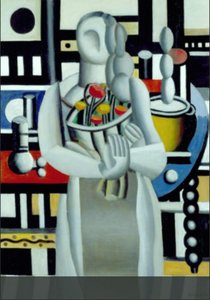
The Creation of Stalingrad by Fernand Léger
In 1924, Fernand Léger turned his gaze toward the heavy, rhythmic pulse of industrial labor. His painting, Stalingrad, emerged from this fascination with the intersection of man and machine. The canvas captures a moment of intense industrial collaboration, where the human form and the mechanical tool become inseparable. It is a scene of construction and movement, a study of how steel and muscle work in tandem to reshape a landscape.
The work is rooted in the language of Cubism, utilizing fragmented planes to organize the chaos of the machine age. At the same time, it carries the simplified, direct clarity often associated with Naïve Art. This duality allows the subject matter to remain grounded. The heavy machinery and the workers are not mere decorations; they are the structural bones of the composition. Fernand Léger sought to translate the energy of the modern era into a visual reality of intersecting lines and solid forms.
Steel pistons and heavy cranes define the space. The work exists in the tension between the organic and the manufactured. It is a quiet record of strength.
Artistic Movements and Stylistic Influences
The canvas is anchored in the fractured logic of Cubism. It follows the path cleared by the pioneers of the movement, breaking the world into a sequence of overlapping planes and geometric shards. This is not a soft dissolution of form, but a structural dismantling. The artist’s own hand developed a specific variation of this language, often called Tubism, which emphasizes cylindrical, tubular shapes. These rounded, mechanical volumes replace the organic curves of the natural world with the hard, rhythmic precision of the machine age.
There is a heavy, industrial pulse within these shapes. The work looks toward the future, acting as a forerunner to the Pop Art movement that would emerge decades later. By treating modern, mechanical subjects with such directness, the artist bridges the gap between fine art and the objects of a consumer society. The painting captures a moment where the human figure and the machine become inseparable parts of a single, moving mechanism. Steel and shadow define the new reality.
Întrebări și răspunsuri
Stalingrad este pictat manual sau este o printare?
Pictată manual: un pictor profesionist recreează Stalingrad în ulei pe pânză de in.
Ce dimensiune ar trebui să aleg pentru Stalingrad?
Dimensiunile originalului sunt 32 x 50 cm. Dimensiunile variază de la 29.9 x 33.4 cm (lei1195) la 217.2 x 242.6 cm (lei9394); tabelul de pe această pagină prezintă principalele variante de dimensiuni și prețurile acestora.
Cât durează livrarea?
Livrarea durează între 4 și 5 săptămâni, cu transport expres gratuit în întreaga lume; pe această pagină este disponibilă o opțiune de producție urgentă. Îl puteți returna în termen de 100 de zile pentru o rambursare integrală, fără nicio condiție.
Ce tehnică a folosit Fernand Léger pentru Stalingrad?
Oil On Canvas
Mai multe detalii despre această pictură
 Previzualizare

 Trimite prin felicitare
 Distribuie
 Detalii despre lucrare
 Fișă informativă


 Descarcă imaginea
 Produse similare
 Radiografie
 Galerie foto
 Întrebări și răspunsuri

 Statistici