Cubist Style
Mechanical Elements (Fernand Léger)
Fernand Léger (1881–1955) a realizat Mechanical Elements. Face parte din mișcarea Cubist Style. Este realizată în Oil On Canvas. Este păstrat la Metropolitan Museum of Art în New York, Statele Unite ale Americii.
- Oil On Canvas
- Metropolitan Museum of Art, New York

 Previzualizare

 Tablou în ulei pictat manual
 Trimite prin felicitare
 Distribuie
 Fișă informativă


 Descarcă imaginea
 Produse similare
 Radiografie
 Galerie foto
 Întrebări și răspunsuri

 Statistici
Mechanical Elements, pe scurt
- Titlu
- Mechanical Elements
- Artist
- Fernand Léger (1881–1955)
- Artist născut în
- Argentan, Franța
- Medium
- Oil On Canvas
- Unde poate fi vizualizată
- Metropolitan Museum of Art, New York, Statele Unite ale Americii
- Mișcare
- Cubist Style
- Perioadă
- Modern
- Subiect
- mechanical elements, cubism, geometry, industrial design, abstraction, assemblage
Ce reprezintă Mechanical Elements?
A Vision of Industrial Harmony
Fernand Léger’s “Mechanical Elements,” painted in 1924, stands as a striking testament to the burgeoning fascination with technology during the interwar period. More than just a depiction of gears and pipes—though undeniably prominent—the artwork embodies Léger's ambitious goal: to synthesize Cubist fragmentation with the dynamism of the machine age, creating an aesthetic that simultaneously challenged artistic conventions and reflected the transformative realities of modern life.
Born Joseph Fernand Henri Léger in Argentan, Normandy, 1881, Léger embarked on a journey from rural landscapes to the epicenter of Parisian avant-garde. Initially drawn to architecture, his artistic path swiftly pivoted toward painting after arriving in Paris around 1900, fueled by an unwavering conviction that art could engage with the complexities of its time.
Cubism Revisited: Geometric Precision
Léger’s stylistic evolution is inextricably linked to Cubism. Influenced profoundly by Picasso and Braque, he adopted the fractured perspective and simultaneous viewpoints characteristic of this revolutionary movement—a deliberate rejection of traditional representation in favor of exploring spatial relationships through geometric forms. However, Léger didn't simply replicate Cubist principles; he pushed them further, distilling them into a simplified vocabulary of circles, squares, and lines.
“Mechanical Elements” exemplifies this approach brilliantly. The canvas is dominated by interlocking geometric shapes—primarily circles and squares—arranged in a rhythmic pattern that evokes the precision and repetition found in industrial machinery. These forms aren’t merely decorative; they actively contribute to conveying a sense of movement and energy, mirroring the ceaseless pace of urban life.
Symbolism Beyond Mechanism
While the artwork's visual language speaks directly to the influence of technology, Léger imbued “Mechanical Elements” with deeper symbolic resonance. The repetition of geometric shapes isn’t merely a stylistic device; it represents an attempt to capture the impersonal logic and order inherent in industrial processes—a deliberate contrast to the organic forms favored by Impressionism and Post-Impressionism.
Furthermore, Léger's use of color – predominantly shades of gray punctuated by vibrant accents – underscores this thematic preoccupation. Gray symbolizes the materiality of metal and concrete, while bursts of color represent human vitality and creativity—a harmonious blend reflecting Léger’s belief that art could coexist with technological advancement without sacrificing beauty or emotional depth.
A Legacy of Innovation
"Mechanical Elements" cemented Léger's position as a pioneer of Tubism – a variant of Cubism developed by Léger himself—characterized by the use of tubular forms to represent objects and figures. This innovative technique anticipated developments in Pop Art decades later, demonstrating Léger’s enduring influence on subsequent generations of artists.
Today, reproductions of “Mechanical Elements” continue to captivate audiences with their bold aesthetic and intellectual ambition. They serve as a powerful reminder that art can not only reflect the spirit of its time but also actively shape our understanding of it—a timeless masterpiece celebrating both geometric precision and human resilience.
În ce muzeu se află Mechanical Elements?
Metropolitan Museum of Art
New York, Statele Unite ale Americii
Origini și Istoria Metropolitan Museum of Art Povestea Metropolitan Museum of Art a început odată cu viziunea comună a unui grup de oameni de afaceri, finanțatori și, în special, a unor artiști și gânditori de renume. În urma înființării sale în anul 1870, instituția a căutat un cămin permanent pentru a adăposti colecțiile în continuă expansiune. Înainte de a se stabili în locația actuală, muzeul a rezidat pentru o scurtă perioadă în domeniul Douglas Mansion, pe West 14th Street.


Imagini la înaltă rezoluție ale lui Mechanical Elements

Domeniu public: artistul a decedat în 1955.
Alte dimensiuni, cadrări și citări →Fernand Léger, Mechanical Elements, Metropolitan Museum of Art. Domeniu public
Culorile sunt adaptate după original de către un expert digital, iar fișierul este fin retușat, fiind fidel picturii artistului.
Cumpără fișierul la rezoluție înaltăÎntrebări despre Mechanical Elements, răspunsuri
În ce muzeu se află originalul "Mechanical Elements"?
Originalul "Mechanical Elements" de Fernand Léger este păstrat la Metropolitan Museum of Art, New York, Statele Unite ale Americii. O reproducere permite expunerea operei în propria locuință.
În ce tehnică este realizată lucrarea "Mechanical Elements" de Fernand Léger?
Tehnica utilizată pentru "Mechanical Elements" de Fernand Léger este Oil On Canvas, iar reproducerile urmăresc să reducă aspectul acestei tehnici.
Ce subiecte sunt reprezentate în "Mechanical Elements" de Fernand Léger?
"Mechanical Elements" de Fernand Léger surprinde: mechanical elements, cubism, geometry, industrial design, abstraction, assemblage, modern art.
Imaginea pentru "Mechanical Elements" de Fernand Léger poate fi reprodusă liber?
Statusul drepturilor de autor pentru "Mechanical Elements" de Fernand Léger: opera este în domeniul public – drepturile de autor au expirat. Acest lucru determină dacă reproducerile imaginii pot fi realizate liber.
Cine este artistul din spatele "Mechanical Elements"?
„Mechanical Elements” a fost creat de Fernand Léger. Informațiile de pe această pagină descriu opera originală a lui Fernand Léger.
Din ce curent artistic face parte "Mechanical Elements" de Fernand Léger?
"Mechanical Elements" de Fernand Léger face parte din mișcarea Cubist Style. Acest curent oferă contextul stilistic al operei.
Din ce perioadă a carierei lui Fernand Léger face parte „Mechanical Elements”?
„Mechanical Elements” aparține perioadei Mechanical Period din cariera lui Fernand Léger. Această clasificare corelează opera cu evoluția artistului.
Care este situația drepturilor de autor pentru "Mechanical Elements" de Fernand Léger?
Statutul drepturilor de autor pentru "Mechanical Elements" - în domeniul public – drepturile de autor au expirat - este determinat de data decesului artistului, în anul 1955.
"Mechanical Elements" de Fernand Léger este păstrat în țara de origine a artistului?
Nu – opera de artă este păstrată în străinătate. „Mechanical Elements” face parte din colecția din Statele Unite ale Americii, în timp ce Fernand Léger s-a născut în Franța.
Despre artistul Fernand Léger

1881–1955, Franța
Fernand Léger
Viața lui Fernand Léger Povestea lui Fernand Léger începe în satul Argentan, situat în regiunea Orne, din Normandia Inferioară. El a venit pe această lume pe 4 februarie 1881, fiind singurul fiu al familiei. Anii săi de început au fost modelați de liniștea câmpului francez și de prezența mamei sale, Marie-Adèle Daunou. Tatăl său, un om care își câștiga viața din comerțul cu vite, a decedat când Fernand era încă un copil mic, lăsându-l pe cel mic să fie crescut de mamă într-un cămin marcat de pietate și de o anumită natură modestă.
Despre Fernand Léger Lucrări remarcabile ale lui Fernand Léger
Alte lucrări ale lui Fernand Léger
 Orașul1919
 The Mechanic1920
 Cele Trei femei1921
 Nude în pădure1910

Eseuri despre Mechanical Elements
 Cubism Unveiled: How Picasso and Braque Redefined Modern Art through Geometric RevolutionExplore the revolutionary world of Cubism. Discover how Pablo Picasso and Georges Braque dismantled perspective to redefine modern art thro…
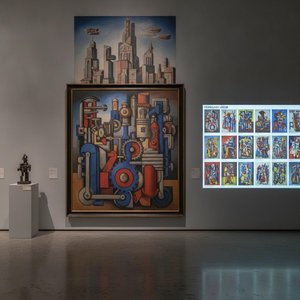 Mastering the Machine Age: The 25 Best Artworks by Fernand LégerImmerse yourself in the vibrant world of Fernand Léger. Explore 25 iconic masterpieces of Cubism and Tubism, from bold geometric forms to m…
 Top 10 Opere de Artă cu Atmosferă Industrială: Inspirație pentru Decorul CaseiDescoperă top 10 opere de artă care surprind atmosfera industrială! Explorează picturi iconice de Van Gogh, Monet și Hopper, simbolizând re…