

 Vezi în context
 Trimite
 Distribuie
 Detalii
 Ghidul

 Descarcă
 Produse similare
 Radiografie
 Diaporama
 Statistici
Still Life


 Citește mai mult
Reproducere pictată manual în ulei
Pictură în ulei pe pânză, realizată manual de artiștii noștri la dimensiunea și ramele dorite de dumneavoastră, pe comandă. ( Comută pe versiunea Print Treci la imagine digitală)




P118B lei10

P118H lei10

P118W lei10

P438Z lei10

P508JH lei12

P508YH lei12

P805H lei10

P805Z lei10

P919BZ lei10

P919G lei10

P919XJ lei10

P959ZH lei10

P968JZ lei12

W106C lei8

W218G lei10

W218JH lei8

W218Y lei10

W307PJ lei10

W316G lei10

W316PJ lei8

W316Y lei10

W398PJ lei8

W4111J lei10

W500HY lei15

W500JH lei15

W692G lei12

W849H lei8

W940BG lei15

W953PJ lei8




Alegeți dintre dimensiunile noastre prestabilite, care respectă proporțiile originale ale operei de artă.

Introduceți lățimea și înălțimea de care aveți nevoie, pentru a se potrivi ramei sau peretelui dumneavoastră. Această lucrare este pictată manual, așa că pentru o dimensiune cu o formă diferită, artistul poate picta puțin mai mult în jurul imaginii sau poate tăia puțin din margini — dumneavoastră decideți. Vă vom trimite o simulare digitală pentru aprobare înainte de a începe pictarea. Imaginea afișată pe această pagină nu reprezintă rezultatul real — doar simularea este reprezentativă.
După plasarea comenzii, echipa OriginalUniqueArt.com va contacta clientul prin e-mail pentru instrucțiuni și îi va furniza o previzualizare a machetei
Livrare în întreaga lume () în 3-4 săptămâni, în loc de cele 5 săptămâni standard. (22 Octombrie). Fără compromisuri în ceea ce privește calitatea.

Livrare expres gratuită la nivel mondial

Pânză de in premium

Asigurare completă pentru transport

Garanție de rambursare a taxelor vamale

Garanția fidelității culorilor

Politica de retur în 100 de zile (doar pentru defecte)

Garanție de rambursare 100%

Reducere pentru comenzi multiple
 Opțiunea cu sticlă este disponibilă doar pentru dimensiuni de sub 110 cm

Still Life
Tip de reproducere
Dimensiune reproducere
-


Preț total
lei 1388
A Moment Frozen in Time: Ferdinand Guillaimin’s “Still Life”
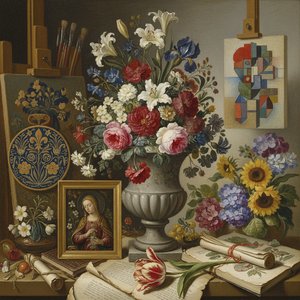
Ferdinand Guillaimin's "Still Life," painted in 1872, isn’t merely a depiction of objects arranged on a table; it’s a carefully constructed tableau brimming with quiet observation and subtle symbolism. This work, rendered in the heart of the Impressionist movement, captures a fleeting moment of domestic tranquility – a scene both familiar and imbued with an understated elegance. The painting immediately draws the eye to the central arrangement: a vase overflowing with vibrant red and yellow flowers, their petals seemingly caught mid-bloom, radiating warmth against the cooler tones that dominate the rest of the composition. Beside them rests a worn book, its pages hinting at untold stories and intellectual pursuits, while a simple bowl holds what appears to be fruit – perhaps apples or pears – adding another layer of earthly abundance.
Guillaimin’s technique is distinctly Impressionistic, prioritizing capturing the *impression* of light and color rather than precise detail. Loose brushstrokes dance across the canvas, creating an atmospheric haze that softens the edges of each object. He masterfully employs broken color – applying small dabs of paint side-by-side to build up hues and create a shimmering effect, particularly noticeable in the reflections on the table’s surface. The dark background serves not as mere backdrop but as a crucial element, intensifying the luminosity of the floral arrangement and lending the scene a sense of intimacy and depth. The artist's focus is less on photographic realism and more on conveying the *feeling* of being present within this quiet space.
The Context of Parisian Impressionism
To fully appreciate “Still Life,” it’s essential to understand the artistic climate in which Guillaimin was working. The 1870s were a period of profound change and experimentation for French art, marked by the rise of Impressionism. Artists like Monet, Renoir, and Pissarro sought to break free from the rigid conventions of academic painting, embracing plein air (outdoor) painting and capturing the ephemeral qualities of light and atmosphere. Guillaimin’s work reflects this spirit of innovation, moving away from traditional subject matter and exploring new ways of representing the world around him.
Guillaimin's connection to Pissarro is particularly noteworthy. The artist spent a significant period painting alongside Pissarro in Pontoise, a suburb of Paris, where he found inspiration in the everyday life of the region. This proximity fostered a collaborative environment, allowing Guillaimin to refine his style and develop his unique approach to capturing light and color. The Impressionists were not simply interested in depicting what they *saw*; they were driven by a desire to express their subjective experience of the world.
Symbolism and the Language of Objects
Beyond its aesthetic qualities, “Still Life” is rich with symbolic meaning. The flowers themselves represent beauty, fragility, and the fleeting nature of life – themes frequently explored in Impressionist art. The book suggests knowledge, contemplation, and a connection to the past. The bowl of fruit symbolizes abundance, nourishment, and the pleasures of earthly existence. Even the dark background can be interpreted as representing mortality or the unknown.
Guillaimin’s use of these objects is deliberate and carefully considered, inviting the viewer to engage in a process of interpretation. He doesn't offer explicit explanations; instead, he presents a series of interconnected symbols that resonate with universal themes of beauty, life, and death. The arrangement feels deliberately balanced, creating a harmonious composition that evokes a sense of peace and serenity.
A Legacy of Delicate Beauty
Ferdinand Guillaimin’s “Still Life” stands as a testament to the power of observation and the enduring appeal of simple subjects rendered with exquisite sensitivity. It's a painting that rewards close attention, revealing layers of meaning and emotional depth with each viewing. Reproductions capture much of the original atmosphere, but nothing quite replicates the subtle nuances of light and color that define Guillaimin’s masterful technique.
Today, this work is celebrated for its evocative beauty and its contribution to the development of Impressionism. It remains a poignant reminder of the quiet moments of everyday life – a timeless meditation on beauty, mortality, and the enduring power of art.
Întrebări și răspunsuri
Ce fel de culori folosește "Still Life"?
"Still Life" de Ferdinand Guillaumin utilizează o paletă de culori Earthy. Această paletă sintetizează caracterul cromatic general al operei.
Există lucrări similare cu "Still Life"?
Pagina Lucrări similare pentru "Still Life" de Ferdinand Guillaumin prezintă opere de artă similare.
Cine a creat "Still Life" și în ce an?
Autorul operei „Still Life” este Ferdinand Guillaumin, iar lucrarea datează din 1872.
Biografie artist
early life and career
Jean Baptiste Armand Guillaumin (1841 – 1927) was born in Paris, France, the grandson of Jean Joseph Guillaumin who was a notary by trade. Sent to school at a young age, he demonstrated an early aptitude for drawing and painting, nurturing his artistic inclinations throughout his formative years. His initial training encompassed traditional academic techniques, yet he swiftly embraced the burgeoning Impressionist movement—a revolutionary approach prioritizing direct observation and capturing fleeting moments of light and color—marking a pivotal shift in his artistic trajectory.contribution to impressionism
Guillaumin’s involvement with Impressionism extended beyond mere participation; it constituted a profound engagement with its core principles. He actively collaborated with fellow artists like Claude Monet, Camille Pissarro, and Vincent van Gogh, fostering intellectual exchange and stylistic experimentation within the group. Exhibiting regularly at Salon des Beaux-Arts and other prominent venues, Guillaumin showcased his distinctive style—characterized by hazy landscapes imbued with atmospheric luminescence and expressive brushstrokes—solidifying his position as a key figure in shaping Impressionist aesthetics. His canvases often depicted serene vistas of French countryside, capturing the subtle nuances of dawn or dusk with remarkable sensitivity.notable works and associations
Guillaumin’s artistic legacy rests upon a collection of celebrated paintings that exemplify the movement's hallmark qualities. Among his most notable creations are “Garden in Janville in June,” depicting a tranquil floral arrangement bathed in dappled sunlight, and “River Scene,” portraying a meandering waterway reflecting the ethereal hues of twilight. Furthermore, he produced “View of Puy de Dôme,” capturing the majestic volcanic peak against a backdrop of expansive skies—a testament to his mastery of tonal gradation and compositional balance. His artistic collaborations extended beyond Monet; he befriended Eugène Delacroix and collaborated on ambitious projects that reflected the spirit of their time. Notably, Guillaumin’s work was honored by Mount Holyoke College Art Museum, which houses a significant collection showcasing Impressionist masterpieces.style and influences
Guillaumin's artistic style blended Impressionistic techniques with Symbolist sensibilities—a movement concerned with exploring psychological depths and conveying spiritual themes through evocative imagery. Like many Symbolists, he favored bold color palettes and emotionally charged subjects, mirroring the influence of artists such as Edvard Munch and Gustav Klimt. His brushwork was loose and fluid, prioritizing tonal variation over meticulous detail, reflecting a desire to capture not merely what the eye perceives but also what resides beneath the surface—a characteristic that distinguishes his oeuvre from more conventional artistic expressions.legacy and remembrance
Ferdinand Guillaumin’s enduring influence on Impressionist art is undeniable. His paintings continue to resonate with audiences today, inspiring admiration for their beauty and conveying a profound appreciation of nature's ephemeral splendor. He remains remembered as one of the foremost practitioners of Impressionism—a movement that irrevocably transformed the landscape of European painting and ushered in an era of artistic innovation. Explore more of Guillaumin’s works and the Impressionist movement on OriginalUniqueArt: ferdinand guillaumin | 3 artworks impressionism art movement
Ferdinand Guillaumin
1841 - 1927 , Franța
Informații rapide
- Artistic Movement Or Style: Impressionism
- Artists Or Movements Influenced By This Artist: ['Symbolism']
- Artists Who Influenced This Artist:
- Vincent van Gogh
- Claude Monet
- Paul Cézanne
- Date Of Birth: Feb 16, 1841
- Date Of Death: Jun 26, 1927
- Full Name: Jean Baptiste Armand Guillaumin
- Nationality: French
- Notable Artworks:
- Garden in Janville
- River Scene
- View of Puy de Dôme
- Place Of Birth: Paris, France
Articole conexe

Blossoms of Time: A Historical Journey Through Flower Painting
Explore the captivating history of flower painting! Discover Dutch masters, symbolic meanings, & botanical art. Expert insights & high-quality reproductions at OriginalUniqueArt.
Blossoming Symbolism: A Historical Journey Through Flowers in Western Painting
Explore the rich history of flower symbolism in Western painting! Discover how artists from the Renaissance to Modernism used blossoms to convey meaning, emotion & beauty. Learn about iconic artworks and movements.

Impressionism: Cele Mai Frumoase Opere de Artă și Inspirație pentru Decorul Casei
Descoperă cele mai frumoase 10 opere impresioniste de la Monet, Renoir și Degas! Explorează istoria, tehnicile și culorile vibrante ale acestui stil revoluționar. Găsește inspirație pentru decorul casei tale cu reproduceri de artă de calitate muzeală pe OriginalUniqueArt.com.

Silent Narratives: Exploring the Enduring Appeal of Still Life Painting Across Centuries
Explore the rich history of still life painting with OriginalUniqueArt. Discover Dutch Masters, decode vanitas symbolism & learn about collecting timeless art. Expert insights and museum-quality reproductions.

Paul Cézanne: Cele Mai Reprezentative 25 De Capodopere – Artă, Istorie și Decorațiuni Interioare
Descoperă cele mai frumoase 25 de capodopere Paul Cézanne! Explorează istoria, tehnicile și semnificația picturilor impresioniste iconice. Reproduceri artă de calitate muzeală & inspirație decor interioară pe OriginalUniqueArt.com.