Comută pe versiunea Print
 Vezi mai mult







































 Pentru opere de artă sau reproduceri care depășesc 105 cm (aproximativ 41 de inch) pe oricare dintre laturi, cadrul va fi livrat demontat, sub formă de kit. Această metodă asigură o livrare sigură și previne deteriorarea în timpul transportului.


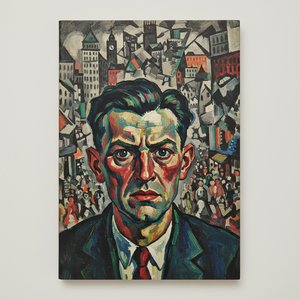
A Portrait of Urban Anxiety: Dr. Alfred Döblin by Ernst Ludwig Kirchner
Ernst Ludwig Kirchner’s “Dr. Alfred Döblin,” painted in 1912, isn't merely a likeness; it’s a visceral embodiment of the anxieties simmering beneath the surface of early 20th-century Berlin. This oil on canvas, measuring just over 50 by 41 centimeters, housed within the Fogg Art Museum in Cambridge, offers a profound glimpse into the artist’s Expressionist vision and the turbulent intellectual landscape of its time. Kirchner, a founding member of Die Brücke (The Bridge) group, sought to capture not just appearances but the raw emotional currents shaping modern life – a pursuit powerfully realized in this arresting portrait.
Kirchner's style is immediately recognizable: bold, fractured forms and an intense palette dominate the composition. The figure of Döblin, a prominent German writer and physician, is rendered with a deliberate distortion, his features elongated and simplified into geometric shapes. His gaze, direct and unwavering, pierces through the viewer, creating an immediate connection—and perhaps a subtle unease. The background isn’t a simple backdrop; it's a swirling vortex of blues, purples, and greens – colors often associated with melancholy, introspection, and the disorientation of urban existence. These hues aren’t blended smoothly; instead, Kirchner employs thick, visible brushstrokes that contribute to the painting’s dynamic energy.
The Echoes of Berlin: Context and Influences
To understand “Dr. Alfred Döblin,” one must consider the context in which it was created. 1912 Berlin was a city undergoing rapid transformation – an explosion of industry, immigration, and social upheaval. Kirchner, deeply affected by this dynamism, sought to portray its unsettling effects on the human psyche. The painting reflects the growing sense of alienation and fragmentation experienced by many during this period. Kirchner’s work was profoundly influenced by African and Oceanic art, particularly the use of simplified forms and symbolic color palettes. He also drew inspiration from the avant-garde movements emerging in Europe at the time, embracing a rejection of academic tradition in favor of subjective expression.
Furthermore, the portrait is inextricably linked to the intellectual world of Berlin. Döblin himself was a key figure in this milieu, known for his innovative and often challenging novels that explored themes of modernity, alienation, and the subconscious. Kirchner’s portrayal captures not just Döblin's physical appearance but also something of his intellectual intensity – a sense of being both deeply engaged with and profoundly troubled by the complexities of the modern world.
Symbolism and Emotional Resonance
Beyond its formal elements, “Dr. Alfred Döblin” is rich in symbolic meaning. The doctor’s spectacles, prominently displayed, represent his profession—a symbol of reason and order attempting to navigate a chaotic reality. However, the intensity of his gaze suggests that this rational approach is insufficient to fully comprehend the anxieties he observes. The swirling background can be interpreted as a metaphor for the overwhelming forces shaping modern life – industrialization, urbanization, and the breakdown of traditional values. The painting’s emotional impact is undeniably powerful; it evokes a sense of unease, isolation, and perhaps even despair.
Kirchner masterfully uses color to amplify these emotions. The cool blues and purples contribute to a feeling of melancholy and introspection, while the flashes of brighter hues—particularly in Döblin’s eyes—suggest a flicker of defiance or resistance against this encroaching darkness. The directness of the subject's gaze compels the viewer to confront their own anxieties about the modern world, making “Dr. Alfred Döblin” a timeless and profoundly moving work of art.
A Legacy in Reproduction: Bringing Kirchner’s Vision Home
High-quality reproductions of "Dr. Alfred Döblin" are now available through OriginalUniqueArt.com, meticulously crafted to capture the essence of Kirchner's original masterpiece. Utilizing archival-grade materials and employing traditional oil painting techniques, these reproductions faithfully recreate the artist’s bold brushstrokes, vibrant colors, and evocative symbolism. Whether adorning a contemporary living space or serving as a striking addition to an art collection, this reproduction offers a tangible connection to one of the most significant figures in Expressionist art – a poignant reminder of the anxieties and complexities of modern life.
For further insights into Ernst Ludwig Kirchner and his artistic journey, we invite you to explore our website at https://OriginalUniqueArt.com or delve deeper into his biography on Wikipedia: https://en.wikipedia.org/wiki/Ernst_Ludwig_Kirchner.
Întrebări și răspunsuri
Cât de saturată este paleta culorilor din "Dr. Alfred Döblin"?
Paleta lucrării "Dr. Alfred Döblin" are o saturație de Clear Color Presence.
Câți oameni vizualizează "Dr. Alfred Döblin"?
Pagina Statistici pentru "Dr. Alfred Döblin" de Ernst Ludwig Kirchner prezintă statistici privind vizitele publice: numărul de vizite lunare ale acestei opere, o comparație cu cele mai vizionate lucrări ale artistului și proveniența vizitatorilor.
"Dr. Alfred Döblin" de Ernst Ludwig Kirchner este păstrat în țara de origine a artistului?
Nu – opera de artă este păstrată în străinătate. „Dr. Alfred Döblin” face parte din colecția din Statele Unite ale Americii, în timp ce Ernst Ludwig Kirchner s-a născut în Germania.
 Previzualizare
 Trimite prin felicitare
 Distribuie
 Detalii despre lucrare
 Ghid
Ghid

 Descarcă imaginea
 Produse similare
 Radiografie
 Galerie foto
 Q&A
Q&A Statistici