German Expressionism
Friends (Emil Nolde)
Emil Nolde (1867–1956) a realizat Friends. Face parte din mișcarea German Expressionism. Este realizată în Oil On Canvas.
- Oil On Canvas

 Previzualizare

 Tablou în ulei pictat manual
 Trimite prin felicitare
 Distribuie
 Fișă informativă


 Descarcă imaginea
 Produse similare
 Radiografie
 Galerie foto
 Întrebări și răspunsuri

 Statistici
Friends, pe scurt
- Titlu
- Friends
- Artist
- Emil Nolde (1867–1956)
- Artist născut în
- Nolde, Danemarca
- Medium
- Oil On Canvas
- Mișcare
- German Expressionism
- Perioadă
- Modern
- Subiect
- landscape painting, german art scene, rural scenery, expressionist style, colorful palette”,, friendship theme”,
Ce reprezintă Friends?
Identification of the Artwork and Artist
Friends is a work by the German painter and printmaker Emil Nolde. The piece focuses on the complexities of human connection, intimacy, and emotional vulnerability. Through a simplified and expressive visual language, the artist explores the fundamental themes of friendship or love.
Nolde, a prominent figure in the Expressionist movement and a member of the Die Brücke group, sought to move beyond mere surface representation. His approach prioritized the internal weight of a subject over literal likeness. In this work, the focus remains on the psychological depth of the figures, utilizing a directness that emphasizes feeling over anatomical precision.
Composition and Visual Elements
The composition is tightly cropped, focusing intensely on the faces and upper bodies of the individuals. The intertwined forms of the two figures dominate the frame, filling almost the entire space. This proximity creates a sense of intimacy, pressing the subjects almost directly against the picture plane. The figures occupy the foreground entirely, leaving little room for spatial recession.
The background remains minimal, providing no environmental context. This lack of detail ensures the viewer's attention remains fixed on the physical connection between the subjects. Organic shapes define the human forms, while loose, gestural lines contribute to a sense of movement and emotional intensity. The flattened perspective further emphasizes the closeness of the embrace, removing traditional depth in favor of immediate, tactile presence.
Technique and Material Application
Executed in oil, the work exhibits a rough, painterly texture. The application of pigment is direct, leaving visible brushstrokes across the surface. In certain areas, the paint is applied with enough thickness to suggest an impasto technique, adding a physical weight to the forms. This tactile approach emphasizes the materiality of the medium.
The linework is characterized by a loose, gestural quality rather than precision. Lines are frequently blurred and overlapping, which creates a sense of movement and visual tension. These indistinct boundaries contribute to a dynamic effect, prioritizing the sensation of the subject over anatomical or structural accuracy.
Color Palette and Lighting
The palette is grounded in earthy, muted tones. Dominant shades of brown, ochre, and grey establish a somber foundation for the composition. These neutral colors are interrupted by a striking red hue applied to a figure's hair or head covering, creating a singular point of visual intensity. Small accents of yellow appear in the background and around the faces of the figures, providing a subtle contrast to the darker, more subdued surroundings.
Lighting is diffused and uneven across the surface. There is no singular, identifiable light source; instead, the illumination creates a series of irregular shadows and highlights. This lack of uniform light emphasizes the contours of the faces and bodies, adding a sense of weight to the physical proximity of the subjects. The interplay of light and shadow contributes to the overall emotional density of the work.
Style and Artistic Expression
The work is characterized by a strong Expressionistic style, prioritizing emotional intensity over literal representation. Through the use of non-naturalistic colors and simplified forms, the artist moves away from academic realism toward a more subjective visual language. The composition relies on organic shapes that reflect the human form, creating a sense of physical and emotional closeness.
Facial features are suggested rather than realistically rendered, favoring abstraction to convey the internal state of the subjects. This approach utilizes simplified and somewhat abstracted shapes to emphasize the essence of the human connection. The resulting aesthetic is one of immediacy and raw feeling, where the distortion of form serves to heighten the psychological weight of the embrace.
Related Works by the Same Artist
Nolde’s exploration of human connection and psychological depth extends through various subjects, from religious narratives to landscape studies. His religious output includes Christ among the Children and the visceral 1909 work The Mocking of Christ. These pieces reflect a shift toward depicting the emotional weight of spiritual moments through non-naturalistic color and simplified forms.
The artist also engaged with the primal and the figurative in works such as Masks, executed about 1906-1907. His interest in the natural world and the atmospheric qualities of light is evident in Autumn Sea, painted about 1908, and in the composition of Two Women against a Blue Sky. Each work demonstrates a consistent preoccupation with using color as the primary substance of form.
Imagini la înaltă rezoluție ale lui Friends
Domeniu public: artistul a decedat în 1956.
Emil Nolde, Friends. Domeniu public
Întrebări despre Friends, răspunsuri
Din ce materiale este realizată „Friends”?
"Friends" este realizat în Oil On Canvas."
Ce reprezintă "Friends" de Emil Nolde?
"Friends" de Emil Nolde surprinde: landscape painting, german art scene, rural scenery, expressionist style, colorful palette”,, friendship theme”,, nolde’s landscapes”.
Este "Friends" în domeniul public?
Statusul drepturilor de autor pentru "Friends" de Emil Nolde: opera este în domeniul public – drepturile de autor au expirat. Acest lucru determină dacă reproducerile imaginii pot fi realizate liber.
Cine este artistul din spatele "Friends"?
„Friends” este atribuit lui Emil Nolde.
Din ce curent artistic face parte "Friends" de Emil Nolde?
Mișcarea asociată cu "Friends" de Emil Nolde este German Expressionism. Această clasificare plasează lucrarea printre artiști și opere de artă conexe.
În ce etapă a evoluției lui Emil Nolde se încadrează „Friends”?
„Friends” aparține perioadei Early Modern din cariera lui Emil Nolde. Această clasificare corelează opera cu evoluția artistului.
Este "Friends" de Emil Nolde în domeniul public și care este motivul?
"Friends" de Emil Nolde este în domeniul public – drepturile de autor au expirat. Durata protecției drepturilor de autor se calculează de la data decesului artistului, survenit în anul 1956.
Cum se încadrează „Friends” în temele și stilul lui Emil Nolde?
În creația lui Emil Nolde, „Friends” se înscrie în stilul German Expressionism, alături de temele german expressionism, rural landscapes", friendship & nature, nolde's regional focus, "simple, emotive forms", spiritual undertones.
Este "Friends" reprezentativ pentru temele abordate de obicei de Emil Nolde?
Temele recurente ale lui Emil Nolde includ german expressionism, rural landscapes", friendship & nature, nolde's regional focus, "simple, emotive forms", spiritual undertones; „Friends” se concentrează pe landscape painting, german art scene, rural scenery, expressionist style, colorful palette”,, friendship theme”,, nolde’s landscapes”.
Despre artistul Emil Nolde
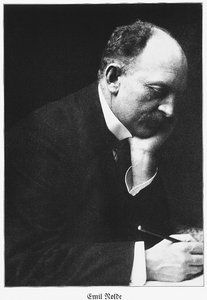
1867–1956, Danemarca
Emil Nolde
Viața și Identitatea lui Emil Nolde Născut sub numele de Hans Emil Hansen, pe 7 august 1867, omul care avea să devină cunoscut sub numele de Emil Nolde, a crescut în apropierea satului Nolde, în Duchia Schleswig. Primii săi ani de viață au fost modelați de viața rurală și agrară a familiei sale, un univers guvernat de ritmurile pământului. Cu toate acestea, el a ales să se îndepărteze de acest destin predeterminat, preferând să lucreze ca sculptor pe lemn și decorator de mobilier. Această muncă tactilă și fizică a fost fundamentul care a precedat transformarea sa către pictură și gravură.
Alte lucrări ale lui Emil Nolde
 Sunset
 Sea with Red Sky
 Couple on the beach1903
 Masks1911
Eseuri despre Friends
 Norwegian artworks of the 1900sNorwegian Expressionism and the intense works of Edvard Munch, including The Scream and Anxiety, define this era. View the collection at Or…
 Nature’s Flow: How Organic Forms and Biomorphic Abstraction Bring Harmony to Modern Interior DesignDiscover how organic forms and biomorphic abstraction bring serenity to your home. Explore expert tips on integrating nature-inspired textu…
 Expressionism vs. New Objectivity: Emotion vs. Precision in German ArtMaster the tension between Expressionist emotion and New Objectivity precision. Explore the soul of German modern art now.