Comută pe versiunea Print
 Vezi mai mult







































 Pentru opere de artă sau reproduceri care depășesc 105 cm (aproximativ 41 de inch) pe oricare dintre laturi, cadrul va fi livrat demontat, sub formă de kit. Această metodă asigură o livrare sigură și previne deteriorarea în timpul transportului.


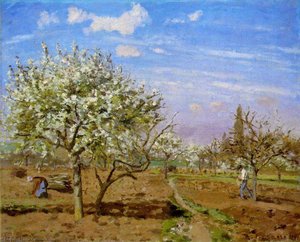
Pontoise Landscape, Through the Fields – A Window Into Impressionism’s Soul
Camille Pissarro's “Pontoise Landscape, Through the Fields,” painted in 1879, isn’t merely a depiction of rural France; it’s a distillation of Impressionist philosophy itself. This canvas, measuring 46 x 55 cm housed in Musée d'Orsay, Paris, transcends simple observation to capture fleeting moments of light and atmosphere—a hallmark of the movement that propelled Pissarro alongside Cézanne and Van Gogh into artistic prominence.
The Scene Unfolds: Rural Tranquility Captured
The painting transports us to a tranquil field bathed in dappled sunlight. Lush green grass dominates the foreground, punctuated by mature trees offering welcome shade. Two figures stroll leisurely through this idyllic space—one positioned slightly to the left, another further back on the right—representing everyday life and human connection within the natural world. The artist’s masterful use of perspective subtly guides the viewer's gaze across the landscape.
Impressionist Technique: Broken Brushstrokes and Vibrant Color
What distinguishes “Pontoise Landscape” is Pissarro’s distinctive Impressionist technique. Rather than striving for photographic realism, he employs short, broken brushstrokes—a revolutionary departure from academic conventions—to convey the ephemeral qualities of light and color. Notice how the artist blends hues directly onto the canvas without preliminary sketching or blending, allowing individual strokes to mingle and create a shimmering effect. The palette is rich with greens, blues, and yellows, reflecting the vibrancy of the season.
Historical Context: Impressionism’s Birthplace
Painted during the formative years of Impressionism, “Pontoise Landscape” embodies the movement's core tenets—a rejection of traditional artistic dogma in favor of subjective experience. Influenced by Eugène Boudin and Claude Monet, Pissarro sought to depict what he *saw*, prioritizing sensory impressions over intellectual contemplation. This painting exemplifies the desire to capture the beauty of ordinary life and the transformative power of natural light – a sentiment that resonated deeply with artists of the era.
Symbolism and Emotional Resonance
Beyond its technical brilliance, “Pontoise Landscape” carries symbolic weight. The trees represent stability and permanence against the transient nature of sunlight and human presence. The birds soaring overhead symbolize freedom and aspiration, mirroring the spirit of artistic innovation that characterized Impressionism. Ultimately, the painting evokes a feeling of serenity and contentment—a celebration of simple pleasures and the restorative effects of immersion in nature. It’s a piece that invites contemplation and reminds us to appreciate the beauty of the everyday.
Reproductions available at OriginalUniqueArt.com offer art enthusiasts the opportunity to experience this masterpiece firsthand, bringing its luminous colors and evocative atmosphere into their homes.
Întrebări și răspunsuri
Cât de saturată este paleta culorilor din "Pontoise Landscape, Through the Fields"?
Paleta lucrării "Pontoise Landscape, Through the Fields" are o saturație de Culori discrete.
La ce artist este atribuită opera „Pontoise Landscape, Through the Fields”?
„Pontoise Landscape, Through the Fields” a fost creat de Camille Pissarro. Informațiile de pe această pagină descriu opera originală a lui Camille Pissarro.
În ce perioadă și în ce stil a fost creat(ă) "Pontoise Landscape, Through the Fields" de Camille Pissarro?
„Pontoise Landscape, Through the Fields” a fost creat în 1879, făcând parte din mișcarea Impressionist Landscape.
Mai multe detalii despre această pictură
 Previzualizare
 Trimite prin felicitare
 Distribuie
 Detalii despre lucrare
 Ghid
Ghid

 Descarcă imaginea
 Produse similare
 Radiografie
 Galerie foto
 Întrebări și răspunsuri
 Statistici