Comută pe versiunea Print
 Vezi mai mult







































 Pentru opere de artă sau reproduceri care depășesc 105 cm (aproximativ 41 de inch) pe oricare dintre laturi, cadrul va fi livrat demontat, sub formă de kit. Această metodă asigură o livrare sigură și previne deteriorarea în timpul transportului.


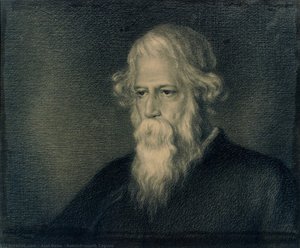
Rabindranath Tagore: A Portrait of Wisdom and Reflection
The painting “Rabindranath Tagore” by Atul Basu stands as a testament to the enduring power of portraiture—a genre that transcends mere likeness, striving instead for an embodiment of character and intellect. Executed in 1944, during a period marked by profound artistic experimentation and social reform in India, this artwork captures Tagore’s gaze with remarkable precision, conveying not just his physical appearance but also the depth of his contemplative spirit. Basu skillfully employs oil paints on plywood—a relatively unconventional choice for portraiture at the time—to achieve an astonishing level of detail, meticulously rendering Tagore's facial features and capturing the subtle nuances of expression that speak volumes about his inner life.- Style: Impressionistic – Basu’s approach leans heavily into impressionism, prioritizing atmospheric light and color over strict realism. This stylistic decision lends an ethereal quality to the portrait, mirroring Tagore's philosophical musings on beauty and spirituality.
- Technique: Basu utilizes layering techniques—building up thin glazes of pigment upon each other—to create a luminous surface that captures the subtleties of light and shadow. The meticulous blending ensures that no detail is overlooked, resulting in an image brimming with texture and vibrancy.
- Historical Context: Painted during the British Raj, “Rabindranath Tagore” reflects the anxieties and aspirations of its era. Tagore himself was a vocal critic of colonialism, advocating for Indian self-determination and cultural preservation—themes that resonate powerfully within the artwork’s visual language.
- Color Palette: The subdued tones contribute to the painting's contemplative mood, mirroring Tagore's philosophical outlook on life and death.
- Composition: The framing directs the viewer's eye towards Tagore’s face, highlighting his expression and conveying a sense of profound introspection.
Întrebări și răspunsuri
Sub ce alte nume sau pseudonime este cunoscut Atul Basu?
Atul Basu este cunoscut și sub numele de Atul Bose.
De unde provin vizitatorii "Rabindranath Tagore" de Atul Basu?
Există o pagină de Statistici pentru "Rabindranath Tagore". Aceasta prezintă graficul vizitelor lunare pentru această operă și pentru celelalte lucrări ale artistului, cu detalii pe țări și limbi vorbite.
Din ce curent artistic face parte "Rabindranath Tagore" de Atul Basu?
„Rabindranath Tagore” este o operă de Graphic art. Acest curent indică tradiția artistică din care face parte lucrarea.
Mai multe detalii despre această pictură
 Previzualizare
 Trimite prin felicitare
 Distribuie
 Detalii despre lucrare
 Ghid
Ghid

 Descarcă imaginea
 Produse similare
 Radiografie
 Galerie foto
 Întrebări și răspunsuri
 Statistici