Comută pe versiunea Print
 Vezi mai mult







































 Pentru opere de artă sau reproduceri care depășesc 105 cm (aproximativ 41 de inch) pe oricare dintre laturi, cadrul va fi livrat demontat, sub formă de kit. Această metodă asigură o livrare sigură și previne deteriorarea în timpul transportului.


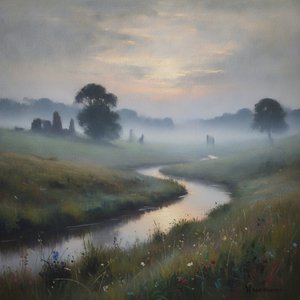
A Pastoral Reverie: Alphonse Legros’s “Hilly Landscape”
Alphonse Legros's "Hilly Landscape," painted in 1876, isn’t merely a depiction of a rural scene; it’s a carefully constructed meditation on light, atmosphere, and the quiet beauty of the English countryside. This evocative work, now housed within the Victoria and Albert Museum’s collection, offers a glimpse into the artist's evolving style—a synthesis of Realist observation with a subtle Impressionistic sensibility—and speaks volumes about his time as an expatriate in London. Legros, having moved from France to England in 1863, found himself immersed in a landscape that both mirrored and subtly diverged from his native French vistas, leading him to develop a unique perspective on the English pastoral.
The painting immediately draws the eye with its harmonious blend of greens and blues. The rolling hills, rendered with loose, confident brushstrokes, are bathed in a soft, diffused light—a characteristic of Legros’s approach that suggests an outdoor setting, painted *en plein air*. Notice how he avoids sharp outlines or dramatic contrasts; instead, he employs subtle gradations of color to create a sense of depth and atmospheric perspective. The distant spire of Hampstead church provides a grounding element, anchoring the scene within a recognizable location while simultaneously contributing to the overall feeling of serene distance.
The Influence of Realism and Impressionism
Legros’s artistic journey is defined by his engagement with two significant movements: Realism and Impressionism. Initially trained in traditional academic styles, he was profoundly influenced by Gustave Courbet's rejection of idealized representation and his commitment to depicting the world as it truly appeared. This influence is evident in Legros’s meticulous observation of natural details—the texture of the grass, the subtle variations in the foliage—and his avoidance of overtly sentimental or romanticized imagery. However, he also embraced the Impressionists' focus on capturing fleeting moments and the subjective experience of light and color. The loose brushwork and emphasis on atmospheric effects demonstrate this dual influence, creating a painting that is both grounded in observation and imbued with a sense of immediacy.
Furthermore, Legros’s background as a house decorator and wall-painter—a profession demanding an understanding of materials and spatial relationships—contributed to his ability to create convincing landscapes. He wasn't simply sketching from memory; he was translating three-dimensional space onto a two-dimensional surface with remarkable skill. The composition itself is carefully balanced, guiding the viewer’s eye through the scene and establishing a sense of harmonious unity.
Symbolism and Emotional Resonance
Beyond its technical merits, “Hilly Landscape” resonates with a quiet emotional depth. It evokes a feeling of tranquility and contemplation—a welcome respite from the bustle of urban life. The painting’s muted palette and soft light contribute to this sense of serenity, while the distant church spire suggests a connection to faith and tradition. The scene feels timeless, inviting the viewer to lose themselves in the simple pleasures of nature.
Interestingly, Legros's work often reflected his personal experiences as an expatriate artist. The English countryside, with its rolling hills and picturesque villages, became a source of inspiration for him, offering a contrast to the landscapes of his native France. “Hilly Landscape” can be interpreted as a celebration of this new environment—a testament to the beauty and charm he discovered in England.
A Legacy of British Art
Alphonse Legros’s contribution to British art extends beyond this single painting. He played a pivotal role in establishing etching as a respected medium, teaching at the Slade School of Fine Art and fostering a new generation of artists. His influence can be seen in the work of his students, including Jessie Mothersole and Elinor Hallé, who went on to become prominent figures in the British art world. “Hilly Landscape” stands as a testament to Legros’s artistic versatility and enduring legacy—a beautiful example of a painter who seamlessly blended Realist observation with Impressionistic techniques to create works that continue to captivate viewers today.
Întrebări și răspunsuri
Sub ce alte nume sau pseudonime este cunoscut Alphonse Legros?
Alte nume înregistrate pentru Alphonse Legros, creatorul operei „Hilly Landscape”, includ Alphons Legros.
Cine este autorul operei "Hilly Landscape" și din ce curent artistic face parte?
"Hilly Landscape" a fost creat de Alphonse Legros, în stilul Contemporary Realism. Artistul și mișcarea definesc tradiția acestei opere.
În ce an a fost creată "Hilly Landscape" de Alphonse Legros?
"Hilly Landscape" de Alphonse Legros a fost creat(ă) în 1876.
Mai multe detalii despre această pictură
 Previzualizare
 Trimite prin felicitare
 Distribuie
 Detalii despre lucrare
 Ghid
Ghid

 Descarcă imaginea
 Produse similare
 Radiografie
 Galerie foto
 Întrebări și răspunsuri
 Statistici