Romanticism
Alpine Landscape (Alexandre Calame)
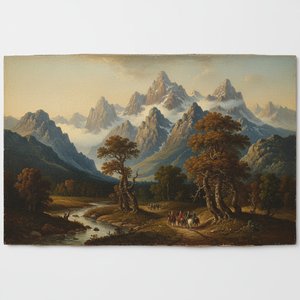
Alexandre Calame (1810–1864) a realizat Alpine Landscape. Face parte din mișcarea Romanticism. Este realizată în Oil On Canvas. Dimensiunile sunt 45 × 31 cm.
- Oil On Canvas
- 45 × 31 cm

 Previzualizare

 Tablou în ulei pictat manual
 Trimite prin felicitare
 Distribuie
 Fișă informativă


 Descarcă imaginea
 Produse similare
 Radiografie
 Galerie foto
 Întrebări și răspunsuri

 Statistici
Alpine Landscape, pe scurt
- Titlu
- Alpine Landscape
- Artist
- Alexandre Calame (1810–1864)
- Artist născut în
- Vevey, Elveția
- Medium
- Oil On Canvas
- Dimensiuni
- 45 × 31 cm
- Mișcare
- Romanticism
- Perioadă
- 19th Century
- Subiect
- alpine landscape, mountain scenery, swiss alps view, river valley scene, atmospheric perspective, landscape painting
Ce reprezintă Alpine Landscape?
Identification of the Alpine Landscape
Alpine Landscape is an oil painting by the Swiss artist Alexandre Calame. The canvas captures a mountainous valley where a river winds through the terrain. A rocky outcrop anchors the left side of the scene, leading the eye toward distant, receding peaks. This work reflects the artist's lifelong preoccupation with the rugged topography of his homeland.
Alexandre Calame was born in 1810 in Vevey, Switzerland. He spent much of his life observing the textures of the Alps, from the weight of granite to the movement of mountain streams. The artist eventually passed away in 1864 in Menton, France. In this specific composition, the light remains diffused, as if filtered through an overcast sky or the soft glow of early morning.
The scene focuses on the scale of the natural world. Trees and shrubs ground the foreground, providing a sense of texture against the vastness of the background. The mountains rise in geometric triangles, their forms softening as they vanish into the atmospheric distance. A quiet stillness settles over the valley.
Composition and Visual Elements
A rocky outcrop anchors the left side of the frame, its jagged edges catching the light to pull the eye into the scene. From this stone threshold, the gaze follows a river as it winds through a mountainous valley. In the foreground, the earth is textured with the presence of shrubs and trees, grounding the viewer amidst the wild vegetation. These small, detailed forms provide a tactile entry point before the eye moves toward the vastness of the background.
The composition relies on a steady use of perspective to carve out a sense of immense depth. The mountains recede into the distance, their scale dwarfing the river and the greenery below. This arrangement emphasizes the sheer magnitude of the alpine terrain. The verticality of the peaks meets the horizontal flow of the water, creating a structured balance within the natural chaos. The light remains diffused, casting soft shadows across the mountain slopes and the valley floor. A quiet stillness settles over the stone and the stream.
Technique and Artistic Materials
Oil paint meets canvas in this landscape. The artist applied thin, translucent washes of pigment, layering them one after another in a sequence of glazes. This meticulous process builds a luminous depth, allowing light to settle within the layers. It is a slow accumulation of color. The surface holds the weight of the mountain and the softness of the air.
The brushwork captures the physical reality of the terrain. Roughness defines the stone of the rocky outcrop, while the texture of the foliage is rendered with precise, tactile strokes. Light enters the scene as a diffused glow, suggesting the quiet of an overcast day or the pale clarity of early morning. Shadows settle into the mountain crevices, creating a sense of immense scale through tonal modulation. The atmosphere feels heavy with moisture, as if the light itself is filtered through a mountain mist.
The Artistic Style of Calame
A sense of the sublime anchors this work, a hallmark of the Romanticism movement. Calame was a pivotal figure within the Düsseldorf School of Painting, bringing a disciplined eye to the untamed wilderness. He treats the mountains not as static stone, but as living, breathing entities. Through a mastery of atmospheric perspective, the distant peaks recede into a soft, hazy light, creating a profound sense of depth. This tonal modulation allows the viewer to feel the weight of the air between the rocky foreground and the far horizon.
The brushwork is expressive, capturing the rugged textures of the landscape. He uses these strokes to convey the emotional impact of nature, translating the scale of the valley into a felt experience. There is a palpable emotion in the way light hits the river and the cliffs, suggesting the solitude of the high Alps. His connection to these mountains is evident in the precise, almost tactile rendering of the terrain. The scene remains quiet, held in a delicate balance of light and shadow.
Related Works by Alexandre Calame
The artist’s hand often returned to the weight of the mountains and the movement of the air. In 1838, he captured the tension of a storm at Handeck, where the sky meets the jagged rock. This energy persists in his 1856 work, Storm in the Alps, a scene of chaotic weather and turbulent clouds. He also documented the specific topography of the Valley of Lauterbrunnen in 1856, rendering the deep clefts of the Swiss terrain. These works reflect a lifelong preoccupation with the raw power of the high passes.
Water remains a constant presence in his compositions, shifting from the violent to the still. He painted the Lake of the Four Cantons, near Brunnen, in 1853, finding a different rhythm in the alpine waters. His vision extended beyond the peaks to the warmth of the south, seen in Pozzuoli and the Bay of Naples, 1844. Even in more quiet studies, such as Landscape with Oaks, about 1859, the meticulous observation of nature remains central. The light continues to shift across the stone.
Imagini la înaltă rezoluție ale lui Alpine Landscape
Domeniu public: artistul a decedat în 1864.
Alexandre Calame, Alpine Landscape.
Alexandre Calame (1810–1864), Alpine Landscape, oil on canvas. Domeniu public Imagine: OriginalUniqueArt.com.
Întrebări despre Alpine Landscape, răspunsuri
Din ce materiale este realizată „Alpine Landscape”?
"Alpine Landscape" este realizat în Oil On Canvas."
Ce dimensiuni are "Alpine Landscape" de Alexandre Calame în realitate?
„Alpine Landscape” măsoară 45 x 31 cm în formatul său original. Dimensiunile originale reprezintă o referință utilă atunci când alegeți dimensiunea unei reproduceri.
Ce reprezintă "Alpine Landscape" de Alexandre Calame?
Temele prezente în "Alpine Landscape" de Alexandre Calame includ alpine landscape, mountain scenery, swiss alps view, river valley scene, atmospheric perspective, landscape painting, nature’s grandeur”. Împreună, acestea definesc subiectul întregii opere de artă.
Este "Alpine Landscape" în domeniul public?
"Alpine Landscape" de Alexandre Calame este în domeniul public (în domeniul public – drepturile de autor au expirat). Acest statut reglementează modul în care imaginea lucrării poate fi reprodusă.
Cine este artistul din spatele "Alpine Landscape"?
Artistul din spatele operei „Alpine Landscape” este Alexandre Calame. Lucrarea este catalogată sub numele lui Alexandre Calame.
Din ce curent artistic face parte "Alpine Landscape" de Alexandre Calame?
„Alpine Landscape” este o operă de Romanticism. Acest curent indică tradiția artistică din care face parte lucrarea.
Din ce perioadă a carierei lui Alexandre Calame face parte „Alpine Landscape”?
În cariera lui Alexandre Calame, „Alpine Landscape” aparține perioadei Mature Period. Această etapă facilitează compararea sa cu celelalte opere ale artistului.
Este "Alpine Landscape" de Alexandre Calame în domeniul public și care este motivul?
„Alpine Landscape” de Alexandre Calame este în domeniul public – drepturile de autor au expirat. Termenul de protecție a drepturilor de autor se calculează de la data decesului artistului, iar Alexandre Calame a decedat în 1864.
Ce punct comun are "Alpine Landscape" cu restul creației lui Alexandre Calame?
"Alpine Landscape" face parte din perioada Romanticism a lui Alexandre Calame, ale cărei teme recurente includ romantic nature's beauty, düsseldorf school influence, swiss landscape focus", alpine sublime ideal, detailed observation, calame's signature style, nature as spiritual space.
Despre artistul Alexandre Calame

1810–1864, Elveția
Alexandre Calame
Alexandre Calame (1810 – 1864): Capturarea Majestății Alpine Alexandre Calame, născut în Arabie (astăzi Vevey), Elveția, în 1810, a fost un pictor de peisaje svab care a obținut o renume considerabilă în timpul erei romantice și este considerat o figură esențială în cadrul Școlii de Pictură de la Düsseldorf. Călătoria sa artistică a început în circumstanțe dificile — ruina financiară a tatălui său i-a împiedicat să urmeze o educație formală, forțându-l să lucreze ca funcționar bancar încă de la adolescență. Totuși, această necesitate pragmatică i-a alimentat pasiunea pentru artă, fiind hrănită de o întâlnire cu bananul Diodati, care i-a asigurat o instruire neprețuită sub îndrumarea lui François Diday, un celebru pictor de peisaje de la Düsseldorf. Recunoscând talentul său înnăscut și dedicarea sa, Alexandre Calame a abandonat rapid atribuțiile de funcționar pentru a urmări excelența artistică.
Despre Alexandre Calame Lucrări remarcabile ale lui Alexandre Calame
Alte lucrări ale lui Alexandre Calame
 Torrent in the Alps1849
 Valley of Lauterbrunnen1856
 The Mythen1861
 Landscape1837
Eseuri despre Alpine Landscape
 Apertures of Perspective: The Window as a Compositional Device in Landscape ArtExplore how masters use windows to frame landscapes and depth. Master the art of composition now.
 19th century Swiss paintersLouis Buvelot left Switzerland for Melbourne in 1864 to become the father of Australian landscape painting. How did his Swiss training chan…
 Majestic Peaks on Canvas: A Historical & Artistic Exploration of Mountains in Fine ArtExplore the history of mountain painting! Discover Romantic masterpieces & key artists like Dahl & Calame. Learn about the Sublime & Pictur…