

 Vezi în context
 Trimite
 Distribuie
 Detalii
 Ghidul

 Descarcă
 Produse similare
 Radiografie
 Diaporama
 Statistici
Red Lily Pads (Nénuphars rouges)


 Citește mai mult
Giclée / Imprimare artistică
Printuri giclée sau pe canvas de calitate muzeală, cu proces de producție rapid și opțiuni flexibile de finisare. ( Comandă pictură realizată manual Treci la imagine digitală)




P118B $10

P118H $10

P118W $10

P438Z $10

P508JH $12

P508YH $12

P805H $10

P805Z $10

P919BZ $10

P919G $10

P919XJ $10

P959ZH $10

P968JZ $12

W106C $8

W218G $10

W218JH $8

W218Y $10

W307PJ $10

W316G $10

W316PJ $8

W316Y $10

W398PJ $8

W4111J $10

W500HY $15

W500JH $15

W692G $12

W849H $8

W940BG $15

W953PJ $8




Alegeți dintre dimensiunile noastre prestabilite, care respectă proporțiile originale ale operei de artă.

Puteți introduce propriile dimensiuni pentru a se potrivi unui anumit cadru sau spațiu. Dacă dimensiunea selectată nu corespunde proporțiilor imaginii originale, vom decupa lucrarea de artă sau vom extinde imaginea cu margini oglindite sau cu o culoare uniformă. Un mockup digital va fi trimis pentru aprobarea dumneavoastră înainte de începerea producției.
Vă rugăm să rețineți că previzualizarea de pe ecran nu reflectă decuparea sau extinderea reală. Doar mockup-ul va arăta cu exactitate compoziția finală.
Deși dimensiunile personalizate sunt disponibile, vă recomandăm să selectați o dimensiune din lista predefinită pentru a păstra proporțiile originale.
Livrare în întreaga lume () în 2 săptămâni, în loc de cele 4/5 săptămâni standard. (25 Septembrie)

Livrare expres gratuită la nivel mondial

Pânză de in premium

Asigurare completă pentru transport

Garanție de rambursare a taxelor vamale

Garanția fidelității culorilor

Politica de retur în 100 de zile (doar pentru defecte)

Garanție de rambursare 100%

Reducere pentru comenzi multiple
 Opțiunea cu sticlă este disponibilă doar pentru dimensiuni de sub 110 cm

Red Lily Pads (Nénuphars rouges)
Giclée / Imprimare artistică
Dimensiune reproducere
-


Preț total
$ 80
A Dance of Light and Reflection: Unveiling Calder’s “Red Lily Pads”
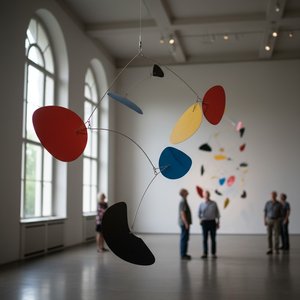
Alexander Milne Calder's "Red Lily Pads (Nénuphars rouges)" isn’t merely a depiction of a serene pond; it’s an invitation to lose oneself in the delicate balance of form, color, and movement. Created in 1956, this captivating sculpture – captured through a masterful photograph – embodies Calder's signature approach: embracing chance and celebrating the ephemeral beauty of nature within a distinctly modern aesthetic. The piece resides within a contemporary architectural space, its organic shapes echoing the curves of the surrounding walls, creating an illusion of seamless integration between art and environment.
The composition immediately draws the eye to the central arrangement of circular lily pads, rendered in a vibrant coral-red that commands attention against the cool neutrality of the white architecture. These aren’t static forms; they possess a subtle dynamism, hinting at an unseen movement – perhaps the gentle sway of water or the whisper of air currents. The delicate wires and rods connecting them are almost invisible, yet crucial to the sculpture's overall effect, suggesting a complex network of support and balance. Calder masterfully utilizes negative space, allowing the surrounding walls to contribute significantly to the artwork’s visual weight and sense of openness.
The Legacy of a Pioneer: Calder and His Architectural Sculptures
To fully appreciate “Red Lily Pads,” it's essential to understand Alexander Milne Calder’s broader artistic trajectory. Born in Aberdeen, Scotland, in 1846, he initially trained as a stonemason before embarking on a career that would ultimately define him as one of the 20th century’s most innovative sculptors. His early work focused on monumental commissions for public buildings, notably his groundbreaking design for Philadelphia City Hall – a project that spanned two decades and involved over 250 individual sculptures. This experience profoundly shaped Calder's approach to architectural sculpture, instilling in him a deep appreciation for the interplay between form, space, and function.
Calder’s fascination with movement is evident throughout his oeuvre, but it’s perhaps most powerfully expressed in his mobiles – kinetic sculptures that respond to air currents. “Red Lily Pads” represents a shift towards a more static form while retaining this core principle of dynamic balance. The photograph captures a fleeting moment of equilibrium, suggesting the constant negotiation between stability and motion that characterizes Calder's work.
Symbolism and Emotional Resonance
The lily pad itself is a potent symbol – representing tranquility, purity, and rebirth. In this context, however, Calder subverts traditional associations, transforming these symbols into an abstract meditation on form and color. The red hue adds a layer of intensity, evoking feelings of passion, energy, and perhaps even a hint of melancholy. The surrounding white walls create a sense of serenity and contemplation, inviting the viewer to lose themselves in the sculpture’s visual rhythm.
Ultimately, “Red Lily Pads” is more than just a beautiful image; it's an invitation to experience the world through Calder’s unique lens. It speaks to our innate desire for balance, harmony, and connection with nature – qualities that resonate deeply in today’s increasingly complex and chaotic environment.
Biografie artist
Introduction to Alexander Milne Calder
Alexander Milne Calder (MILL-nee) was a Scottish American sculptor born in Aberdeen, Scotland, on August 23, 1846. He is best known for his architectural sculpture of Philadelphia City Hall and both his son, Alexander Stirling Calder, and grandson, Alexander ‘Sandy’ Calder, became significant sculptors in the 20th century. His artistic journey began with a formative influence from his father, John Rhind, a sculptor who instilled in him an early appreciation for stone carving during his childhood years. Calder attended the Royal Academy in Edinburgh where he honed his skills and studied alongside fellow artists, shaping his understanding of classical sculpture traditions. He subsequently moved to London and collaborated on monumental projects like the Albert Memorial, demonstrating his versatility and ambition as a craftsman.- Early Life and Education: Calder’s upbringing in Aberdeen exposed him to the craft of stone carving from a young age, profoundly impacting his artistic sensibilities.
- Royal Academy Training: His studies at the Royal Academy provided foundational knowledge in sculpture techniques and broadened his artistic horizons.
- London Collaborations: Calder’s involvement with the Albert Memorial showcased his ability to execute large-scale architectural sculptures, cementing his reputation as a skilled artist.
Career Highlights
Calder's professional life unfolded in stages marked by pivotal commissions and collaborations. He secured a prominent role on the construction of Philadelphia City Hall, undertaking an ambitious project that demanded meticulous attention to detail and involved crafting over 250 pieces—primarily marble and bronze—spanning two decades. This monumental endeavor solidified his position as one of Scotland’s foremost sculptors. Furthermore, he was entrusted with creating William Penn, a colossal statue honoring Pennsylvania's founder atop City Hall’s tower, showcasing his mastery of sculptural form and symbolism. Calder’s artistic vision extended beyond architectural projects; he produced striking sculptures like *Indian Figure*, reflecting his engagement with indigenous cultures and artistic experimentation.- Philadelphia City Hall Commission: Calder’s dedication to this project resulted in a masterpiece of architectural sculpture, demonstrating his commitment to ambitious artistic endeavors.
- William Penn Statue: The creation of William Penn exemplifies Calder's ability to convey historical significance through monumental sculptural representations.
- *Indian Figure*: This sculpture embodies Calder’s exploration of cultural influences and innovative artistic techniques.
Notable Sculptures
Calder’s oeuvre encompasses a diverse range of artworks characterized by both static and kinetic forms. Among his most celebrated creations are the illuminated portals of Philadelphia City Hall, adorned with colored lights—a testament to Calder's meticulous craftsmanship and artistic flair. He also produced *Spirale*, a towering sculpture commissioned for UNESCO headquarters in Paris, reflecting his engagement with contemporary art trends and architectural innovation. His final masterpiece, *Flamingo*, stands proudly at Chicago’s Federal Center Plaza, symbolizing Calder’s enduring legacy as one of America's most influential sculptors.- Philadelphia City Hall Portals: Calder’s incorporation of colored lights into these portals exemplifies his artistic attention to detail and visual impact.
- *Spirale*: This monumental sculpture commissioned for UNESCO headquarters demonstrates Calder’s ability to create impactful artworks that resonate with global audiences.
- *Flamingo*: Calder's final sculpture at Chicago’s Federal Center Plaza represents his enduring contribution to American art history.
Legacy and Influence
Alexander Milne Calder’s impact on the artistic landscape extends beyond his own creations. His son, Alexander Stirling Calder, and grandson, Alexander ‘Sandy’ Calder, followed in his footsteps as sculptors, perpetuating a lineage of artistic excellence. Calder's pioneering approach to sculpture—particularly his exploration of kinetic art and chance—inspired generations of artists and continues to influence contemporary sculptural practices. He remains revered for his unwavering dedication to artistic innovation and his profound contribution to the visual arts. “Theories may be all very well for the artist himself, but they shouldn't be broadcast to other people.”
Alexandru Milne Calder
1898 - 1976 , Regatul Unit
Informații rapide
- Artistic Movement Or Style: Architectural sculpture
- Artists Who Influenced This Artist: ['John Rhind']
- Date Of Birth: August 23, 1846
- Date Of Death: June 14, 1923
- Full Name: Alexander Milne Calder
- Nationality: Scottish-American
- Notable Artworks:
- Philadelphia City Hall
- William Penn statue
- Place Of Birth: Aberdeen, United Kingdom
Articole conexe

The Enduring Form: Exploring Themes & Techniques in Sculpture Across Historical Periods
Explore the rich history of sculpture from ancient masterpieces to contemporary innovations. Discover key techniques, influential artists & investment potential for discerning art collectors.

Top 10 Capodopere din Bronz care au Revoluționat Arta – Inspirație pentru Decor
Descoperă Top 10 sculpturi din bronz care au schimbat istoria artei! Explorează operele lui Rodin, Michelangelo și alți maeștri, tehnicile lor unice și inspirația pentru decorul casei tale. Replici de calitate muzeală pe OriginalUniqueArt.com.

Wassily Kandinsky: Cele Mai Iconice 25 De Opere – Artă Abstractă pentru Decor Rafinat
Descoperă cele mai emblematice 25 de opere ale lui Wassily Kandinsky, pionierul artei abstracte! Explorează culorile vibrante, compozițiile unice și istoria fascinantă din spatele fiecărei picturi. Reproduceri de calitate muzeală pe OriginalUniqueArt.com – inspiră-ți decorul cu artă modernă!
Alexander Calder: Kinetic Sculpture, Mobile Art & the Poetics of Chance
Explore the revolutionary world of Alexander Calder's kinetic sculptures & mobiles. Discover insights for collectors, acquisition advice, and the enduring legacy of this modern master. Expert analysis & art valuation.

Top 10 Capodopere ale Expresionismului Abstract: Artă, Artiști și Decorațiuni de Lux | OriginalUniqueArt.ro
Descoperă Top 10 capodopere ale Expresionismului Abstract! Explorează poveștile lui Pollock, Rothko și De Kooning. Reproduceri de artă de lux & inspirație decor pe OriginalUniqueArt.ro. Găsește pictura perfectă pentru spațiul tău!
