

 Previzualizare
 Trimite
 Distribuie
 Detalii despre lucrare

 Descarcă
 Produse similare
 Radiografie
 Diapozitive automate
 Statistici
Study for Yosemite Valley Glacier Point Trail
 Oil On Canvas
- WallArt
- Luminism Art Movement
 1873
1873- 19th Century
 25.0 x 35.0 cm
 Vezi mai mult
Giclée / Imprimare artistică
Printuri giclée sau pe canvas de calitate muzeală, cu proces de producție rapid și opțiuni flexibile de finisare. ( Comandă pictură lucrată manual Comută pe Imagine Digitală)




P118B $10

P118H $10

P118W $10

P438Z $10

P508JH $12

P508YH $12

P805H $10

P805Z $10

P919BZ $10

P919G $10

P919XJ $10

P959ZH $10

P968JZ $12

W106C $8

W218G $10

W218JH $8

W218Y $10

W307PJ $10

W316G $10

W316PJ $8

W316Y $10

W398PJ $8

W4111J $10

W500HY $15

W500JH $15

W692G $12

W849H $8

W940BG $15

W953PJ $8




Alegeți dintre dimensiunile noastre prestabilite, care respectă proporțiile originale ale operei de artă.

Puteți introduce propriile dimensiuni pentru a se potrivi unui anumit cadru sau spațiu. Dacă dimensiunea selectată nu corespunde proporțiilor imaginii originale, vom decupa lucrarea de artă sau vom extinde imaginea cu margini oglindite sau cu o culoare uniformă. Un mockup digital va fi trimis pentru aprobarea dumneavoastră înainte de începerea producției.
Vă rugăm să rețineți că previzualizarea de pe ecran nu reflectă decuparea sau extinderea reală. Doar mockup-ul va arăta cu exactitate compoziția finală.
Deși dimensiunile personalizate sunt disponibile, vă recomandăm să selectați o dimensiune din lista predefinită pentru a păstra proporțiile originale.
Livrare în întreaga lume () în 2 săptămâni, în loc de cele 4/5 săptămâni standard. (9 Septembrie)

Livrare expres gratuită la nivel mondial

Pânză de in de înaltă calitate

Asigurare completă pentru transport

Garanție de rambursare a taxelor vamale

Garanția fidelității culorilor

Politica de retur de 100 de zile (doar pentru defecte)

Garanție de rambursare 100%

Ofertă pentru comenzi multiple
 Opțiunea cu sticlă este disponibilă doar pentru dimensiuni de sub 110 cm

Study for Yosemite Valley Glacier Point Trail
Giclée / Imprimare artistică
Dimensiune reproducere
-


Preț total calculat
$ 80
A Vision of Untamed Majesty: Bierstadt's Yosemite Dream
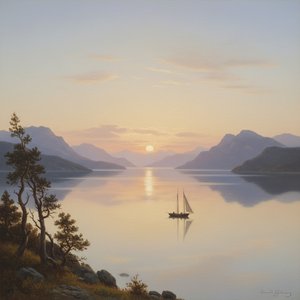
To gaze upon Albert Bierstadt’s Study for Yosemite Valley Glacier Point Trail is not simply to look at a painting; it is to step across the threshold and breathe the crisp, golden air of the American West. Created in 1873, this oil on canvas captures a moment of sublime stillness within one of nature's grandest cathedrals. The scene unfolds with breathtaking scope, presenting a mountain landscape where the sheer scale of the wilderness dwarfs human endeavor, yet simultaneously invites us into its profound quietude. Bierstadt, ever the master chronicler of American grandeur, has imbued this canvas with an almost palpable sense of light—a warm, ethereal glow that seems to emanate from the very heart of the valley itself.
The Luminist Embrace: Light as Subject
This work stands as a quintessential testament to the Luminism Art Movement. For those familiar with this style, they recognize immediately Bierstadt’s unparalleled devotion to light and atmosphere. It is not merely illumination that dominates; it is the quality of the light—the way the late afternoon sun filters through the pine boughs, casting a golden wash over the distant peaks. This technique elevates the landscape from mere scenery to an emotional experience. The scattered pine trees in the foreground serve as delicate anchors, providing texture and depth against the vast sweep of the valley beyond. Bierstadt understood that light, when handled with such reverence, becomes the primary subject matter itself, whispering tales of tranquility and awe.
Echoes of Exploration: Human Scale and Presence
What gives this monumental landscape its intimate resonance are the subtle touches of human presence. In the distance, two small figures can be discerned, seemingly pausing to absorb the overwhelming beauty before them. These figures are crucial; they do not dominate the scene but rather serve as necessary markers of scale. They allow the viewer to gauge the immense majesty surrounding them, prompting a shared moment of contemplation with the artist’s imagined voyagers. It speaks to that universal human impulse: the desire to explore, to witness something so vast it momentarily stills the hurried rhythm of modern life.
A Legacy for the Modern Collector
For the discerning collector or designer seeking an anchor piece for a grand space, this reproduction offers more than just decoration; it offers a narrative. It speaks of pioneering spirit, of the sublime power inherent in untouched nature, and the enduring romance of American exploration. Bierstadt’s mastery, honed through his studies in Europe and applied to the wild heartland, results in an artwork that feels both historically significant and eternally fresh. Owning this piece is to invite a daily dose of serene wonder into your home, transforming any room into a sanctuary overlooking Yosemite Valley.
Biografie artist
A Pioneer of the American West: The Life and Art of Albert Bierstadt
Albert Bierstadt’s story is deeply intertwined with the formation of America itself. His early life, beginning in Prussia in 1830, set the stage for a lifelong fascination with the landscapes that would define his artistic legacy. Born into a family who emigrated to New Bedford, Massachusetts when he was just one year old, Bierstadt’s roots were firmly planted in the burgeoning maritime world of the United States. Initially self-taught, sketching with crayons as a youth, he quickly recognized the need for formal training and embarked on studies in Düsseldorf, Germany, in 1853. This European grounding proved crucial, providing him with technical mastery—a meticulous attention to detail and a sophisticated understanding of light and atmosphere—that he would later apply to his depictions of the American wilderness. It wasn’t merely replication that Bierstadt sought; he aimed to convey the sublime power and beauty of nature, creating immersive experiences for viewers.Capturing the Majesty: The Hudson River School and Beyond
Upon returning to the United States in 1857, Bierstadt swiftly became associated with the Hudson River School, a group of artists dedicated to portraying the American landscape with both accuracy and romantic idealism. While sharing their reverence for nature, Bierstadt distinguished himself through his ambitious scale and dramatic compositions. He wasn’t content with simply painting pretty pictures; he aimed to transport viewers into the heart of the wilderness. His breakthrough came in 1858 with a Swiss landscape exhibited at the National Academy of Design, earning him immediate acclaim and honorary membership. However, it was his subsequent expeditions westward—first with land surveyor Frederick W. Lander in 1859, then with author Fitz Hugh Ludlow in 1863 to Yosemite Valley—that truly ignited his artistic vision. These journeys weren’t merely observational; they were immersive experiences, allowing Bierstadt to absorb the grandeur of the Rocky Mountains, the vastness of the plains, and the awe-inspiring scale of canyons and waterfalls. He meticulously documented these scenes, translating them onto canvas with a remarkable ability to capture both the physical reality and the emotional impact of the wilderness.The Painter of Empires: Shaping Perceptions of the West
Bierstadt’s paintings weren't simply landscapes; they were statements about national identity and Manifest Destiny. His canvases—often enormous in size—depicted the American West not as a harsh, untamed frontier, but as a land of promise, abundance, and divine beauty. The Rocky Mountains, Lander’s Peak, completed in 1863 and purchased for an astonishing $25,000 (equivalent to nearly $400,000 today), exemplifies this approach. The painting isn't a precise topographical rendering; it’s a carefully constructed vision of idealized grandeur, bathed in golden light and imbued with a sense of spiritual significance. Bierstadt skillfully employed techniques learned during his time in Düsseldorf, utilizing atmospheric perspective and dramatic lighting to create a sense of depth and scale that dwarfed the human figures within the scene. This ability to evoke emotion, to inspire awe, made him immensely popular during his lifetime. He wasn’t just an artist; he was a cultural ambassador, shaping how Americans—and the world—perceived the West. His work fueled westward expansion by presenting it as a noble and divinely ordained undertaking.Influences and Techniques
Bierstadt's artistic style evolved significantly throughout his career. Initially influenced by European Romanticism, particularly the Düsseldorf School of painting, he developed a distinctive Luminist approach—a technique characterized by intense light and atmospheric effects. He meticulously studied nature, often sketching directly from life during his expeditions to the West. His technical skill was remarkable, honed through years of practice and informed by his understanding of color theory and composition. Bierstadt’s use of scale was particularly noteworthy; he frequently employed enormous canvases to capture the vastness of the landscapes he depicted, creating a sense of immersion for the viewer. He also drew inspiration from the Hudson River School, adopting their emphasis on capturing the beauty and sublimity of nature, but adding his own unique vision and dramatic flair.Legacy and Historical Significance
While Bierstadt’s popularity waned somewhat in the late 19th century as artistic tastes shifted towards Impressionism, his influence on American landscape painting remains undeniable. He demonstrated the power of large-scale canvases to create immersive experiences, a technique later adopted by many artists. His meticulous attention to detail and masterful use of light continue to inspire painters today. Beyond his technical achievements, Bierstadt’s work serves as a valuable historical document, offering insights into the evolving perceptions of the American West during a period of rapid change and expansion. He captured a moment in time—a vision of pristine wilderness before it was irrevocably altered by human intervention. His paintings are not just beautiful images; they are windows into a pivotal era in American history, reminding us of both the promise and the cost of westward expansion. His legacy endures, ensuring that his breathtaking landscapes will continue to captivate and inspire generations to come.
Albert Bierstadt
1830 - 1902 , Germania
Detalii rapide
- Artistic Movement Or Style: Școala Hudson River
- Artists Or Movements Influenced By This Artist: ['Pictori americani']
- Artists Who Influenced This Artist:
- Turner
- David
- Date Of Birth: 7 ianuarie 1830
- Date Of Death: 18 februarie 1902
- Full Name: Albert Bierstadt
- Nationality: German-American
- Notable Artworks:
- Pâine și pâslă
- Munții Stâncoși
- Place Of Birth: Solingen, Germania
Articole similare

Evocations of Place: A Historical Journey Through Landscape Art
Explore the rich history of landscape art with OriginalUniqueArt. Discover renowned artists, movements like Impressionism & Romanticism, and expert guidance for collecting timeless pieces. Find your perfect serene escape today!
Sanford Robinson Gifford: Luminism & the American Landscape Tradition
Explore the serene landscapes of Sanford Robinson Gifford, a leading Luminist painter of the Hudson River School. Discover his mastery of light, atmospheric effects & lasting influence on American art. Hand-painted reproductions available.

Școlile de Artă Hudson River: 10 Capodopere Iconice pentru Decorul Casei | OriginalUniqueArt.ro
Descoperă Școala Hudson River prin 10 capodopere iconice! Explorează picturile lui Thomas Cole, Frederic Church și Albert Bierstadt. Reproduceri de artă premium pentru un decor rafinat. Inspiră-te acum pe OriginalUniqueArt.com!

Katsushika Hokusai: Cele Mai Iubite 25 de Opere de Artă – Inspirație pentru Decorul Casei Tale
Descoperă cele mai frumoase 25 de opere de artă semnate de Katsushika Hokusai, maestru ukiyo-e. Explorează istoria valului Kanagawa și a picturilor japoneze iconice. Reproduceri de calitate muzeală pentru decorul casei tale pe OriginalUniqueArt.com!

Albert Bierstadt: Luminosity, Landscape & the American Ideal
Explore the breathtaking landscapes of Albert Bierstadt, master of the American West & a leading figure in the Hudson River School. Discover his luminous style and iconic paintings – a timeless investment for art lovers.


