Comută pe versiunea Print
 Vezi mai mult







































 Pentru opere de artă sau reproduceri care depășesc 105 cm (aproximativ 41 de inch) pe oricare dintre laturi, cadrul va fi livrat demontat, sub formă de kit. Această metodă asigură o livrare sigură și previne deteriorarea în timpul transportului.


A Haunting Encounter with Faith and Violence
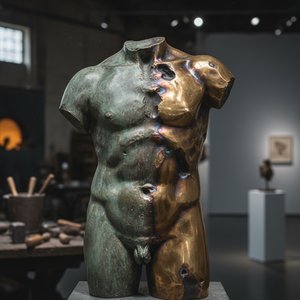
In the provocative landscape of contemporary art, few works command attention with such visceral intensity as Adel Abdessemed’s Also sprach Allah. Created in 2008, this piece serves as a profound meditation on the intersection of religious fervor and the specter of global conflict. The work does not merely present an image; it presents a confrontation. Through a masterful use of unsettling imagery, Abdessemed invites the viewer into a space where the sacred and the profane collide, forcing an immediate emotional response that lingers long after the initial encounter. The piece functions as a mirror to our modern anxieties, reflecting the tensions that simmer beneath the surface of contemporary political and religious discourse.
The visual language of the work is deeply rooted in Abdessemed’s unique ability to repurpose familiar cultural symbols to evoke profound discomfort. By utilizing elements that suggest both ritualistic sanctity and the raw edges of violence, the artist creates a tension that is almost tactile. The composition draws the eye into a complex web of meaning, where every detail—from the textures of the materials used to the starkness of the presentation—contributes to an atmosphere of high alert. For the discerning collector or interior designer, this piece offers more than mere decoration; it provides a powerful intellectual anchor, a conversation starter that demands presence and reflection within any curated space.
Symbolism and the Weight of History
To understand Also sprach Allah, one must delve into the biographical and historical currents that flow through Abdesselem’s oeuvre. Born in Algeria, an environment shaped by the complexities of identity and the scars of political struggle, the artist brings a heavy sense of memory to his practice. The title itself—a play on Nietzsche’s Also sprach Zarathustra—suggests a divine or prophetic declaration, yet it is stripped of traditional comfort. Instead, it points toward a reality where faith is inextricably linked to the materialization of conflict.
The symbolism within the work often utilizes materials that carry their own historical weight. Abdessemed frequently employs textures that evoke both the domestic and the industrial, much like his use of barbed wire or terra cotta in other seminal works. In this piece, the interplay between the concept of a sacred text or object and the underlying threat of destruction creates a powerful metaphor for the fragility of peace. It is an exploration of how ideologies can be both a source of profound spiritual connection and a catalyst for devastating physical upheaval. This duality makes the work an essential study in the psychological residue left by history's most turbulent eras.
An Essential Addition to the Contemporary Collection
For those seeking to curate a collection that transcends the superficial, Abdessemed’s work offers an unparalleled depth of narrative. A high-quality reproduction of Also sprach Allah allows for the appreciation of its stark, monochromatic intensity and its complex emotional layers. The piece is particularly suited for environments that value intellectual rigor and avant-garde aesthetics—spaces where art is intended to challenge, provoke, and inspire deep thought.
Integrating such a powerful work into an interior design scheme requires a bold vision. It serves as a centerpiece of gravity, capable of anchoring a room with its somber elegance and historical resonance. Whether placed in a private gallery or a sophisticated contemporary living space, the reproduction maintains the artist's uncompromising vision, bringing the haunting beauty of Abdessemed’s exploration of exile, identity, and memory into the heart of the home. It is an investment in a piece of contemporary history, capturing a moment of profound cultural reflection that remains as relevant today as it was at its inception.
Întrebări și răspunsuri
Ce reprezintă "Also sprach Allah" de Adel Abdessemed?
Temele prezente în "Also sprach Allah" de Adel Abdessemed includ violence, exile, religion, memory, conflict, sculpture, installation. Împreună, acestea definesc subiectul întregii opere de artă.
În ce an a fost creată "Also sprach Allah" de Adel Abdessemed?
"Also sprach Allah" de Adel Abdessemed a fost creat(ă) în 2008.
"Also sprach Allah" de Adel Abdessemed este o operă de artă luminoasă sau întunecată?
Luminozitatea percepută a operei "Also sprach Allah" de Adel Abdessemed este deep_shadow. Aceasta poate fi adaptată la lumina spațiului în care va fi expusă.
Mai multe detalii despre această pictură
 Trimite prin felicitare
 Distribuie
 Detalii despre lucrare
 Ghid
Ghid

 Descarcă imaginea
 Produse similare
 Galerie foto
 Întrebări și răspunsuri
 Statistici