Retrato de Ludovico Carracci

As 64 Pinturas Mais Famosas de Ludovico Carracci, Cada Uma Única

Atualizado em Outubro 2026 · classificado pela nossa pontuação de popularidade (pesquisas, visitas e pedidos de cada obra) · 67 obras de Ludovico Carracci em nosso catálogo

Em resumo

The Dream of Saint Catherine of Alexandria (1593) é a pintura de Ludovico Carracci que mais atrai olhares; a obra original pertence ao National Gallery of Art, Washington. Depois disso, o olhar recai sobre Madonna and Child with Saints (1607) e The Lamentation (1582). Entre as 67 obras de Ludovico Carracci em nosso catálogo, estas 64 são as mais famosas, cada uma uma original única apresentada com o seu ano, o seu museu e a razão pela qual perdura.

1555 – 1619, Bolonha Baroque Mais obras: Bavarian State Painting Collections

As 10 principais pinturas de Ludovico Carracci, sob o olhar da galeria

1
The Dream of Saint Catherine of Alexandria (1593) de Ludovico Carracci

The Dream of Saint Catherine of Alexandria

1593 · Oil On Canvas · National Gallery of Art, Washington

To gaze upon this depiction of The Dream of Saint Catherine of Alexandria is to step directly into the heart of Baroque devotion. It is an artwork that does not merely hang on a wall; it envelops the viewer in a palpable atmosphere of sacred serenity and profound familial love. The composition immediately draws the eye into a pyramidal embrace, centering the Virgin Mary with the infant Jesus at its…

2
Madonna and Child with Saints (1607) de Ludovico Carracci

Madonna and Child with Saints

1607 · Oil On Copper · Metropolitan Museum of Art, Nova York

To gaze upon this depiction of the Madonna and Child with Saints is to step directly into the heart of Bologna's artistic fervor during the early seventeenth century. Ludovico Carracci, a master whose hand guided art through a period of profound transition, has gifted us a scene that is both deeply devotional and exquisitely sophisticated. The composition immediately draws the eye into a moment suspended between earthly celebration and heavenly…

3
The Lamentation (1582) de Ludovico Carracci

The Lamentation

1582 · Oil On Canvas · Metropolitan Museum of Art, Nova York

To stand before The Lamentation by Ludovico Carracci is to be enveloped in an atmosphere so thick with palpable sorrow that it feels almost breathable. This is not the polished, idealized grief often depicted in later art; rather, it is a raw, visceral outpouring of human emotion captured at its most agonizing peak. The scene presents a profound tableau of loss, centering on figures whose poses and expressions reject classical…

4
The Dream of Saint Catherine of Alexandria (detail) (1593) de Ludovico Carracci

The Dream of Saint Catherine of Alexandria (detail)

1593 · Oil On Canvas · National Gallery of Art, Washington

To gaze upon this detail from Ludovico Carracci’s The Dream of Saint Catherine of Alexandria is to step directly into the heart of the Bolognese Baroque—a moment where profound spirituality met breathtaking artistic realism. The scene unfolds with an almost palpable sense of devotion, capturing a sacred narrative rich with human emotion and divine mystery. At its core, we find Mary cradling the infant Jesus, their forms rendered with a…

5
An Angel Frees the Souls of Purgatory (1610) de Ludovico Carracci

An Angel Frees the Souls of Purgatory

1610 · Oil · Pinacoteca Vaticana, Cidade do Vaticano

Completed in 1610, this work reflects the religious fervor of the Counter-Reformation. As the Catholic Church sought to reaffirm its doctrines against Protestant critiques, artists in Bologna moved away from the artificiality of Mannerism toward a more visceral, emotive naturalism. This piece likely originated as a sketch for an altarpiece within the Carracci workshop. It captures a pivotal theological moment: the transition of souls from the state of purification to…

6
The Trinity with the Dead Christ (1590) de Ludovico Carracci

The Trinity with the Dead Christ

1590 · Oil On Canvas · Pinacoteca Vaticana, Cidade do Vaticano

In this work from around 1590, we find ourselves witnessing a heavy, quiet moment of transition. The composition is built upon a pyramidal structure, drawing the eye upward toward the limp, lifeless body of Christ. He rests upon a draped cloth, marked by the imprint of Veronica, a detail that anchors the scene in a tradition of compassion. There is a palpable sense of weight here, as the physical reality…

7
The Transfiguration (1590) de Ludovico Carracci

The Transfiguration

1590 · Oil On Canvas · Scottish National Gallery, Edimburgo

The air seems to thicken with a sudden, celestial weight as Jesus Christ stands at the center of this unfolding miracle. He is not a distant figure of stone, but a presence felt in the very movement of his outstretched arms. Light does not merely strike his form; it seems to emanate from within him, carving his silhouette against a world caught in a moment of profound spiritual upheaval. Around…

8
Saint Francis of Assisi in the Portiuncula (1601) de Ludovico Carracci

Saint Francis of Assisi in the Portiuncula

1601 · Oil · Museu do Prado, Madrid

The air in the Portiuncula feels heavy, thick with the scent of damp earth and the weight of a profound, sudden silence. Below, in the dimness of the earthly realm, Saint Francis of Assisi kneels. He is a figure of deep humility, his body pressed toward the ground in a gesture of total surrender. His arms cross over his chest, a physical manifestation of a soul caught in a moment…

9
The Vision of Saint Francis (1602) de Ludovico Carracci

The Vision of Saint Francis

1602 · Oil On Canvas · Art Institute of Chicago, Chicago

The canvas splits into two distinct realms, divided by a diagonal surge of clouds. On the lower left, Saint Francis kneels in the heavy shadows of the earthly plane, his form solid and grounded. Above him, the darkness of the night is pierced by a sudden, divine light. The Virgin Mary and the infant Christ emerge from this celestial glow, surrounded by the soft, rounded shapes of cherubs. A moon…

10
The Agony in the Garden (1590) de Ludovico Carracci

The Agony in the Garden

1590 · Oil On Canvas · Museu do Prado, Madrid

The Agony in the Garden emerges from the shadows of history as a profound oil on canvas by Ludovico Carracci. This specific work, known in collections as Prado P00074, captures a moment of intense spiritual weight. The paint clings to the fabric, holding the tension of a scene that feels as though it is unfolding right before our eyes. It is a work that breathes with the heavy atmosphere of…

Pinturas famosas de Ludovico Carracci, números 11 a 64

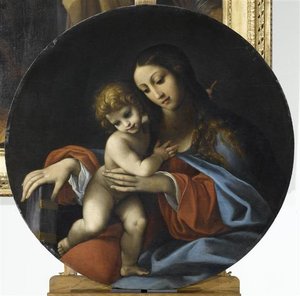
11The Vision of St Jerome (1594) de Ludovico CarracciThe Vision of St Jerome1594 · Statens Museum For Kunst 12Bacchus and Ariadne (1591) de Ludovico CarracciBacchus and Ariadne1591 13Portrait of a Widow (1585) de Ludovico CarracciPortrait of a Widow1585 · Instituto de Arte de Dayton 14St Sebastian (1590) de Ludovico CarracciSt Sebastian1590 · Fitzwilliam Museum 15Portrait of a Young Man (1583) de Ludovico CarracciPortrait of a Young Man1583 · Museus Capitolinos 16Saint Francis in Meditation (1580) de Ludovico CarracciSaint Francis in Meditation1580 · Dulwich Picture Gallery 17Sacrifice of Isaac (1586) de Ludovico CarracciSacrifice of Isaac1586 18Holy Family (1600) de Ludovico CarracciHoly Family1600 · Slovak National Gallery 19Annunciation (1603) de Ludovico CarracciAnnunciation1603 · Musei di Strada Nuova 20Allegory of Providence (1604) de Ludovico CarracciAllegory of Providence1604 · Museus Capitolinos 21Singing angels (1605) de Ludovico CarracciSinging angels1605 · Museo Cerralbo 22Hercules and the Hydra (1594) de Ludovico CarracciHercules and the Hydra1594 23The Adoration of the Shepherds (1613) de Ludovico CarracciThe Adoration of the Shepherds1613 24Three angels visiting Abraham (1610) de Ludovico CarracciThree angels visiting Abraham1610 · Pinacoteca Nazionale di Bologna 25The Stories of Jason (detail) (1584) de Ludovico CarracciThe Stories of Jason (detail)1584 · Palazzo Fava 26The Virgin Appearing to St Hyacinth (1594) de Ludovico CarracciThe Virgin Appearing to St Hyacinth1594 · Museu do Louvre 27Ludovico ) (1555) de Ludovico CarracciLudovico )1555 28Male Nude (Hercules ?) (1588) de Ludovico CarracciMale Nude (Hercules ?)1588 · Kunstpalast 29The Agony in the Garden (1590) de Ludovico CarracciThe Agony in the Garden1590 · National Gallery 30The Marriage of the Virgin (1590) de Ludovico CarracciThe Marriage of the Virgin1590 · National Gallery 31Portrait of Carlo Alberto Rati Opizzoni in Armour (1597) de Ludovico CarracciPortrait of Carlo Alberto Rati Opizzoni in Armour1597 32Christ in the Wilderness, Served by Angels (1608) de Ludovico CarracciChrist in the Wilderness, Served by Angels1608 · Gemäldegalerie 33The Martyrdom of St Margaret (1616) de Ludovico CarracciThe Martyrdom of St Margaret1616 34Susannah and the Elders (1616) de Ludovico CarracciSusannah and the Elders1616 35Annunciation (1616) de Ludovico CarracciAnnunciation1616 · Kunstpalast 36The Denial of Saint Peter (1616) de Ludovico CarracciThe Denial of Saint Peter1616 · Metropolitan Museum of Art 37Bargellini Madonna (1588) de Ludovico CarracciBargellini Madonna1588 · Pinacoteca Nazionale 38Saint Francis de Ludovico CarracciSaint FrancisBavarian State Painting Collections 39Presentation in the Temple (1605) de Ludovico CarracciPresentation in the Temple1605 · Museu Thyssen-Bornemisza 40Preaching of John the Baptist de Ludovico CarracciPreaching of John the BaptistBavarian State Painting Collections 41Portrait of a Young Man de Ludovico CarracciPortrait of a Young ManBavarian State Painting Collections 42Saint Francis Seraphic de Ludovico CarracciSaint Francis SeraphicBavarian State Painting Collections 43Entombment of Christ de Ludovico CarracciEntombment of ChristBavarian State Painting Collections 44The Agony in the Garden of Gethsemane de Ludovico CarracciThe Agony in the Garden of Gethsemane 45St. John the Baptist at the Fontain de Ludovico CarracciSt. John the Baptist at the FontainMusée Fesch 46Saint Mary Magdalene de Ludovico CarracciSaint Mary MagdaleneMuseu Nacional de Belas Artes 47Le martyre de saint Pierre et saint Paul de Ludovico CarracciLe martyre de saint Pierre et saint Paul 48LE BAPTEME DE JESUS de Ludovico CarracciLE BAPTEME DE JESUSMuseu de Belas Artes de Lyon 49The Baptism of Christ de Ludovico CarracciThe Baptism of ChristBavarian State Painting Collections 50Christ Served by Angels in the Wilderness (1608) de Ludovico CarracciChrist Served by Angels in the Wilderness1608 · Staatliche Museen zu Berlin 51The Vision of Saint Francis of Assisi, Ludovico Carracci, 1583 - 1585 (1585) de Ludovico CarracciThe Vision of Saint Francis of Assisi, Ludovico Carracci, 1583 - 15851585 52Madona Troncada com o Menino Jesus, São João, o Arcanjo Miguel, São Francisco, Santa Lúcia e São José (1616) de Ludovico CarracciMadona Troncada com o Menino Jesus, São João, o Arcanjo Miguel, São Francisco, Santa Lúcia e São José1616 · Royal Łazienki Museum 53L'apparition de la Vierge et de l'enfant Jésus à saint Hyacinthe de Ludovico CarracciL'apparition de la Vierge et de l'enfant Jésus à saint HyacintheMuseu do Louvre 54Antonio Landscape with Bathers de Ludovico CarracciAntonio Landscape with Bathers 55The Vision of Saint Francis de Ludovico CarracciThe Vision of Saint Francis 56L'Adoration des bergers La Nativité de Jésus Christ de Ludovico CarracciL'Adoration des bergers La Nativité de Jésus Christ 57The Marriage of the Virgin de Ludovico CarracciThe Marriage of the Virgin 58The Assumption of the Virgin de Ludovico CarracciThe Assumption of the Virgin 59Orlando Delivering Olympia from the Sea Monster de Ludovico CarracciOrlando Delivering Olympia from the Sea MonsterNational Trust 60La Vierge à l'enfant de Ludovico CarracciLa Vierge à l'enfantMuseu do Louvre 61St. Sebastian Thrown into the Cloaca Maxima (1612) de Ludovico CarracciSt. Sebastian Thrown into the Cloaca Maxima1612 · J. Paul Getty Museum 62Chess players (1590) de Ludovico CarracciChess players1590 · Gemäldegalerie 63The Funeral of the Virgin Mary (1605) de Ludovico CarracciThe Funeral of the Virgin Mary1605 · Galleria Nazionale 64La Flagellation de Ludovico CarracciLa FlagellationMusée de la Chartreuse de Douai

Pinturas famosas de Ludovico Carracci, período por período

Os temas que cativaram o olhar de Ludovico Carracci

Os quatro temas que mais se repetem nestas obras originais, cada um com o seu melhor exemplo.

Os museus que guardam os originais de Ludovico Carracci

Os 8 museus que detêm a maioria das pinturas desta página.

Museus Cidade Obras de Ludovico Carracci Pinturas desta lista
Bavarian State Painting Collections, MuniqueBavarian State Painting Collections Munique 6 Saint Francis, Preaching of John the Baptist, Portrait of a Young Man
Metropolitan Museum of Art, Nova YorkMetropolitan Museum of Art Nova York 3 Madonna and Child with Saints, The Lamentation, The Denial of Saint Peter
Museu do Louvre, ParisMuseu do Louvre Paris 3 The Virgin Appearing to St Hyacinth, L'apparition de la Vierge et de l'enfant Jésus à saint Hyacinthe, La Vierge à l'enfant
National Gallery of Art, WashingtonNational Gallery of Art Washington 2 The Dream of Saint Catherine of Alexandria, The Dream of Saint Catherine of Alexandria (detail)
Pinacoteca Vaticana, Cidade do VaticanoPinacoteca Vaticana Cidade do Vaticano 2 An Angel Frees the Souls of Purgatory, The Trinity with the Dead Christ
Museu do Prado, MadridMuseu do Prado Madrid 2 Saint Francis of Assisi in the Portiuncula, The Agony in the Garden
Museus Capitolinos, RomaMuseus Capitolinos Roma 2 Portrait of a Young Man, Allegory of Providence
Kunstpalast, DüsseldorfKunstpalast Düsseldorf 2 Male Nude (Hercules ?), Annunciation

Ludovico Carracci ao longo das décadas: uma obra original única para cada uma

Obras por década

Escolha uma década para ver a obra original que a define.

Pinturas de Ludovico Carracci: perguntas para a galeria

Qual é a obra mais famosa de Ludovico Carracci?Revelar a resposta

The Dream of Saint Catherine of Alexandria (1593), National Gallery of Art, Washington. Madonna and Child with Saints (1607) e The Lamentation (1582) vêm a seguir.

Com que idade Ludovico Carracci criou The Dream of Saint Catherine of Alexandria?Revelar a resposta

38 anos: The Dream of Saint Catherine of Alexandria data de 1593, e Ludovico Carracci nasceu em 1555.

Quais são as dez pinturas mais famosas de Ludovico Carracci?Revelar a resposta

The Dream of Saint Catherine of Alexandria, Madonna and Child with Saints, The Lamentation, The Dream of Saint Catherine of Alexandria (detail), An Angel Frees the Souls of Purgatory, The Trinity with the Dead Christ, The Transfiguration, Saint Francis of Assisi in the Portiuncula, The Vision of Saint Francis e The Agony in the Garden. O ranking acima apresenta o ano e o museu de cada uma.

Quantas obras de Ludovico Carracci são conhecidas?Revelar a resposta

Nosso catálogo contém 67 obras de Ludovico Carracci, datadas de 1580 a 1616.

Onde se pode ver os originais mais famosos de Ludovico Carracci?Revelar a resposta

Principalmente em Bavarian State Painting Collections (Munique), Metropolitan Museum of Art (Nova York) e Museu do Louvre (Paris). A tabela de museus acima lista todos eles.

Em que período Ludovico Carracci criou as suas pinturas mais conhecidas?Revelar a resposta

Em 1590s: 14 das 64 obras nesta página foram feitas então, sendo The Dream of Saint Catherine of Alexandria delas.

Qual pintura famosa de Ludovico Carracci é a mais antiga e qual é a mais recente?Revelar a resposta

Nesta página, a mais antiga é Saint Francis in Meditation (1580) e a mais recente é The Martyrdom of St Margaret (1616).

Quais temas Ludovico Carracci preferia?Revelar a resposta

Man (11), Angels (8) e Virgin mary (6), entre as 64 obras nesta página.

Com quais materiais Ludovico Carracci mais pintou?Revelar a resposta

Oil On Canvas, para 21 das 64 obras nesta página.

A qual movimento pertence a obra de Ludovico Carracci?Revelar a resposta

Baroque, a julgar pelos originais nesta página.

Quais originais de Ludovico Carracci posso ver no Bavarian State Painting Collections?Revelar a resposta

Saint Francis, Preaching of John the Baptist e Portrait of a Young Man: o Bavarian State Painting Collections, Munique detém 6 das obras desta página.

Ludovico Carracci: um retrato do artista

O Arquiteto do Barroco Bologuês

No coração vibrante e intelectual de Bolonha, uma cidade onde a tradição renascentista encontrou o espírito emergente de uma nova era, Ludovico Carracci surgiu como uma força transformadora na arte europeia. Nascido em 1555, sua vida esteve intrinsecamente ligada aos próprios fundamentos da Escola Bolognesa. Como parte da ilustre família Carracci, ao lado de seus primos Annibale e Agostino, Ludovico não apenas participou de um movimento artístico; ele ajudou a arquitetar a transição da elegância estilizada e muitas vezes artificial do Maneirismo para o naturalismo profundo e emotivo do Barroco. Seus primeiros anos foram moldados pelo ateliê de seu pai, Prospero Carracci, um ambiente que serviu como cadinho para a experimentação e um santuário para o estudo do disegno—a observação meticulosa da forma e da anatomia que se tornaria uma marca registrada de seu legado.

Enquanto seus primos frequentemente buscavam a fama nas grandes cortes de Roma, Ludovico permaneceu profundamente enraizado em sua Bolonha natal. Essa conexão constante permitiu-lhe cultivar um santuário artístico único, dirigindo uma academia que se tornou um farol para a próxima geração de mestres, incluindo Guido Reni e Domenichino. Sua obra representa uma síntese magistral de influências históricas; ele bebeu da graça divina de Rafael, da suave luminosidade de Correggio e do rico colorismo de Ticiano, mas infundiu esses elementos clássicos com uma nova e dramática vitalidade. Ao rejeitar as poses alongadas e muitas vezes forçadas dos pintores maneiristas tardios, como Parmigianino, Ludovico abraçou uma realidade mais visceral, utilizando gestos audaciosos e uma luz atmosférica e trêmula para comover as almas de seus espectadores.

Luz, Sombra e Intensidade Espiritual

O verdadeiro gênio de Ludovico Carracci reside em sua habilidade de manipular o chiaroscuro—o jogo dramático entre luz e sombra—para servir como um condutor para a contemplação espiritual. Suas telas raramente são meras representações de eventos bíblicos; são experiências imersivas projetadas para evocar fervor religioso. Em obras como Um Anjo Liberta as Almas do Purgatório, pode-se testemunhar como seu uso da luz não apenas ilumina uma cena, mas participa ativamente de sua narrativa, esculpindo figuras da escuridão para destacar momentos de compaixão e graça divina. Esta técnica, que remete ao naturalismo emergente visto em Caravaggio, permitiu-lhe imbuir até os temas mais sagrados com uma emoção humana palpável.

Sua maestria estendeu-se por diversos meios, desde a escala monumental dos afrescos até a delicada precisão de gravuras e impressões. Quer estivesse capturando a serena santidade da Apresentação no Templo ou a tensão muscular e heroica encontrada em seu Nu Masculino (Hércules ?), há um fio constante de profundidade emocional percorrendo sua obra. Suas pinturas religiosas, como a Madona Bargellini, demonstram uma capacidade de organizar grupos complexos de santos e anjos em composições harmoniosas, porém dinâmicas, onde cada dobra de tecido e cada inclinação de cabeça contribui para um sentido maior de movimento celestial.

Um Legado Duradouro no Cânone Italiano

A importância histórica de Ludovico Carracci não pode ser subestimada. Ele foi uma figura fundamental que ajudou a reavivar a arte italiana em um momento em que ela corria o risco de estagnar sob o peso de suas próprias tradições formalistas. Ao defender um estilo que priorizava a verdade emocional e a observação naturalista, ele forneceu o modelo para as conquistas mais celebradas da era Barroca. Sua influência irradiou de Bolonha, moldando a linguagem estética de grande parte da Europa e fornecendo a base para o naturalismo clássico que dominaria o século XVII.

Ao refletirmos sobre sua vida e obra, vemos um artista que conseguiu unir dois mundos: a perfeição estruturada do Renascimento e a energia dramática e teatral do Barroco. Sua capacidade de casar o rigor intelectual do disegno com um profundo senso de colore e ressonância emocional garante seu lugar como um dos pintores mais vitais de sua era. Através de sua devoção ao ofício e seu compromisso com o poder espiritual da arte, Ludovico Carracci deixou uma marca indelével na história da pintura ocidental, lembrando-nos de que a verdadeira beleza reside na intersecção entre a maestria técnica e o coração humano.