Retrato de Johann Heinrich Füssli

Pinturas de Johann Heinrich Füssli: As 100 mais famosas, sob o olhar de uma galeria

Atualizado em Novembro 2026 · classificado pela nossa pontuação de popularidade (pesquisas, visitas e pedidos de cada obra) · 161 obras de Johann Heinrich Füssli em nosso catálogo

Em resumo

Aos olhos da galeria, a pintura mais famosa de Johann Heinrich Füssli é O Pesadelo (1781), cuja obra original está exposta no Detroit Institute of Arts, em Detroit. Titânia e Bottom com a Cabeça de Burro e O Pesadelo (1790) completam o trio que todos reconhecem. Dos 161 trabalhos de Johann Heinrich Füssli em nosso catálogo, a galeria apresenta abaixo as 100 obras mais famosas, cada uma original, com seu ano, seu museu e o que a torna única.

1741 – 1825, Zurique Romantic gothic horror Mais obras: Kunsthaus Zürich

As 10 principais pinturas de Johann Heinrich Füssli na galeria

1
O Pesadelo (1781) de Johann Heinrich Füssli

O Pesadelo

1781 · Óleo sobre tela · Detroit Institute of Arts, Detroit

A obra "O Pesadelo", de Henry Fuseli, é um trabalho icônico que captura a essência do horror gótico e do Romantismo. Criada em 1781, esta pintura a óleo é uma exploração profunda da mente subconsciente, fundindo uma composição dramática com um simbolismo rico para evocar uma sensação de inquietação e fascínio.

2
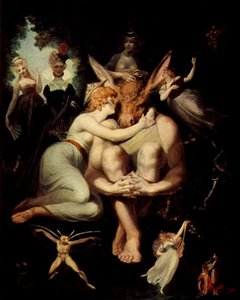
Titânia e Bottom com a Cabeça de Burro de Johann Heinrich Füssli

Titânia e Bottom com a Cabeça de Burro

Óleo sobre tela

Nas profundezas sombrias e iluminadas pelo luar de uma floresta ancestral, Johann Heinrich Füssli nos convida a entrar em um reino onde as fronteiras entre o humano e o sobrenatural se dissolvem por completo. Sua obra-prima, Titânia e Bottom com a Cabeça de Burro, captura um momento crucial de transformação da peça Sonho de uma Noite de Verão, de William Shakespeare. A composição é um turbilhão de tirar o fôlego,…

3
O Pesadelo (1790) de Johann Heinrich Füssli

O Pesadelo

1790 · Óleo sobre tela · Goethe-Museum, Frankfurt

In the shadowy realm of Johann Heinrich Füssli, the boundaries between sleep and wakefulness dissolve into a haunting spectacle of terror and desire. His seminal work, The Nightmare, stands as a profound exploration of the human psyche, capturing that breathless moment when the terrors of the unconscious manifest in the physical world. The painting presents a woman lying prostrate in bed, her limbs cast downward in a state of vulnerable,…

4
Lady Macbeth with the Daggers (1812) de Johann Heinrich Füssli

Lady Macbeth with the Daggers

1812 · Oil On Canvas · Tate Gallery, Londres

To stand before this depiction of Lady Macbeth is to confront the very precipice of human ambition curdled by guilt. Johann Heinrich Friesli’s masterful rendering captures not merely a scene from Shakespeare, but the suffocating aftermath of moral transgression. The air in the painting feels thick, heavy with unspoken secrets and the metallic tang of spilled blood. It is an intensely dramatic tableau, steeped in the Romantic fascination with the…

5
The incubus leaving two young women (1794) de Johann Heinrich Füssli

The incubus leaving two young women

1794 · Oil On Canvas

The incubus leaving two young women is an oil on canvas painting by Henry Fuseli. Created about 1794, the work captures a moment of supernatural departure. It belongs to the realms of folklore and demons. The canvas holds a heavy, nocturnal stillness.

6
O artista desesperado pela grandeza das ruínas antigas (1778) de Johann Heinrich Füssli

O artista desesperado pela grandeza das ruínas antigas

1778 · Giz pastel · Kunsthaus Zürich, Zurique

O Artista Desesperado Diante da Grandiosidade das Ruínas Antigas A obra "O Artista Desesperado Diante da Grandiosidade das Ruínas Antigas" de Johann Heinrich Fuseli, criada entre 1778 e 1780, é um desenho em vermelho tinta sobre lavagem sépia que captura uma imagem poderosa e inquietante do artista diante dos restos decadentes do Coliseu Romano. Esta obra emblemática, adquirida pelo Kunsthaus Zürich em 1940, permanece como um testemunho da estética romântica…

7
Hamlet and his father's Ghost (1785) de Johann Heinrich Füssli

Hamlet and his father's Ghost

1785 · Drawing

In this drawing from 1785, we find ourselves drawn into a moment of profound psychological unrest. The scene captures a dramatic encounter, likely inspired by the tension of Shakespearean tragedy, where the boundary between the living and the supernatural dissolves. A central figure, arms outstretched, appears caught in a state of sudden, violent realization. Around this focal point, other figures react with a mixture of struggle and silent observation, their…

8
The Night-Hag Visiting Lapland Witches (1796) de Johann Heinrich Füssli

The Night-Hag Visiting Lapland Witches

1796 · Oil On Canvas · Metropolitan Museum of Art, Nova York

Henry Fuseli's "The Night-Hag Visiting Lapland Witches," painted in 1796, isn’t merely a depiction of a scene; it’s an immersion into the shadowed heart of human psychology. This arresting oil on canvas, currently residing within the hallowed halls of The Metropolitan Museum of Art in New York City, pulsates with a potent blend of gothic horror and nascent Romanticism – a visual embodiment of fear, superstition, and the unsettling allure…

9
Portrait of a Young Woman (1781) de Johann Heinrich Füssli

Portrait of a Young Woman

1781 · Oil On Canvas · Detroit Institute of Arts, Detroit

The Portrait of a Young Woman by Henry Fuseli is a formal portrait of a woman that captures a quiet, contemplative presence. Painted in 1781, this oil on canvas work presents the subject in a way that invites a closer, more personal inspection of her features and expression. It is a piece that reflects the artist's specific interest in the psychological nuances of his sitters.

10
Scene of Witches, from The Masque of Queens by Ben Jonson (1785) de Johann Heinrich Füssli

Scene of Witches, from The Masque of Queens by Ben Jonson

1785 · Painting · Yale Center for British Art, New Haven

In the shadowy corridors of art history, few names evoke as much intrigue and nocturnal wonder as Johann Heinrich Füssli. Known to the English-speaking world as Henry Fuseli, this Swiss master was a pioneer of the Romantic movement, a painter who dared to venture into the deepest recesses of the human psyche. His work, particularly his depictions of the supernatural, serves as a bridge between the rational Enlightenment and the…

Pinturas de Johann Heinrich Füssli, classificadas de 11 a 100

11Head of a Damned Soul from Dante's "Inferno," (verso) (1774) de Johann Heinrich FüssliHead of a Damned Soul from Dante's "Inferno," (verso)1774 · Art Institute of Chicago 12The insane Kate (1807) de Johann Heinrich FüssliThe insane Kate1807 13Deutsch Titania liebkost den eselköpfigen Bottom (1794) de Johann Heinrich FüssliDeutsch Titania liebkost den eselköpfigen Bottom1794 · Kunsthaus Zürich 14Leonora Discovers Alonzo’s Dagger (1792) de Johann Heinrich FüssliLeonora Discovers Alonzo’s Dagger1792 · Nationalmuseum 15Celadon and Amelia (1801) de Johann Heinrich FüssliCeladon and Amelia1801 · Staatliche Kunsthalle Karlsruhe 16John Milton's Paradise Lost, Satan and the Birth of Sin (Book II, 746-758)  Painting no. 6 from The Milton Gallery (1785) de Johann Heinrich FüssliJohn Milton's Paradise Lost, Satan and the Birth of Sin (Book II, 746-758) Painting no. 6 from The Milton Gallery1785 · Dallas Museum of Art 17Study for the three witches in Macbeth (1783) de Johann Heinrich FüssliStudy for the three witches in Macbeth1783 · Auckland Art Gallery Toi o Tāmaki 18Euphrosyne before the Imagination and the Temperance (1800) de Johann Heinrich FüssliEuphrosyne before the Imagination and the Temperance1800 · Kurpfälzisches Museum 19Sketch for "Oath on the Rütli," Female Figure (verso) (1779) de Johann Heinrich FüssliSketch for "Oath on the Rütli," Female Figure (verso)1779 · Art Institute of Chicago 20The Dream of Queen Katherine (from William Shakespeare's 'Henry VIII', Act IV, Scene 2) (1781) de Johann Heinrich FüssliThe Dream of Queen Katherine (from William Shakespeare's 'Henry VIII', Act IV, Scene 2)1781 · Victoria and Albert Museum 21Prince Arthur and the Fairy Queen. (1788) de Johann Heinrich FüssliPrince Arthur and the Fairy Queen.1788 · Kunstmuseum Basel 22Tekemessa and Eurysake (1805) de Johann Heinrich FüssliTekemessa and Eurysake1805 · Yale Center for British Art 23Thetis asks Hephaistos to forge armor for her son Achilles (1803) de Johann Heinrich FüssliThetis asks Hephaistos to forge armor for her son Achilles1803 · Kunsthaus Zürich 24Satan and Death with Sin Intervening (1792) de Johann Heinrich FüssliSatan and Death with Sin Intervening1792 · Bavarian State Painting Collections 25Ariadne Watching the Struggle of Theseus with the Minotaur (1820) de Johann Heinrich FüssliAriadne Watching the Struggle of Theseus with the Minotaur1820 · Yale Center for British Art 26Erotic Scene with a man and three women de Johann Heinrich FüssliErotic Scene with a man and three women 27Danaë and Perseus on Seriphos (?) (1787) de Johann Heinrich FüssliDanaë and Perseus on Seriphos (?)1787 · Yale University Art Gallery 28The Erinyes Drive Alcmaeon from the Corpse of his Mother, Eriphyle, Whom He Has Killed. (1821) de Johann Heinrich FüssliThe Erinyes Drive Alcmaeon from the Corpse of his Mother, Eriphyle, Whom He Has Killed.1821 · Kunsthaus Zürich 29Satan Starting from the Touch of Ithuriels Spear de Johann Heinrich FüssliSatan Starting from the Touch of Ithuriels Spear 30The Weird Sisters -The Three Witches de Johann Heinrich FüssliThe Weird Sisters -The Three Witches 31Christ Disappearing at Emmaus (1792) de Johann Heinrich FüssliChrist Disappearing at Emmaus1792 · Yale Center for British Art 32A Shakespearean Subject (1785) de Johann Heinrich FüssliA Shakespearean Subject1785 33Psyche walks past the Fates undeterred (1780) de Johann Heinrich FüssliPsyche walks past the Fates undeterred1780 34Laying Nude and piano player (1799) de Johann Heinrich FüssliLaying Nude and piano player1799 · Kunstmuseum Basel 35Paolo Malatesta and Francesca da Polenta surprised by Gianciotto Malatesta (1785) de Johann Heinrich FüssliPaolo Malatesta and Francesca da Polenta surprised by Gianciotto Malatesta1785 · Aargauer Kunsthaus 36The Three Conspirators Swear an Oath on the Rüthli Meadow (1779) de Johann Heinrich FüssliThe Three Conspirators Swear an Oath on the Rüthli Meadow1779 · Kunsthaus Zürich 37Portrait of Joseph Priestley (1783) de Johann Heinrich FüssliPortrait of Joseph Priestley1783 38The nightmare, Detroit Institute of (1781) de Johann Heinrich FüssliThe nightmare, Detroit Institute of1781 39Selling of Cupids (1776) de Johann Heinrich FüssliSelling of Cupids1776 · Yale Center for British Art 40The Daughters of Pandareos (1795) de Johann Heinrich FüssliThe Daughters of Pandareos1795 · Kunsthaus Zürich 41The Vision of the Deluge (1800) de Johann Heinrich FüssliThe Vision of the Deluge1800 42The loneliness at dawn (1796) de Johann Heinrich FüssliThe loneliness at dawn1796 43A Scene from 'The Wife of Bath's Tale' (from Geoffrey Chaucer's, 'Canterbury Tales') (recto); Falstaff in the Laundry Basket mocked by Five Women (?) (verso) (1812) de Johann Heinrich FüssliA Scene from 'The Wife of Bath's Tale' (from Geoffrey Chaucer's, 'Canterbury Tales') (recto); Falstaff in the Laundry Basket mocked by Five Women (?) (verso)1812 · Petworth House 44Puck (1810) de Johann Heinrich FüssliPuck1810 45Untitled (AQR9W9) (1812) de Johann Heinrich FüssliUntitled (AQR9W9)1812 46Kriemhild sees the dead Siegfried in a dream (1805) de Johann Heinrich FüssliKriemhild sees the dead Siegfried in a dream1805 47Portrait of a Lady (1781) de Johann Heinrich FüssliPortrait of a Lady1781 · Detroit Institute of Arts 48The Serpent tempting Eve (Satan's first address to Eve) (1802) de Johann Heinrich FüssliThe Serpent tempting Eve (Satan's first address to Eve)1802 · Auckland Art Gallery Toi o Tāmaki 49Henry V' Act II Scene 2 Discovering the Conspirators (1790) de Johann Heinrich FüssliHenry V' Act II Scene 2 Discovering the Conspirators1790 · Royal Shakespeare Company Collection 50The Infant Shakespeare Between Tragedy and Comedy (1805) de Johann Heinrich FüssliThe Infant Shakespeare Between Tragedy and Comedy1805 · University of London 51Ezzelin and Meduna (1779) de Johann Heinrich FüssliEzzelin and Meduna1779 · Sir John Soane's Museum 52Silence (1799) de Johann Heinrich FüssliSilence1799 · Kunsthaus Zürich 53Titania, Bottom and the Fairies (1794) de Johann Heinrich FüssliTitania, Bottom and the Fairies1794 · Kunsthaus Zürich 54The Shepherd's Dream (1793) de Johann Heinrich FüssliThe Shepherd's Dream1793 · Tate Gallery 55The Incubus Leaving Two Sleeping Women (1793) de Johann Heinrich FüssliThe Incubus Leaving Two Sleeping Women1793 56Macbeth' Act I Scene 3 The Weird Sisters (1783) de Johann Heinrich FüssliMacbeth' Act I Scene 3 The Weird Sisters1783 · Royal Shakespeare Company Collection 57Woman Sitting, Curled up (1778) de Johann Heinrich FüssliWoman Sitting, Curled up1778 · Galeria Nacional da Dinamarca 58The Shepherd (1786) de Johann Heinrich FüssliThe Shepherd1786 · Albertina 59Portrait of the Artist (1790) de Johann Heinrich FüssliPortrait of the Artist1790 · Szépművészeti Múzeum 60Dante and Virgil on the Ice of Kocythos (1774) de Johann Heinrich FüssliDante and Virgil on the Ice of Kocythos1774 · Kunsthaus Zürich 61Untitled (AQR9WB) (2006) de Johann Heinrich FüssliUntitled (AQR9WB)2006 62The Death of Cardinal Beaufort de Johann Heinrich FüssliThe Death of Cardinal Beaufort 63Huon and Amanda with the Dead Alphonso de Johann Heinrich FüssliHuon and Amanda with the Dead Alphonso 64Teiresias Foretells the Future to Odysseus, 1780-1785 (1785) de Johann Heinrich FüssliTeiresias Foretells the Future to Odysseus, 1780-17851785 · Albertina 65Bust Portrait of a Woman with Bonnet de Johann Heinrich FüssliBust Portrait of a Woman with BonnetKupferstichkabinett 66Swiss; practiced in England, ) (1741) de Johann Heinrich FüssliSwiss; practiced in England, )1741 67Deutsch Der Feuerkönig English The Fire King Русский Король огня (1810) de Johann Heinrich FüssliDeutsch Der Feuerkönig English The Fire King Русский Король огня1810 68The Great Father and Ancient Night de Johann Heinrich FüssliThe Great Father and Ancient Night 69King Lear Banishing Cordelia (1784) de Johann Heinrich FüssliKing Lear Banishing Cordelia1784 70Dispute between Hotspur, Glendower, Mortimer and Worcester (from Shakespeare's Henry IV Part 1) (1784) de Johann Heinrich FüssliDispute between Hotspur, Glendower, Mortimer and Worcester (from Shakespeare's Henry IV Part 1)1784 · Birmingham Museums And Art Gallery 71The Italian Count (also known as Ezzelin Bracciaferro, Musing over Meduna, Destroyed by him for Disloyalty) (1780) de Johann Heinrich FüssliThe Italian Count (also known as Ezzelin Bracciaferro, Musing over Meduna, Destroyed by him for Disloyalty)1780 72Untitled (AQR9VM) (1790) de Johann Heinrich FüssliUntitled (AQR9VM)1790 · Museum of All Saints 73Hagen and the Nymphs of the Danube (1802) de Johann Heinrich FüssliHagen and the Nymphs of the Danube1802 · Metropolitan Museum of Art 74German Gertrud, Hamlet und der Geist des Vaters (1793) de Johann Heinrich FüssliGerman Gertrud, Hamlet und der Geist des Vaters1793 75Milton Dictating to His Daughter (1794) de Johann Heinrich FüssliMilton Dictating to His Daughter1794 · Art Institute of Chicago 76The Elf Queen Titania and labels, the weavers with donkey's head (1794) de Johann Heinrich FüssliThe Elf Queen Titania and labels, the weavers with donkey's head1794 77Macbeth, Banquo and the Witches ('Macbeth' Act I Scene 3) (1794) de Johann Heinrich FüssliMacbeth, Banquo and the Witches ('Macbeth' Act I Scene 3)1794 · Petworth House 78Mamillius Conjuring up Sprites and Goblins for His Mother (1786) de Johann Heinrich FüssliMamillius Conjuring up Sprites and Goblins for His Mother1786 79Deutsch Belindas Traum English Dream of Belinda Русский Сон Белинды (1790) de Johann Heinrich FüssliDeutsch Belindas Traum English Dream of Belinda Русский Сон Белинды1790 80Titania is leevtallig met Bottom met de daare Eselkopp (1794) de Johann Heinrich FüssliTitania is leevtallig met Bottom met de daare Eselkopp1794 81Deutsch Das Erwachen der Elfenkönigin Titania English The Awakening of the Fairy Queen Titania (1790) de Johann Heinrich FüssliDeutsch Das Erwachen der Elfenkönigin Titania English The Awakening of the Fairy Queen Titania1790 82Milton When a Boy Instructed by His Mother (1799) de Johann Heinrich FüssliMilton When a Boy Instructed by His Mother1799 83The Ladies of Hastings (1800) de Johann Heinrich FüssliThe Ladies of Hastings1800 84Horseman attacked by a giant snake (1800) de Johann Heinrich FüssliHorseman attacked by a giant snake1800 85Deutsch Das Schweigen English The Silence Русский Тишина (1801) de Johann Heinrich FüssliDeutsch Das Schweigen English The Silence Русский Тишина1801 86Kriemhild is haunted by her remorse (1805) de Johann Heinrich FüssliKriemhild is haunted by her remorse1805 87La débutante (1807) de Johann Heinrich FüssliLa débutante1807 88Brunhilde Observing Gunther, Whom She Has Tied to the Ceiling (1807) de Johann Heinrich FüssliBrunhilde Observing Gunther, Whom She Has Tied to the Ceiling1807 · City Museum and Art Gallery 89Kriemhild zeigt Gunther im Gefängnis den Nibelungenring (1807) de Johann Heinrich FüssliKriemhild zeigt Gunther im Gefängnis den Nibelungenring1807 90The fairy queen Titania finds the magic ring on the beach (1805) de Johann Heinrich FüssliThe fairy queen Titania finds the magic ring on the beach1805 91Kriemhild zeigt Hagen das Haupt Gunthers (1805) de Johann Heinrich FüssliKriemhild zeigt Hagen das Haupt Gunthers1805 92The Fire King (1810) de Johann Heinrich FüssliThe Fire King1810 93Deutsch Cerasimus und Huon fliehen vor dem Elfenkönig Oberon (1805) de Johann Heinrich FüssliDeutsch Cerasimus und Huon fliehen vor dem Elfenkönig Oberon1805 94Kriemhild throws herself on the dead Siegfried (1817) de Johann Heinrich FüssliKriemhild throws herself on the dead Siegfried1817 95Leonore Discovering the Dagger Left by Alonzo de Johann Heinrich FüssliLeonore Discovering the Dagger Left by Alonzo 96Portrait of Magdalena Hess from Zurich de Johann Heinrich FüssliPortrait of Magdalena Hess from Zurich 97The Enchanted Island. Before the Cell of Prospero de Johann Heinrich FüssliThe Enchanted Island. Before the Cell of Prospero 98PERSEUS RETURNING THE EYE OF THE GRAII de Johann Heinrich FüssliPERSEUS RETURNING THE EYE OF THE GRAII 99Die Hexe de Johann Heinrich FüssliDie Hexe 100Puck de Johann Heinrich FüssliPuck

Pinturas famosas de Johann Heinrich Füssli, período por período

Os temas que cativaram o olhar de Johann Heinrich Füssli

Os quatro temas que mais se repetem nestas obras originais, cada um com o seu melhor exemplo.

Os museus que guardam os originais de Johann Heinrich Füssli

Os 8 museus que detêm a maioria das pinturas desta página.

Museus Cidade Obras de Johann Heinrich Füssli Pinturas desta lista
Kunsthaus Zürich, ZuriqueKunsthaus Zürich Zurique 12 O artista desesperado pela grandeza das ruínas antigas, Deutsch Titania liebkost den eselköpfigen Bottom, Thetis asks Hephaistos to forge armor for her son Achilles
Yale Center for British Art, New HavenYale Center for British Art New Haven 7 Scene of Witches, from The Masque of Queens by Ben Jonson, Tekemessa and Eurysake, Ariadne Watching the Struggle of Theseus with the Minotaur
Detroit Institute of Arts, DetroitDetroit Institute of Arts Detroit 3 O Pesadelo, Portrait of a Young Woman, Portrait of a Lady
Art Institute of Chicago, ChicagoArt Institute of Chicago Chicago 3 Head of a Damned Soul from Dante's "Inferno," (verso), Sketch for "Oath on the Rütli," Female Figure (verso), Milton Dictating to His Daughter
Metropolitan Museum of Art, Nova YorkMetropolitan Museum of Art Nova York 3 The Night-Hag Visiting Lapland Witches, Hagen and the Nymphs of the Danube
Tate Gallery, LondresTate Gallery Londres 2 Lady Macbeth with the Daggers, The Shepherd's Dream
Auckland Art Gallery Toi o Tāmaki, AucklandAuckland Art Gallery Toi o Tāmaki Auckland 2 Study for the three witches in Macbeth, The Serpent tempting Eve (Satan's first address to Eve)
Kunstmuseum Basel, BasileiaKunstmuseum Basel Basileia 2 Prince Arthur and the Fairy Queen., Laying Nude and piano player

Johann Heinrich Füssli, uma pintura emblemática por década

Obras por década

Escolha uma década para ver a obra original que a define.

Pinturas de Johann Heinrich Füssli: a galeria responde

Qual pintura de Johann Heinrich Füssli é a mais famosa de todas?Revelar a resposta

O Pesadelo (1781), Detroit Institute of Arts, Detroit. Titânia e Bottom com a Cabeça de Burro e O Pesadelo (1790) vêm a seguir.

Qual era a idade de Johann Heinrich Füssli ao concluir O Pesadelo?Revelar a resposta

40 anos: O Pesadelo data de 1781, e Johann Heinrich Füssli nasceu em 1741.

Quais são as 10 principais pinturas de Johann Heinrich Füssli?Revelar a resposta

O Pesadelo, Titânia e Bottom com a Cabeça de Burro, O Pesadelo, Lady Macbeth with the Daggers, The incubus leaving two young women, O artista desesperado pela grandeza das ruínas antigas, Hamlet and his father's Ghost, The Night-Hag Visiting Lapland Witches, Portrait of a Young Woman e Scene of Witches, from The Masque of Queens by Ben Jonson. O ranking acima apresenta o ano e o museu de cada uma.

Quantas obras Johann Heinrich Füssli criou?Revelar a resposta

Nosso catálogo contém 161 obras de Johann Heinrich Füssli, datadas de 1774 a 1821.

Onde estão expostos os originais mais famosos de Johann Heinrich Füssli?Revelar a resposta

Principalmente em Kunsthaus Zürich (Zurique), Yale Center for British Art (New Haven) e Detroit Institute of Arts (Detroit). A tabela de museus acima lista todos eles.

Quando é que Johann Heinrich Füssli criou as suas pinturas mais famosas?Revelar a resposta

Em 1790s: 25 das 100 obras nesta página foram feitas então, sendo O Pesadelo delas.

Quais são as obras mais famosas de Johann Heinrich Füssli no início e no fim de sua carreira?Revelar a resposta

Nesta página, a mais antiga é Head of a Damned Soul from Dante's "Inferno," (verso) (1774) e a mais recente é The Erinyes Drive Alcmaeon from the Corpse of his Mother, Eriphyle, Whom He Has Killed. (1821).

Quais temas Johann Heinrich Füssli mais explorou?Revelar a resposta

Woman (22), Man (19) e Shadows (17), entre as 100 obras nesta página.

Em qual técnica Johann Heinrich Füssli mais trabalhou?Revelar a resposta

Oil On Canvas, para 37 das 100 obras nesta página.

Com qual movimento Johann Heinrich Füssli está associado(a)?Revelar a resposta

Romantic gothic horror, a julgar pelos originais nesta página.

Quais obras originais de Johann Heinrich Füssli o Kunsthaus Zürich possui?Revelar a resposta

O artista desesperado pela grandeza das ruínas antigas, Deutsch Titania liebkost den eselköpfigen Bottom e Thetis asks Hephaistos to forge armor for her son Achilles: o Kunsthaus Zürich, Zurique detém 9 das obras desta página.

Johann Heinrich Füssli: o artista

Primeiros Anos, Família e Formação

Henry Fuseli nasceu em 7 de fevereiro de 1741, em Zurique, na Suíça. Ele cresceu em um lar numeroso, sendo o segundo de 18 filhos. Seu pai, Johann Caspar Füssli, era um homem de pincel e pena, atuando como pintor de retratos e paisagens, ao mesmo tempo em que escrevia a obra Lives of the Helvetic Painters. Esse ambiente proporcionou um pano de fundo constante, embora agitado, para os seus primeiros anos de vida.

Sua educação seguiu um caminho estruturado no Collegium Carolinum, em Zurique, onde se dedicou ao estudo dos clássicos. Essa formação formal em linguagem e história viria a colorir, mais tarde, a maneira como ele abordaria seus temas artísticos. No entanto, a vida não o conduziu diretamente para a tela; em 1761, ele seguiu o caminho religioso, dedicando um período de sua vida ao serviço como pastor.

O caminho do clérigo não era o seu destino final. Seus primeiros anos foram marcados por uma tensão latente entre a vida religiosa para a qual fora preparado e o mundo visual de seu pai. Esse período de estudo e serviço espiritual forneceu a base intelectual que, eventualmente, sustentaria seus interesses posteriores, muito mais dramáticos e intensos.

Desenvolvimento Artístico na Inglaterra e na Itália

Em 1765, ele chegou à Inglaterra, encontrando meios de subsistência por meio de diversos trabalhos de escrita. Foi durante este período que conheceu Sir Joshua Reynolds. Após observar seus desenhos, Reynolds sugeriu que ele abandonasse suas outras ocupações e se dedicasse inteiramente à pintura. Este conselho marcou um ponto de virada decisivo em sua trajetória.

Em 1770, partiu para uma peregrinação artística pela Itália, onde permaneceu até 1778. Enquanto vivia em Roma, dedicou grande parte de seu tempo à contemplação das obras de Michelangelo e das estátuas de mármore do Monte Cavallo. Foi durante esses anos em solo italiano que ele escolheu transformar seu nome de Füssli para o de sonoridade mais italiana, Fuseli.

Carreira na Grã-Bretanha e na Royal Academy

Ao retornar à Grã-Bretanha no início de 1779, Henry Fuseli encontrou seu espaço no vibrante cenário artístico de Londres por meio de uma comissão do magistrado John Boydell. Este trabalho envolveu sua contribuição para a Shakespeare Gallery, um projeto ambicioso que lhe permitiu traduzir a literatura dramática para a forma visual. Sua presença na cidade cresceu de maneira constante à medida que ele ascendia pelas fileiras institucionais da Royal Academy, sendo nomeado associado em 1788 e tornando-se um Acadêmico Pleno já em 1790.

Sua influência dentro da Academia estendeu-se muito além de suas próprias telas. Henry Fuseli assumiu responsabilidades administrativas e docentes de grande relevância, servindo como Curador e, posteriormente, como Professor de Pintura. Tais cargos o colocaram no epicentro da instrução artística britânica. Sua vida em Londres foi marcada por esses deveres oficiais e por seu casamento com Sophia Rawlins, que havia sido uma de suas modelos. Ele permaneceu como uma figura central na estrutura da Academia por muitos anos.

Obras-Primas e Temáticas

Grande parte de sua produção artística volta-se para as sombras da mente humana. Em sua pintura de cerca de 1781, O Pesadelo, Henry Fuseli explora o peso opressor e inquietante dos sonhos e do subconsciente. Ele frequentemente voltava sua atenção para a tensão dramática encontrada na literatura, produzindo diversas obras para a Galeria de Shakespeare de John Boydell, com um foco profundo nas peças de William Shakespeare. Seu interesse pelas narrativas do Bardo o levou a retratar cenas como as de Macbeth, onde capturou com maestria o tormento psicológico de seus personagens.

Para além do palco, o artista buscava inspiração no antigo e no sagrado. Suas telas frequentemente interpretam contos mitológicos e bíblicos, utilizando muitas vezes uma escala idealizada para intensificar a sensação do fantástico. Henry Fuseli também dedicou tempo ao desenvolvimento de uma série de pinturas baseadas nas obras de John Milton, buscando traduzir as visões épicas do poeta para a forma visual. Esses temas permitiram que ele transitasse livremente entre os reinos do divino e do grotesco.

Legado e Influência

Henry Fuseli fez muito mais do que apenas participar do movimento Romântico; ele ajudou a incendiá-lo. Sua obra afastou-se da lógica rigorosa do Iluminismo, inclinando-se, em vez disso, para o visceral e o emocional. Essa mudança ajudou a pavimentar o caminho para um novo tipo de linguagem visual na Grã-Bretanha. Sua preocupação com o subconsciente e o irracional deixou uma marca indelével na paisagem da arte britânica, influenciando a direção que muitos artistas mais jovens tomariam nas décadas seguintes.

É possível enxergar sua sombra na obra de William Blake, que compartilhava um interesse semelhante pelo visionário e pelo intenso. A habilidade de Henry Fuseli em extrair temas das profundezas dos sonhos e do sobrenatural forneceu um modelo para explorar a psique humana através da pintura. Mesmo hoje, seu foco no inquietante e no fantástico continua a atrair o público. Seu interesse na forma como um pesadelo é sentido, e não apenas em como ele se parece, permanece como uma parte central de sua presença na história da arte.

  • The Nightmare
  • Dante and Virgil on the Ice of Kocythos
  • Lady Macbeth with the Daggers