Retrato de Spencer Gore

As 89 Pinturas Mais Famosas de Spencer Gore, uma Seleção da Galeria

Atualizado em Novembro 2026 · classificado pela nossa pontuação de popularidade (pesquisas, visitas e pedidos de cada obra) · 89 obras de Spencer Gore em nosso catálogo

Em resumo

De todas as obras originais que Spencer Gore deixou, a mais famosa é Mornington Crescent, London (1911). Logo atrás vêm Panshanger Park (1908) e Harold Gilman's House at Letchworth, Hertfordshire (1912). Nosso catálogo contém 89 obras de Spencer Gore; a galeria preservou as 89 que o mundo mais admira, cada uma exibida com sua data, seu museu e sua história.

1878 – 1914, Epsom Post-impressionism Mais obras: Tate Gallery

As 10 principais pinturas de Spencer Gore: a escolha da galeria

1
Mornington Crescent, London (1911) de Spencer Gore

Mornington Crescent, London

1911 · Oil On Canvas

Mornington Crescent, London is an oil on canvas work by Spencer Gore, dating to 1911. This piece captures a specific moment in the urban development of the city, focusing on the bustling activity of the Mornington Crescent area during the early twentieth century. The scene provides a view into the daily rhythms of London, documenting the transition of transportation methods as horse-drawn carriages share the street with early motor vehicles…

2
Panshanger Park (1908) de Spencer Gore

Panshanger Park

1908 · Oil On Canvas

In this 1908 oil on canvas, Spencer Gore presents us with Panshanger Park. The work captures a quiet moment within a forest landscape, where the natural world meets the subtle presence of human leisure. It is a scene defined by its greenery and the sprawling reach of the trees that populate the setting.

3
Harold Gilman's House at Letchworth, Hertfordshire (1912) de Spencer Gore

Harold Gilman's House at Letchworth, Hertfordshire

1912 · Oil On Canvas

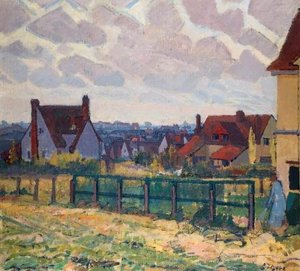
The scene unfolds in the quietude of 1912, captured through the eyes of Spencer Gore in his painting, Harold Gilman's House at Letchworth, Hertfordshire. This work emerges from a period of intense creative movement, a moment when the artist is actively shaping the visual language of a new era. Gore, born in Epsom, United Kingdom, in 1878, brings a specific, lived perspective to this landscape. He moves through the world…

4
From a Canal Bridge, Chalk Farm Road (1913) de Spencer Gore

From a Canal Bridge, Chalk Farm Road

1913 · Watercolor

In "From a Canal Bridge, Chalk Farm Road" by Spencer Gore, a watercolor captures a slice of urban life from about 1913. A canal cuts through the center of the scene, flanked by buildings that line the water's edge. In the distance, a large brick building anchors the background, its heavy presence watching over the waterway. Several boats rest upon the surface, some drifting near the foreground while others recede…

5
The Toilet de Spencer Gore

The Toilet

Oil On Canvas

In The Toilet, Spencer Gore turns his gaze toward the quietude of a private interior. The painting centers on a nude female figure, captured in a moment of stillness. She stands within the confines of a bedroom, a space defined by the soft geometry of domestic life. To her side, a bed is draped in white linens, their folds catching the light in the dimness of the room.

6
Inez and Taki (1910) de Spencer Gore

Inez and Taki

1910 · Oil On Canvas · Tate Gallery, Londres

In the heart of 1910, Spencer Frederick Gore captured more than just a street scene; he distilled the very essence of a burgeoning bohemian era. “Inez and Taki” serves as a vibrant window into a world where the urban bustle of Paris meets the intimate, artistic spirit of London’s Camden Town Group. The painting presents a captivating tableau: a musician, perhaps a self-portrait of Gore himself, lost in performance, playing…

7
The Frenchwoman (1910) de Spencer Gore

The Frenchwoman

1910 · Oil On Canvas · Fenton House, London

In The Frenchwoman by Spencer Gore, the subject is anchored firmly in a centered composition. She occupies the majority of the foreground and middle ground, pressing close to the viewer through a frontal, close-up perspective. This proximity creates a shallow depth of field, where the background feels immediate and compressed. The woman is draped in clothing of bright whites and pale pinks, her form defined by the interplay of light…

8
Mrs Spencer Frederick Gore in the Garden of Rowlandson House (1911) de Spencer Gore

Mrs Spencer Frederick Gore in the Garden of Rowlandson House

1911 · Oil On Canvas · Scottish National Gallery of Modern Art, Edimburgo

The air feels heavy with the scent of damp earth and summer leaves as we find ourselves in the secluded garden of Rowlandson House. A woman sits in profile, her gaze drifting toward something unseen beyond the frame. She is Mary Joanna Kerr, captured in a moment of stillness that feels almost fragile. The light does not strike her directly; instead, it filters through a dense canopy of foliage, creating…

9
Conversation Piece and Self-Portrait (1910) de Spencer Gore

Conversation Piece and Self-Portrait

1910 · Oil · Scottish National Gallery of Modern Art, Edimburgo

Conversation Piece and Self-Portrait is an oil painting by the artist Spencer Gore. This work was created about 1910. The composition integrates a large, semi-transparent face of a man into the background, functioning as a self-portrait, while the foreground features two smaller figures seated in a manner suggesting a conversation piece. One figure wears a dark blue cloak and the other a yellow patterned dress.

10
Landscape with Pond (1913) de Spencer Gore

Landscape with Pond

1913 · Black and White Photography · Galeria Nacional do Canadá, Ottawa

This 1913 black and white documentary photograph captures a rural scene of agricultural labor. The composition centers on a horse-drawn cart heavily laden with hay, moving along a dirt path. Two men are seated atop the mound, looking toward the camera. The perspective is from a slightly low angle, emphasizing the scale of the load. The lighting is natural and diffused, creating a high-key, hazy atmosphere. The textures range from…

A seleção de Spencer Gore continua, de 11 a 89

11The Fig Tree (1912) de Spencer GoreThe Fig Tree1912 12The Artist’s Wife (1913) de Spencer GoreThe Artist’s Wife1913 13The Blue Petticoat (1912) de Spencer GoreThe Blue Petticoat1912 14The Green Dress (1908) de Spencer GoreThe Green Dress1908 · Fitzwilliam Museum 15Panshanger Park (1908) de Spencer GorePanshanger Park1908 16The Gas Cooker (1913) de Spencer GoreThe Gas Cooker1913 · Tate Gallery 17Portrait of a Lady (1830) de Spencer GorePortrait of a Lady1830 · Metropolitan Museum of Art 18Mary Ann Garrits (1834) de Spencer GoreMary Ann Garrits1834 · Metropolitan Museum of Art 19Frances Ludlum Morris (Mrs. Robert Morris) (?) (1838) de Spencer GoreFrances Ludlum Morris (Mrs. Robert Morris) (?)1838 · National Gallery of Art 20The Britannia Ballet, the Alhambra (1907) de Spencer GoreThe Britannia Ballet, the Alhambra1907 · Fenton House 21Autumn, Sussex (1907) de Spencer GoreAutumn, Sussex1907 · Art Gallery of South Australia 22Tennis In Mornington Crescent Gardens (1910) de Spencer GoreTennis In Mornington Crescent Gardens1910 · Auckland Art Gallery Toi o Tāmaki 23Ballet Scene from "On the Sands" (1910) de Spencer GoreBallet Scene from "On the Sands"1910 · Yale Center for British Art 24Tennis at Hertingfordbury (1910) de Spencer GoreTennis at Hertingfordbury1910 · Yale Center for British Art 25An Extensive Landscape in Yorkshire (1907) de Spencer GoreAn Extensive Landscape in Yorkshire1907 · Yale Center for British Art 26Mornington Crescent (1911) de Spencer GoreMornington Crescent1911 · Museu de Belas Artes de Boston 27Yorkshire Landscape (1907) de Spencer GoreYorkshire Landscape1907 28The Garden City, Letchworth de Spencer GoreThe Garden City, Letchworth 29Rule Britannia (1910) de Spencer GoreRule Britannia1910 30Landscape, Somerset (1909) de Spencer GoreLandscape, Somerset1909 31The Cricket Match (1909) de Spencer GoreThe Cricket Match1909 32Panshanger Park, Hertfordshire (1909) de Spencer GorePanshanger Park, Hertfordshire1909 33The Mimrain, Panshanger Park, Hertfordshire (1910) de Spencer GoreThe Mimrain, Panshanger Park, Hertfordshire1910 34Hertfordshire Landscape (1909) de Spencer GoreHertfordshire Landscape1909 35The Garden, Hertingfordbury (1909) de Spencer GoreThe Garden, Hertingfordbury1909 36Mornington Crescent (1911) de Spencer GoreMornington Crescent1911 · Amgueddfa Cymru - National Museum of Wales 37Interior with Nude (1907) de Spencer GoreInterior with Nude1907 38Hertingfordbury, Hertfordshire (1908) de Spencer GoreHertingfordbury, Hertfordshire1908 39Interior, Mornington Crescent (1910) de Spencer GoreInterior, Mornington Crescent1910 40Someone who Waits (1907) de Spencer GoreSomeone who Waits1907 41Somerset Landscape (1909) de Spencer GoreSomerset Landscape1909 42Garden at Hertingfordbury (1908) de Spencer GoreGarden at Hertingfordbury1908 43Portrait of the Artist's Wife (1911) de Spencer GorePortrait of the Artist's Wife1911 · Birmingham Museum and Art Gallery 44Mornington Crescent (1911) de Spencer GoreMornington Crescent1911 · Tate Gallery 45Landscape (1907) de Spencer GoreLandscape1907 46The Garden of Rowlandson House (1911) de Spencer GoreThe Garden of Rowlandson House1911 47View from a Window (1909) de Spencer GoreView from a Window1909 48Somerset Landscape (1910) de Spencer GoreSomerset Landscape1910 49Self portrait (1906) de Spencer GoreSelf portrait1906 · Birmingham Museum and Art Gallery 50The Cinder Path (1912) de Spencer GoreThe Cinder Path1912 51The Beanfield, Letchworth (1912) de Spencer GoreThe Beanfield, Letchworth1912 52Cambrian Road, Richmond (1913) de Spencer GoreCambrian Road, Richmond1913 · Yale Center for British Art 53Design for Deer Hunting Mural in the Cabaret Theatre Club (1912) de Spencer GoreDesign for Deer Hunting Mural in the Cabaret Theatre Club1912 · Yale Center for British Art 54Blue and Green Bottles and Orange (1914) de Spencer GoreBlue and Green Bottles and Orange1914 · Yale Center for British Art 55Back Gardens from Houghton Place (1913) de Spencer GoreBack Gardens from Houghton Place1913 · Museu de Belas Artes de Boston 56The Pond (1912) de Spencer GoreThe Pond1912 57Study for a Mural Decoration for 'The Cave of the Golden Calf' (1912) de Spencer GoreStudy for a Mural Decoration for 'The Cave of the Golden Calf'1912 58Letchworth Station (1912) de Spencer GoreLetchworth Station1912 59Richmond Park (1914) de Spencer GoreRichmond Park1914 · Tate Gallery 60In Berkshire (1912) de Spencer GoreIn Berkshire1912 61Icknield Way (1912) de Spencer GoreIcknield Way1912 · Art Gallery of New South Wales 62Still Life with Apples (1912) de Spencer GoreStill Life with Apples1912 · Ferens Art Gallery 63Letchworth, The Road (1912) de Spencer GoreLetchworth, The Road1912 64Wood in Richmond Park (1914) de Spencer GoreWood in Richmond Park1914 · Birmingham Museum and Art Gallery 65Harold Gilman's House at Letchworth (1912) de Spencer GoreHarold Gilman's House at Letchworth1912 66Self portrait (1914) de Spencer GoreSelf portrait1914 · National Portrait Gallery 67Harrington Square from No.2 Houghton Place (1913) de Spencer GoreHarrington Square from No.2 Houghton Place1913 68A Singer at the Bedford Music Hall (1912) de Spencer GoreA Singer at the Bedford Music Hall1912 · Tate Gallery 69The Terrace Gardens (1912) de Spencer GoreThe Terrace Gardens1912 70Letchworth (1912) de Spencer GoreLetchworth1912 · Tate Gallery 71Suburban Street (1913) de Spencer GoreSuburban Street1913 72North London Girl (1911) de Spencer GoreNorth London Girl1911 · Tate Gallery 73Interior, 31, Mornington Crescent, London (1910) de Spencer GoreInterior, 31, Mornington Crescent, London1910 74The Garden Path, Garth House (1910) de Spencer GoreThe Garden Path, Garth House1910 75Richmond Park (1914) de Spencer GoreRichmond Park1914 · Ashmolean Museum 76Houghton Place (1912) de Spencer GoreHoughton Place1912 · Tate Gallery 77Mornington Crescent, London (1911) de Spencer GoreMornington Crescent, London1911 78Harbour Scene (1906) de Spencer GoreHarbour Scene1906 · Ashmolean Museum 79The Garden, Garth House (1908) de Spencer GoreThe Garden, Garth House1908 · Walker Art Gallery 80Hampstead Road, Camden Town (1910) de Spencer GoreHampstead Road, Camden Town1910 · Te Papa 81Interior de Spencer GoreInterior 82The Gravel Pit de Spencer GoreThe Gravel Pit 83Nearing Euston Station de Spencer GoreNearing Euston Station 84Marie Hayes de Spencer GoreMarie Hayes 85Harold Gilman's House at Letchworth, Hertfordshire de Spencer GoreHarold Gilman's House at Letchworth, Hertfordshire 86A View from the Window at 6 Cambrian Road, Richmond de Spencer GoreA View from the Window at 6 Cambrian Road, RichmondFitzwilliam Museum 87Reclining Nude de Spencer GoreReclining Nude 88From a Window in Cambrian Road, Richmond (1913) de Spencer GoreFrom a Window in Cambrian Road, Richmond1913 · Tate Gallery 89Letchworth, Hertfordshire (1912) de Spencer GoreLetchworth, Hertfordshire1912

Pinturas famosas de Spencer Gore, período por período

Os temas que cativaram o olhar de Spencer Gore

Os quatro temas que mais se repetem nestas obras originais, cada um com o seu melhor exemplo.

Os museus que guardam os originais de Spencer Gore

Os 8 museus que detêm a maioria das pinturas desta página.

Museus Cidade Obras de Spencer Gore Pinturas desta lista
Tate Gallery, LondresTate Gallery Londres 9 Inez and Taki, The Gas Cooker, Mornington Crescent
Yale Center for British Art, New HavenYale Center for British Art New Haven 6 Ballet Scene from "On the Sands", Tennis at Hertingfordbury, An Extensive Landscape in Yorkshire
Birmingham Museum and Art Gallery, BirminghamBirmingham Museum and Art Gallery Birmingham 3 Portrait of the Artist's Wife, Self portrait, Wood in Richmond Park
Fenton House, LondonFenton House London 2 The Frenchwoman, The Britannia Ballet, the Alhambra
Scottish National Gallery of Modern Art, EdimburgoScottish National Gallery of Modern Art Edimburgo 2 Mrs Spencer Frederick Gore in the Garden of Rowlandson House, Conversation Piece and Self-Portrait
Fitzwilliam MuseumFitzwilliam Museum 2 The Green Dress, A View from the Window at 6 Cambrian Road, Richmond
Metropolitan Museum of Art, Nova YorkMetropolitan Museum of Art Nova York 2 Portrait of a Lady, Mary Ann Garrits
Museu de Belas Artes de Boston, BostonMuseu de Belas Artes de Boston Boston 2 Mornington Crescent, Back Gardens from Houghton Place

Spencer Gore ano a ano: as obras originais que definem cada um

Em pouco mais de uma década, de 1906 a 1914, o mundo recebeu cada obra original de Spencer Gore nesta seleção: aqui está, ano a ano.

Obras por ano

Escolha um ano para ver as obras originais.

Perguntas de colecionadores sobre as pinturas de Spencer Gore

Por qual obra Spencer Gore é mais conhecido(a)?Revelar a resposta

Mornington Crescent, London (1911). Panshanger Park (1908) e Harold Gilman's House at Letchworth, Hertfordshire (1912) vêm a seguir.

Qual era a idade de Spencer Gore quando Mornington Crescent, London foi feita?Revelar a resposta

33 anos: Mornington Crescent, London data de 1911, e Spencer Gore nasceu em 1878.

Quais são as dez pinturas mais famosas de Spencer Gore?Revelar a resposta

Mornington Crescent, London, Panshanger Park, Harold Gilman's House at Letchworth, Hertfordshire, From a Canal Bridge, Chalk Farm Road, The Toilet, Inez and Taki, The Frenchwoman, Mrs Spencer Frederick Gore in the Garden of Rowlandson House, Conversation Piece and Self-Portrait e Landscape with Pond. O ranking acima apresenta o ano e o museu de cada uma.

Quantas pinturas Spencer Gore deixou?Revelar a resposta

Nosso catálogo contém 89 obras de Spencer Gore, datadas de 1906 a 1914.

Em quais museus estão expostas as obras-primas de Spencer Gore?Revelar a resposta

Principalmente em Tate Gallery (Londres), Yale Center for British Art (New Haven) e Birmingham Museum and Art Gallery (Birmingham). A tabela de museus acima lista todos eles.

Em que anos Spencer Gore pintou as suas obras mais famosas?Revelar a resposta

Em 1912: 19 das 89 obras nesta página foram feitas então, sendo Harold Gilman's House at Letchworth, Hertfordshire delas.

Quais são as primeiras e as últimas obras originais famosas de Spencer Gore?Revelar a resposta

Nesta página, a mais antiga é Self portrait (1906) e a mais recente é Blue and Green Bottles and Orange (1914).

Quais temas Spencer Gore escolheu com mais frequência?Revelar a resposta

Landscape (11), Woman (8) e Gardens and parks (8), entre as 89 obras nesta página.

Qual técnica Spencer Gore mais utilizou?Revelar a resposta

Oil On Canvas, para 18 das 89 obras nesta página.

A qual movimento artístico pertence Spencer Gore?Revelar a resposta

Post-impressionism, a julgar pelos originais nesta página.

Quais obras de Spencer Gore estão expostas no Tate Gallery?Revelar a resposta

Inez and Taki, The Gas Cooker e Mornington Crescent: o Tate Gallery, Londres detém 9 das obras desta página.

Spencer Gore: vida e obra

Spencer Gore (1878 – 1914): Um Pioneiro de Camden Town

Spencer Frederick Gore foi um pintor britânico que emergiu como uma das figuras mais proeminentes do florescente Camden Town Group, marcando um momento crucial na arte britânica do início do século XX. Nascido em 26 de maio de 1878, em Epsom, Surrey, ele descendia de uma família imersa na tradição artística – seu pai, Spencer Gore (o campeão de tênis de Wimbledon), era ele próprio um pintor, e seu irmão Charles Gore era teólogo, fomentando um ambiente que nutria a criatividade e a curiosidade intelectual. Os anos formativos de Gore foram moldados por sua passagem pela Harrow School, onde refinou suas habilidades de observação antes de buscar treinamento formal na Slade School of Fine Art ao lado de contemporâneos como Harold Gilman, consolidando sua conexão com os ideais impressionistas.
  • Influências Iniciais: As sensibilidades artísticas de Gore foram profundamente impactadas por pós-impressionistas como Claude Monet e Vincent van Gogh, cujas explorações de cor e luz serviram como trampolim para seu próprio estilo distintivo.
  • O Camden Town Group: Ele liderou a formação do Camden Town Group em 1904, ao lado de Walter Sickert, Lucien Pisarro, Harold Gilman e Charles Ginner — um coletivo dedicado a capturar a atmosfera do distrito boêmio de Londres com pinceladas ousadas e paletas vibrantes.
  • Obras Notáveis: A obra de Gore compreende uma coleção notável de paisagens, cenas de music halls e interiores, caracterizados pelo detalhe meticuloso e um compromisso inabalável em retratar a beleza natural. São particularmente dignas de nota suas trinta e duas telas do Richmond Park, concluídas nos últimos meses de sua vida — um testemunho de sua fascinação duradente pelo campo inglês.

Técnica e Estilo: Abraçando a Construção Pictórica

A abordagem artística de Gore distinguia-se por um abraço deliberado à construção pictórica, espelhando as inovações estilísticas defendidas pelos impressionistas e pós-impressionistas. Ele empregava habilidosamente técnicas de camadas — frequentemente aplicando glazes finos sobre as subcamadas de tinta — para alcançar efeitos luminosos e imbuir suas telas com profundidade e ressonância. Esta atenção meticulosa ao detalhe estendia-se além da mera representação; Gore buscava transmitir não apenas o que via, mas também o que sentia, refletindo a intensidade emocional inerente à captura de momentos fugazes da experiência. Suas pinturas, como “Hartington Square”, exemplificam este compromisso estilístico, demonstrando um domínio magistral de cor e forma.
  • Paleta de Cores: Gore favorecia paletas harmoniosas dominadas por verdes, azuis e amarelos suaves — cores que evocavam a tranquilidade e a grandiosidade do mundo natural.
  • Pinceladas: Suas pinceladas eram caracterizadas pela fluidez e espontaneidade, capturando o dinamismo da luz e do ar, enquanto simultaneamente transmitiam uma sensação de quietude e contemplação.

Paisagens de Richmond Park: Um Legado de Observação

A série Richmond Park representa a obra-prima de Gore — uma crônica pungente de seus anos finais e um símbolo duradouro da pintura de paisagem britânica. Executadas com dedicação inabalável durante o outono de 1913, estas telas capturam a beleza etérea do parque banhado pela luz outonal. As imagens resultantes são imbuídas de um sentido palpável de melancolia, mas simultaneamente irradiam calor e vitalidade, refletindo a profunda conexão de Gore com o que o cercava. A curadora da Tate, Helena Bonett, observou que a morte de Gore por pneumonia foi repentina, deixando para trás uma obra-prima inacabada — um testemunho de sua busca incessante pela excelência artística.

Frederick Gore: Filho e Artista

O filho de Gore, Frederick John Pym Gore CBE RA (1913–2009), seguiu os passos do pai como pintor, herdando sua visão artística e estabelecendo-se como uma figura respeitada no mundo da arte britânica. Assim como Spencer, ele buscou treinamento formal na Ruskin School of Art e desenvolveu um estilo distinto enraizado nos princípios impressionistas — uma continuação direta do legado de seu pai. A influência de Gore estendeu-se além de seus próprios empreendimentos artísticos; ele atuou como professor, transmitindo conhecimentos inestimáveis a artistas aspirantes e fomentando uma tradição de observação e pintura expressiva que perdurou por gerações.