Retrato de Samuel Scott

As 58 Pinturas Mais Famosas de Samuel Scott, uma Seleção da Galeria

Atualizado em Novembro 2026 · classificado pela nossa pontuação de popularidade (pesquisas, visitas e pedidos de cada obra) · 69 obras de Samuel Scott em nosso catálogo

Em resumo

De todas as obras originais deixadas por Samuel Scott, a mais famosa é View on the Thames with Westminster Bridge (1743), da coleção do Yale Center for British Art, em New Haven. Logo atrás vêm The Building of Westminster Bridge e Table Bay, c. 1730. (1730). Nosso catálogo contém 69 obras de Samuel Scott; a galeria preservou as 58 que o mundo mais admira, cada uma exibida com sua data, seu museu e sua história.

1702 – 1772, Londres Rococo Mais obras: National Maritime Museum

As 10 principais pinturas de Samuel Scott: a escolha da galeria

1
View on the Thames with Westminster Bridge (1743) de Samuel Scott

View on the Thames with Westminster Bridge

1743 · Oil On Canvas · Yale Center for British Art, New Haven

The oil on canvas painting titled View on the Thames with Westminster Bridge was executed by the English painter Samuel Scott. This work depicts a maritime scene on the River Thames, featuring a large sailing vessel in the foreground and the stone arches of Westminster Bridge in the middle ground. The composition captures the urban landscape and river commerce of 18th-century London.

2
The Building of Westminster Bridge de Samuel Scott

The Building of Westminster Bridge

Oil On Canvas · Metropolitan Museum of Art, Nova York

The Building of Westminster Bridge is an oil on canvas riverscape painting. Created in 1742, the work captures a specific moment of transformation within the city of London. The English artist Samuel Scott rendered this scene, documenting the heavy labor required to span the River Thames. He focused his attention on the skeletal progress of the bridge as it rose from the water.

4
Departure from England of Francis, Duke of Lorraine, 1731 (1732) de Samuel Scott

Departure from England of Francis, Duke of Lorraine, 1731

1732 · Oil

The waters churn with the quiet energy of a significant moment in 1731. In Departure from England of Francis, Duke of Lorraine, 1731 by Samuel Scott, the viewer finds themselves amidst a bustling maritime scene. The air feels heavy with the weight of a departure, as ships navigate the shifting currents under a vast, cloudy sky. This work, created about 1732, captures the movement of vessels as they prepare to…

5
Taking and destruction of the port of Paita in 1741 by the squadron of George Anson. (1741) de Samuel Scott

Taking and destruction of the port of Paita in 1741 by the squadron of George Anson.

1741 · Oil On Canvas

In this work, titled Taking and destruction of the port of Paita in 1741 by the squadron of George Anson., the artist Samuel Scott captures a moment of intense naval aggression. The scene depicts a coordinated attack on a port, focusing on the violent intersection of maritime power and coastal settlement. It is a depiction of a specific historical engagement that took place about 1741.

7
Shipping off Dover (1738) de Samuel Scott

Shipping off Dover

1738 · Oil · Yale Center for British Art, New Haven

In this expansive oil painting from 1738, we find ourselves observing a wide, panoramic view of the sea as it meets the iconic white cliffs of Dover. The scene captures a moment of significant naval activity, where the calm, shimmering surface of the water is populated by a variety of vessels. Larger warships navigate the coastal waters alongside smaller transport boats, all appearing to move away from the shoreline under…

8
Shipping on the Thames off Rotherhithe (1740) de Samuel Scott

Shipping on the Thames off Rotherhithe

1740 · Oil On Canvas

The oil on canvas painting titled Shipping on the Thames off Rotherhithe was executed by the English painter Samuel Scott. This work is dated 1740. The artist, who was born in London, United Kingdom, around 1702, specialized in landscape painting and marine art. His career involved detailed observations of the Thames and the architectural developments of the city during the 18th century.

9
An Arch of Westminster Bridge, London (1750) de Samuel Scott

An Arch of Westminster Bridge, London

1750 · Oil On Canvas · National Gallery of Ireland, Dublin

An Arch of Westminster Bridge, London is an oil on canvas landscape painting by the English artist Samuel Scott. Created about 1750, the work captures a specific perspective of the River Thames. The view looks toward the northern bank, directed toward the City of London. It is a moment of architectural permanence fixed in oil.

10
Old London Bridge (1753) de Samuel Scott

Old London Bridge

1753 · Oil On Canvas · Felbrigg Hall, Norwich

Old London Bridge is an oil painting by the English artist Samuel Scott. Created in 1753, this work offers a panoramic upstream view of the River Thames, captured from the south bank. It provides a rare glimpse of the historic structure during a period of significant urban transition. The scene depicts the bridge in its medieval form, crowded with multi-story houses and shops, just years before the era of its…

A seleção de Samuel Scott continua, de 11 a 58

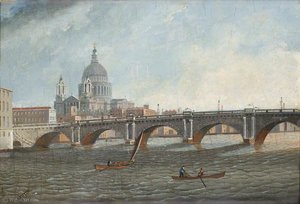
11Beginning of Knowles' action off Havana, 1 October 1748 (1750) de Samuel ScottBeginning of Knowles' action off Havana, 1 October 17481750 · National Maritime Museum 12The Bombardment of Bastia, 6 November 1745 (1750) de Samuel ScottThe Bombardment of Bastia, 6 November 17451750 · National Maritime Museum 13French fireships attacking the English fleet off Quebec, 28 June 1759 (1750) de Samuel ScottFrench fireships attacking the English fleet off Quebec, 28 June 17591750 · National Maritime Museum 14The Capture of the 'Nuestra Señora de Cavadonga' by the 'Centurion', 20 June 1743 (1745) de Samuel ScottThe Capture of the 'Nuestra Señora de Cavadonga' by the 'Centurion', 20 June 17431745 · National Maritime Museum 15A Sunset, with a View of Nine Elms (1755) de Samuel ScottA Sunset, with a View of Nine Elms1755 16A Morning, with a View of Cuckold’s Point (1755) de Samuel ScottA Morning, with a View of Cuckold’s Point1755 17plan of St. Marco in Venice 1740 (1749) de Samuel Scottplan of St. Marco in Venice 17401749 18Arches of Westminster Bridge (1750) de Samuel ScottArches of Westminster Bridge1750 · Yale Center for British Art 19Westminster from Lambeth, with the Ceremonial Barge of the Ironmongers' Company (1745) de Samuel ScottWestminster from Lambeth, with the Ceremonial Barge of the Ironmongers' Company1745 · Yale Center for British Art 20Shipping in a Choppy Sea (1753) de Samuel ScottShipping in a Choppy Sea1753 · Yale Center for British Art 21The Building of Westminster Bridge (1750) de Samuel ScottThe Building of Westminster Bridge1750 22The Thames at Westminster Bridge with Barges (1746) de Samuel ScottThe Thames at Westminster Bridge with Barges1746 23The Thames by the Tower of London (1759) de Samuel ScottThe Thames by the Tower of London1759 · Felbrigg Hall 24View of the Thames with Blackfriars Bridge and St Paul's Cathedral (1761) de Samuel ScottView of the Thames with Blackfriars Bridge and St Paul's Cathedral1761 · Blickling Hall 25An English Man-of-War Firing a Salute (1765) de Samuel ScottAn English Man-of-War Firing a Salute1765 · National Maritime Museum 26A View of Westminster Bridge and Parts Adjacent (1758) de Samuel ScottA View of Westminster Bridge and Parts Adjacent1758 27A View of London Bridge before the Late Alterations (1758) de Samuel ScottA View of London Bridge before the Late Alterations1758 28Ludlow Castle with Dinham Weir, from the South-West (1765) de Samuel ScottLudlow Castle with Dinham Weir, from the South-West1765 · Yale Center for British Art 29The Thames at Twickenham (1760) de Samuel ScottThe Thames at Twickenham1760 · Yale Center for British Art 30Action off the Cape of Good Hope (1757) de Samuel ScottAction off the Cape of Good Hope1757 · Yale Center for British Art 31Action off the Cape of Good Hope (1757) de Samuel ScottAction off the Cape of Good Hope1757 · Yale Center for British Art 32Pope's Villa, Twickenham (1759) de Samuel ScottPope's Villa, Twickenham1759 · Yale Center for British Art 33Lambeth palace de Samuel ScottLambeth palace 34Bombarding of Bastia in 1745 de Samuel ScottBombarding of Bastia in 1745 35Action between HMS Nottingham and the Mars, 11 October 1746 de Samuel ScottAction between HMS Nottingham and the Mars, 11 October 1746National Maritime Museum 36End of Knowles' action off Havana, 1 October 1748 de Samuel ScottEnd of Knowles' action off Havana, 1 October 1748National Maritime Museum 37An English privateer engaging a French privateer de Samuel ScottAn English privateer engaging a French privateerNational Maritime Museum 38The Capture of Fort Chagres, March 1740 de Samuel ScottThe Capture of Fort Chagres, March 1740National Maritime Museum 39The Battle of Porto Bello de Samuel ScottThe Battle of Porto Bello 40Southwark bridge de Samuel ScottSouthwark bridge 41The Thames at London Bridge de Samuel ScottThe Thames at London Bridge 42Somerset House and St Paul's de Samuel ScottSomerset House and St Paul's 43Old london bridge de Samuel ScottOld london bridge 44The Tower of London from the River de Samuel ScottThe Tower of London from the River 45Blackfriars Bridge and St Paul's from the Bridge de Samuel ScottBlackfriars Bridge and St Paul's from the Bridge 46Lambeth Palace from Millbank, London de Samuel ScottLambeth Palace from Millbank, London 47A View of the Thames at Westminster, Seen through an Arch of the Bridge de Samuel ScottA View of the Thames at Westminster, Seen through an Arch of the Bridge 48View of Somerset House Looking Downstream from the York Water-Tower de Samuel ScottView of Somerset House Looking Downstream from the York Water-Tower 49A Danish Timber Bark Getting Under Way (1736) de Samuel ScottA Danish Timber Bark Getting Under Way1736 · National Maritime Museum 50Wager's Action off Cartagena, 28 May 1708 (1772) de Samuel ScottWager's Action off Cartagena, 28 May 17081772 · National Maritime Museum 51French Firerafts Attacking the British Fleet off Quebec, 28 June 1759 (1767) de Samuel ScottFrench Firerafts Attacking the British Fleet off Quebec, 28 June 17591767 · National Maritime Museum 52The Capture of Puerto Bello, 21 November 1739 (1740) de Samuel ScottThe Capture of Puerto Bello, 21 November 17391740 · National Maritime Museum 53An Arch of Westminster Bridge (1750) de Samuel ScottAn Arch of Westminster Bridge1750 54A View of the Tower of London, Supposed on his Majesty's Birthday (1771) de Samuel ScottA View of the Tower of London, Supposed on his Majesty's Birthday1771 · Yale Center for British Art 55The Building of Westminster Bridge (1742) de Samuel ScottThe Building of Westminster Bridge1742 · Yale Center for British Art 56Vice Admiral Sir George Anson's Victory off Cape Finisterre (1749) de Samuel ScottVice Admiral Sir George Anson's Victory off Cape Finisterre1749 · Yale Center for British Art 57Part of Old Westminster Bridge (1750) de Samuel ScottPart of Old Westminster Bridge1750 · Tate Gallery 58A Thames Wharf (1757) de Samuel ScottA Thames Wharf1757 · Victoria and Albert Museum

Pinturas famosas de Samuel Scott, período por período

Os temas que cativaram o olhar de Samuel Scott

Os quatro temas que mais se repetem nestas obras originais, cada um com o seu melhor exemplo.

Os museus que guardam os originais de Samuel Scott

Os 8 museus que detêm a maioria das pinturas desta página.

Museus Cidade Obras de Samuel Scott Pinturas desta lista
National Maritime Museum, LondresNational Maritime Museum Londres 14 A First-Rate Shortening Sail, Beginning of Knowles' action off Havana, 1 October 1748, The Bombardment of Bastia, 6 November 1745
Yale Center for British Art, New HavenYale Center for British Art New Haven 13 View on the Thames with Westminster Bridge, Shipping off Dover, Arches of Westminster Bridge
Felbrigg Hall, NorwichFelbrigg Hall Norwich 2 Old London Bridge, The Thames by the Tower of London
Metropolitan Museum of Art, Nova YorkMetropolitan Museum of Art Nova York 1 The Building of Westminster Bridge
National Gallery of Ireland, DublinNational Gallery of Ireland Dublin 1 An Arch of Westminster Bridge, London
Blickling HallBlickling Hall 1 View of the Thames with Blackfriars Bridge and St Paul's Cathedral
Tate Gallery, LondresTate Gallery Londres 1 Part of Old Westminster Bridge
Victoria and Albert Museum, LondresVictoria and Albert Museum Londres 1 A Thames Wharf

Samuel Scott década a década: a obra original que define cada uma

Obras por década

Escolha uma década para ver a obra original que a define.

Perguntas de colecionadores sobre as pinturas de Samuel Scott

Por qual obra Samuel Scott é mais conhecido(a)?Revelar a resposta

View on the Thames with Westminster Bridge (1743), Yale Center for British Art, New Haven. The Building of Westminster Bridge e Table Bay, c. 1730. (1730) vêm a seguir.

Qual era a idade de Samuel Scott quando View on the Thames with Westminster Bridge foi feita?Revelar a resposta

41 anos: View on the Thames with Westminster Bridge data de 1743, e Samuel Scott nasceu em 1702.

Quais são as dez pinturas mais famosas de Samuel Scott?Revelar a resposta

View on the Thames with Westminster Bridge, The Building of Westminster Bridge, Table Bay, c. 1730., Departure from England of Francis, Duke of Lorraine, 1731, Taking and destruction of the port of Paita in 1741 by the squadron of George Anson., A First-Rate Shortening Sail, Shipping off Dover, Shipping on the Thames off Rotherhithe, An Arch of Westminster Bridge, London e Old London Bridge. O ranking acima apresenta o ano e o museu de cada uma.

Quantas pinturas Samuel Scott deixou?Revelar a resposta

Nosso catálogo contém 69 obras de Samuel Scott, datadas de 1730 a 1772.

Em quais museus estão expostas as obras-primas de Samuel Scott?Revelar a resposta

Principalmente em National Maritime Museum (Londres), Yale Center for British Art (New Haven) e Felbrigg Hall (Norwich). A tabela de museus acima lista todos eles.

Em que anos Samuel Scott pintou as suas obras mais famosas?Revelar a resposta

Em 1750s: 19 das 58 obras nesta página foram feitas então, sendo An Arch of Westminster Bridge, London delas.

Quais são as primeiras e as últimas obras originais famosas de Samuel Scott?Revelar a resposta

Nesta página, a mais antiga é Table Bay, c. 1730. (1730) e a mais recente é Wager's Action off Cartagena, 28 May 1708 (1772).

Quais temas Samuel Scott escolheu com mais frequência?Revelar a resposta

Sky (25), Water (23) e River (16), entre as 58 obras nesta página.

Qual técnica Samuel Scott mais utilizou?Revelar a resposta

Oil On Canvas, para 25 das 58 obras nesta página.

A qual movimento artístico pertence Samuel Scott?Revelar a resposta

Rococo, a julgar pelos originais nesta página.

Quais obras de Samuel Scott estão expostas no National Maritime Museum?Revelar a resposta

A First-Rate Shortening Sail, Beginning of Knowles' action off Havana, 1 October 1748 e The Bombardment of Bastia, 6 November 1745: o National Maritime Museum, Londres detém 14 das obras desta página.

Samuel Scott: vida e obra

O Pai da Aquarela Inglesa: O Legado de Samuel Scott

Samuel Scott, nascido em Londres por volta de 1702, permanece como uma figura envolta em mistério artístico — um testemunho dos desafios enfrentados pelos artistas documentados de sua era. Apesar dos escassos detalhes biográficos sobre seus anos de formação e treinamento, Scott emergiu como um dos pintores de paisagem mais proeminentes da Grã-Bretanha durante meados do século XVIII, estabelecendo-se como um pioneiro na técnica da aquarela e influenciando profundamente as gerações subsequentes de artistas britânicos. Seu estilo distintivo — caracterizado por cenas serenas à beira-rio e paisagens marítimas dramáticas imbuídas de perspectiva atmosférica — capturou o espírito de seu tempo e consolidou seu legado como “o pai da aquarela inglesa”.

A jornada artística de Scott teve início por volta de 1720, focando inicialmente na arte marítima. Como muitos artistas de sua geração, ele foi profundamente impactado pelas obras de Willem van de Velde, o Jovem, possuindo inúmeras cópias e absorvendo um domínio magistral de luz e textura. Essa influência é palpável em suas obras iniciais que retratam navios de guerra em batalhas navais, demonstrando uma atenção meticulosa aos detalhes e uma compreensão de princípios composicionais enraizados nas tradições da pintura de marina holandesa. Sua habilidade em traduzir o poder bruto do mar em imagens delicadas e evocativas permitiu-lhe estreitar a lacuna entre a rígida documentação marítima e as belas artes.

Uma Visão de Londres e do Tâmisa

À medida que sua carreira amadurecia, Scott voltou seu olhar para o coração do Império Britânico, encontrando profunda inspiração nas movimentadas águas do Rio Tâmisa. Suas obras servem como uma janela vívida para a Londres do século XVIII, capturando o pulso rítmico do comércio marítimo e a vida cotidiana às margens do rio. Em obras-primas como A Thames Wharf (1757), ele apresenta uma representação vibrante do comércio, onde o movimento dos barcos e a estrutura dos cais narram a história de uma cidade em constante movimento. Seu talento residia na capacidade de fundir a precisão topográfica com uma atmosfera romantizada, fazendo com que os aspectos industriais e comerciais de Londres parecessem, ao mesmo tempo, grandiosos e íntimos.

Além dos portos movimentados, Scott possuía um dom extraordinário para capturar a majestade arquitetônica dos marcos de Londres. Suas representações da cidade frequentemente utilizavam o meio de óleo sobre tela para alcançar um senso de permanência e grandeza, como visto em The Thames at Westminster Bridge with Barges (1746). Nesta obra, ele exibe o detalhe arquitetônico de Londres através de uma lente romântica, utilizando luz e sombra para criar uma atmosfera histórica cativante. Da mesma forma, sua obra View of Somerset House Looking Downstream from the York Water-Tower demonstra sua habilidade na pintura topográfica, oferecendo um olhar sereno sobre a paisagem urbana e a próxima Torre de Londres, renderizada com uma precisão que honra a elegância estrutural da época.

Colaborações Artísticas e Significância Histórica

O desenvolvimento do estilo de Scott também foi moldado por parcerias profissionais significativas. Seu projeto colaborativo com George Lambert em seis pinturas retratando os assentamentos da Companhia das Índias Orientais demonstrou sua versatilidade e capacidade de sintetizar elementos artísticos díspares — a arquitetura ao lado da paisagem — refletindo as correntes intelectuais do período. Essa parceria resultou em imagens que transmitiam tanto grandiosidade quanto intimidade, capturando a essência da empresa colonial enquanto celebrava, simultaneamente, a beleza do entorno natural. Tais obras não eram meras buscas estéticas, mas serviam como importantes registros históricos do alcance global em expansão da Grã-Bretanha.

A importância duradoura de Samuel Scott reside em seu papel como uma figura de transição que ajudou a elevar a aquarela de um meio de mero esboço para uma forma respeitada de belas artes. Suas contribuições podem ser resumidas através de vários pilares artísticos fundamentais:

  • Técnica Pioneira: Ele introduziu um nível de profundidade atmosférica e manipulação de luz que definiria a tradição da aquarela inglesa por décadas.
  • Maestria Marítima: Ao misturar influências de marina holandesas com temas britânicos, ele criou um gênero único de arte naval e fluvial.
  • Documentação Topográfica: Suas representações detalhadas dos marcos de Londres forneceram um arquivo visual inestimável da vida urbana e da arquitetura do século XVIII.
  • Síntese Cultural: Através de suas colaborações, ele fundiu com sucesso a documentação da expansão colonial com a beleza estética da pintura de paisagem.

Através de sua observação dedicada do Tâmisa e do mar, Samuel Scott fez mais do que apenas pintar paisagens; ele capturou a própria alma de uma nação marítima durante um período de imenso crescimento e transformação.